
Am I a Good Girlfriend Quiz
How the Scales are Structured
Who Usually Takes This Test?
See How You Compare
Below is a preview of how scores are typically distributed across each scale.
Example Questions From the Test
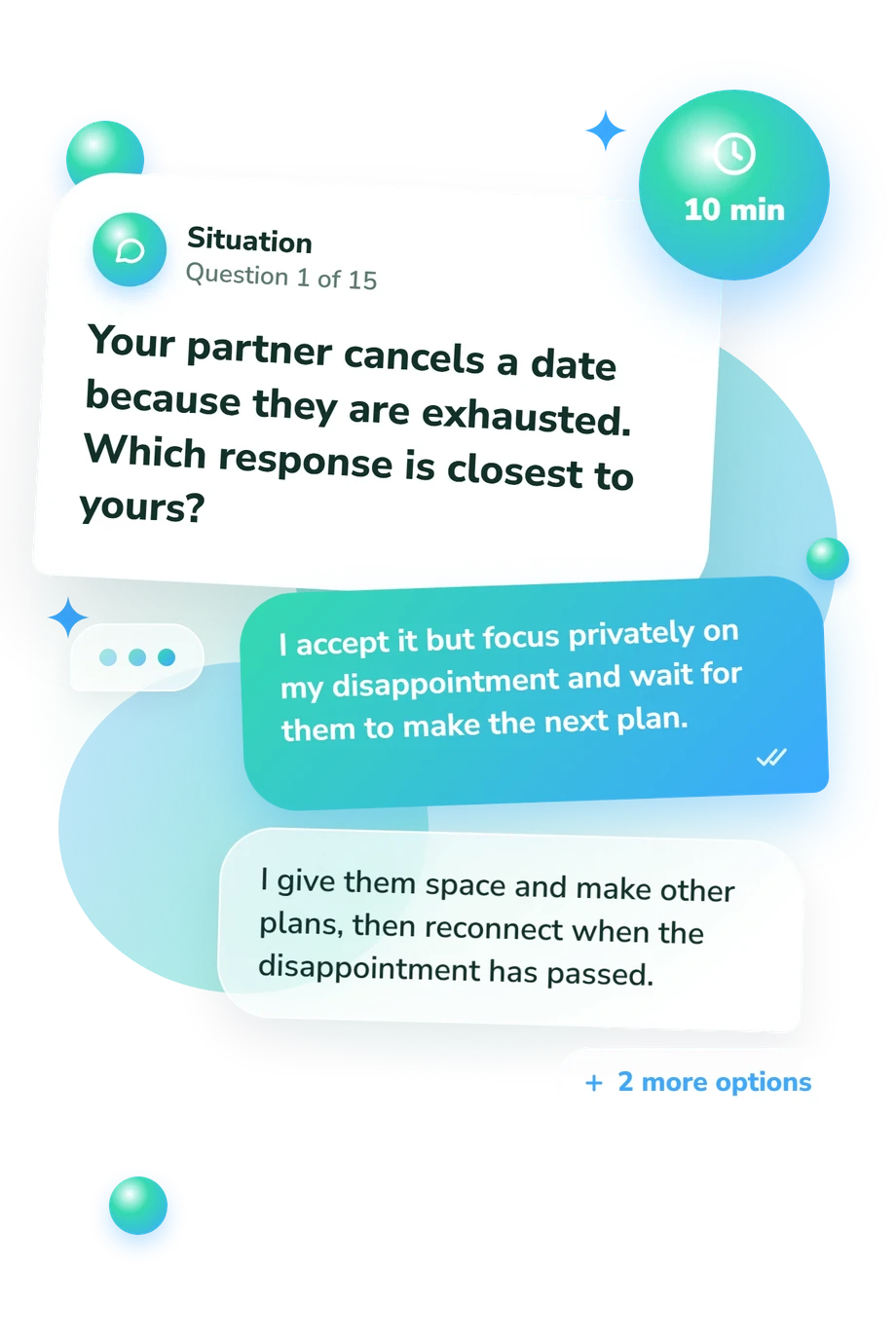
- I accept it but focus privately on my disappointment and wait for them to make the next plan.
- I give them space and make other plans, then reconnect when the disappointment has passed.
- I say I understand while also acknowledging that I was looking forward to seeing them.
- I accept their need for rest, express my disappointment without blame, and ask about rescheduling.
- Reconnect through affection or normal conversation and avoid reopening the conflict.
- Wait for my partner to apologize, then acknowledge my part in return.
- Discuss what each of us did and try to resolve both sides at the same time.
- Acknowledge my own words and their impact first, then invite a mutual repair conversation.
- I set my preference aside at first because preserving harmony matters to me.
- I hint at what I want so the conversation does not feel confrontational.
- I explain my view clearly, although I may focus more on being understood than asking questions.
- I state my need directly and invite my partner to explain theirs so we can compare both.
Am I a Good Girlfriend Quiz - Description and methodology of the test
For readers reflecting on their contribution to a romantic relationship, this assessment offers a structured look at everyday choices rather than a verdict. The Am I a Good Girlfriend Quiz can help you examine how care, openness, reliability, and repair appear in practice. It helps you consider whether you would be a good girlfriend by pointing to habits to discuss and develop, not a fixed identity.
What This Assessment Explores
This questionnaire examines responses when needs, plans, and emotions diverge. To explore whether you are a good girlfriend in practice, this assessment uses situations involving privacy, disagreement, disappointment, commitments, and repair. The result covers three dimensions:
- Care and Respect (0-15) reflects support, boundaries, preferences, and autonomy: Care worth examining (0-5) calls for checking assumptions; Considerate foundation (6-10) reflects respect; Attuned respect (11-15) reflects warmth balanced with independence.
- Open Communication (0-15) reflects expressing needs, listening, and clarifying misunderstandings: Emerging openness (0-5) suggests indirectness; Growing dialogue (6-10) may falter under pressure; Strong openness (11-15) indicates honesty, curiosity, and responsiveness.
- Repair and Reliability (0-15) reflects follow-through, accountability, and reconnection after tension: Inconsistent repair (0-5) indicates uneven ownership; Developing steadiness (6-10) suggests growing consistency; Reliable repair (11-15) indicates dependable return to difficult conversations.
Methodology and Scientific Basis
Items cluster into three thematic groups. Each situation offers four response choices, moving from less direct or consistent reactions to more explicit, accountable, and collaborative ones. You choose the response closest to your usual behavior. Separate scoring bands create a profile across the dimensions rather than one overall verdict.
Conceptually, the questionnaire is consistent with the Interpersonal Competence Questionnaire (Buhrmester et al., 1988), particularly its focus on disclosure, assertion, emotional support, and conflict management. It is not an adaptation of that instrument. Stafford, Dainton, and Haas (2000) describe relational-maintenance behaviors, and Wilder, Prager, and Garapati (2024) describe reconciliation after conflict; both overlap with this questionnaire but do not validate its online version.
Interpretation works best when scores are compared with recent examples and follow-through. In this girlfriend self-assessment, self-report can be shaped by mood, memory, defensiveness, and self-awareness. No standardization or population norms are specified for its displayed bands, so they describe the questionnaire's profile rather than population thresholds. Use the result to choose a behavior or conversation to revisit while considering both partners' perspectives.
- Buhrmester, D., Furman, W., Wittenberg, M. T., & Reis, H. T. (1988). Five Domains of Interpersonal Competence in Peer Relationships. Journal of Personality and Social Psychology, 55(6), 991-1008. 10.1037/0022-3514.55.6.991
- Stafford, L., Dainton, M., & Haas, S. M. (2000). Measuring routine and strategic relational maintenance: Scale revision, sex versus gender roles, and the prediction of relational characteristics. Communication Monographs, 67(3), 306-323. 10.1080/03637750009376512
- Wilder, S., Prager, K. J., & Garapati, S. (2024). But I said I’m sorry: Helpfulness of romantic couples’ efforts to reconcile after conflict. Personal Relationships, 31(3), 836-854. 10.1111/pere.12565
Updated: