
Adverb Quiz
How the Scales are Structured
Who Usually Takes This Test?
See How You Compare
Below is a preview of how scores are typically distributed across each scale.
Example Questions From the Test
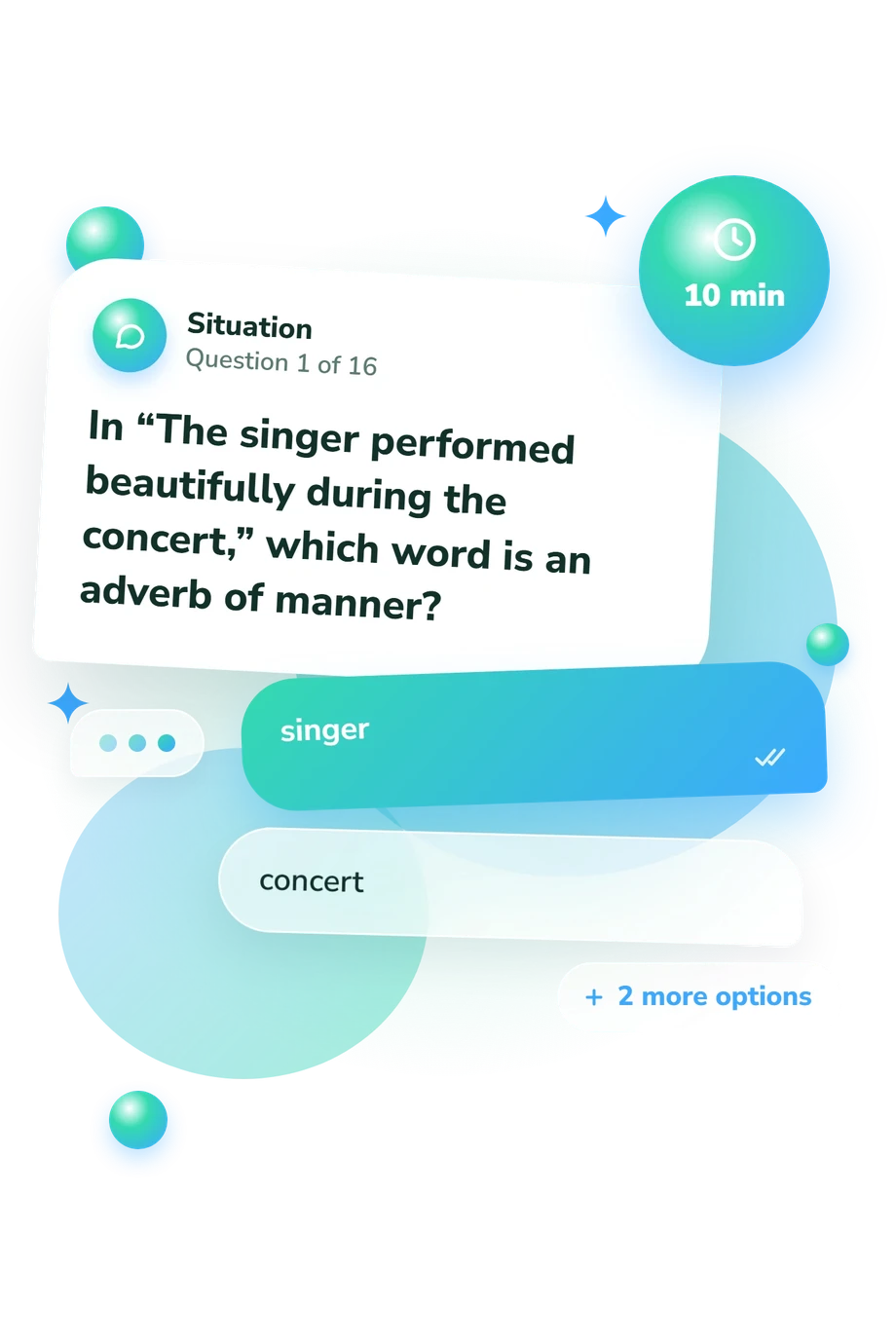
- singer
- concert
- during
- beautifully
- The child solved the puzzle quickly.
- The puzzle was surprisingly easy.
- The puzzle waited on the table.
- The easy puzzle had ten pieces.
- We boarded the fast train.
- She completed a fast before the holiday.
- The train moves fast.
- That is a fast computer.
Adverb Quiz - Description and methodology of the test
Anyone reviewing English grammar can use this adverb quiz to see whether adverbs are being identified by their role in a sentence, not just by memorized labels. It suits school learners, independent students, and teachers planning targeted practice. An adverb practice quiz can reveal which distinctions are secure and which need another explanation or example.
What This Assessment Explores
Adverbs are examined as words that modify verbs, adjectives, other adverbs, or clauses. Short contexts ask whether the respondent can identify an adverb, classify its role, or choose a form that completes the meaning. It suits independent learners and teachers seeking a focused check before targeted practice.
The main result covers these areas:
- Manner explains how an action is carried out, as in beautifully, slowly, or quietly.
- Time and place locate an event, using forms such as tomorrow, now, here, where, and upstairs.
- Frequency identifies how often an action occurs, including often.
- Degree expresses intensity or extent through too and almost.
- Related forms connect clauses or ask about circumstances through conjunctive, interrogative, and relative adverbs.
The result summarizes performance across these areas, so an adverb online quiz can point to examples worth revisiting rather than define overall language ability.
Methodology and Evidence Base
Each item presents a sentence or brief context with four multiple-choice options. Prompts ask the learner to identify an adverb, classify its role, or select the form that best fits a meaning or connection between clauses. The method tests recognition in context rather than free-form composition.
Scoring reports Adverb Knowledge from 0-16 correct answers. The displayed bands are Foundations to build (0-6), Developing knowledge (7-12), and Strong knowledge (13-16). They describe performance on the tested distinctions, not general English proficiency: the lower bands indicate topics to strengthen, while the highest reflects broad accurate recognition.
The grammatical categories are consistent with CGEL (Huddleston & Pullum, 2002) and Quirk et al. (1985). This questionnaire is not a published adaptation or standardized administration of either work; the sources supply a descriptive framework, not norms or validation for this online form. Attention, prior instruction, and uncertainty on one item can affect a self-report result. A learner can revisit uncertain items with a teacher or grammar reference, recording them in a worksheet-style quiz for adverbs for later study.
- Huddleston, Rodney, and Geoffrey K. Pullum. The Cambridge Grammar of the English Language. Cambridge University Press, 2002. 10.1017/9781316423530
- Quirk, Randolph, Sidney Greenbaum, Geoffrey Leech, and Jan Svartvik. A Comprehensive Grammar of the English Language. Longman, 1985.
Updated: