
Will a Robot Take Your Job Quiz
How the Scales are Structured
Who Usually Takes This Test?
See How You Compare
Below is a preview of how scores are typically distributed across each scale.
Example Questions From the Test
- Compile the relevant information so others can decide
- Compare the options against established criteria
- Help the group explore tradeoffs and reach a decision
- Use established relationships to build commitment to an agreement
- By evolving goals and tradeoffs negotiated with stakeholders
- Through contextual judgment about whether it fits the situation
- Against a checklist, followed by some human review
- Against precise, stable, and measurable specifications
- I develop an approach around the case’s particular context
- I investigate the situation and make a contextual judgment
- I select from several defined routes, with some discretion
- A documented rule or decision tree identifies the route
Will a Robot Take Your Job Quiz - Description and methodology of the test
People reflecting on their current work can use this assessment to examine task patterns, human involvement, and present adaptation habits. The Will a Robot Take Your Job Quiz connects present work habits with practical questions about how tasks may change. It offers a structured view of how current work is organized across codifiable duties, human judgment, and changing job tasks.
What This Assessment Explores
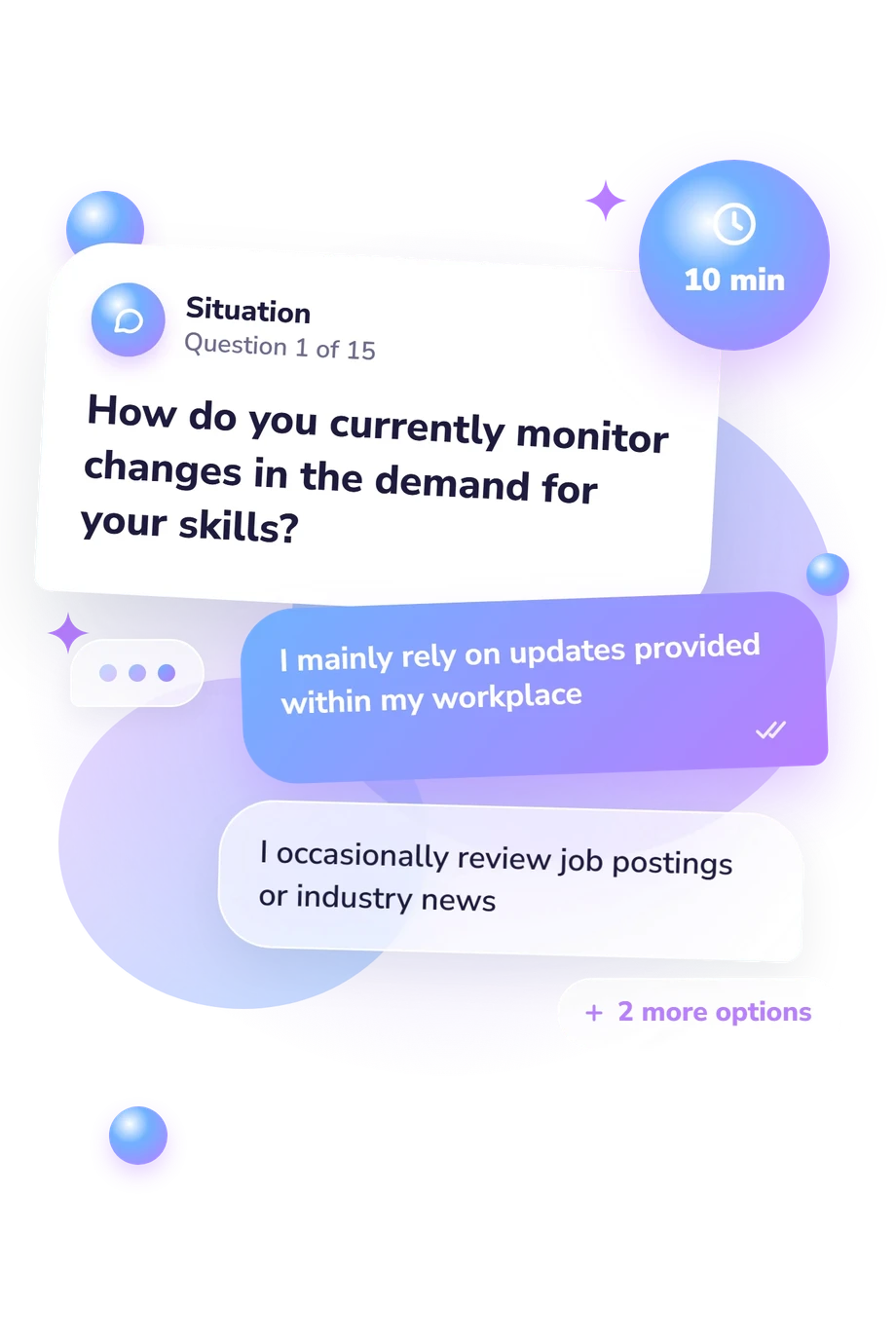
Questions examine whether work follows repeatable procedures or depends on judgment, relationships, physical context, and accountability. They consider opportunity tracking, extra learning, tool testing, and skill translation.
The profile describes the current task structure across three dimensions:
- Career Adaptability: 0-15 reflects current learning, skill translation, tool testing, and opportunity tracking. Stability focused (0-5) shows established-duty reliance; Building flexibility (6-10) shows exploration; Active adaptation (11-15) shows experimentation.
- Human and Context Dependence: 0-15 reflects reliance on human trust, contextual judgment, or variable real-world action. Limited dependence (0-5) indicates structured exchanges; Situational dependence (6-10) indicates local interpretation; Strong dependence (11-15) indicates central relationships, negotiation, embodied work, or accountability.
- Task Automation Exposure: 0-15 reflects how standardized, repeatable, and rule-expressible current tasks are; it does not predict job loss. Less standardized (0-5) indicates variable work; Mixed structure (6-10) combines codifiable and variable duties; Highly codifiable (11-15) indicates stable inputs, rules, and outputs.
Methodology and Scientific Basis
Each item presents a work situation with four ordered response choices covering skill monitoring, learning, tool use, accountability, quality judgment, handovers, and changing assignments. The platform combines responses into three displayed scales, but it does not publish a point-by-point scoring key or population norms; the bands are profile descriptions rather than probabilities.
Lassébie and Quintini (2022) provide the closest conceptual reference for separating task codifiability from wider automation effects. This questionnaire is conceptually consistent with that analysis, not an adaptation of the study. Autor (2015) supports reading automation as a process that can rearrange task bundles rather than simply remove occupations.
The learning and opportunity dimension gives this career change assessment a conceptual link to the Career Adapt-Abilities Scale described by Savickas and Porfeli (2012), but this online questionnaire is not that instrument or a validated short form.
Interpretation depends on honest self-report, current circumstances, and self-awareness. Use the profile to identify questions about transferable skills, codifiable duties, and relationship-dependent value; read the scores as structured self-reflection rather than a diagnosis.
- Lassébie, Julie, and Glenda Quintini. “What skills and abilities can automation technologies replicate and what does it mean for workers?: New evidence.” OECD Social, Employment and Migration Working Papers, No. 282, OECD Publishing, 2022. 10.1787/646aad77-en
- Savickas, Mark L., and Erik J. Porfeli. “Career Adapt-Abilities Scale: Construction, reliability, and measurement equivalence across 13 countries.” Journal of Vocational Behavior, vol. 80, no. 3, 2012, pp. 661-673. 10.1016/j.jvb.2012.01.011
- Autor, David H. “Why Are There Still So Many Jobs? The History and Future of Workplace Automation.” Journal of Economic Perspectives, vol. 29, no. 3, 2015, pp. 3-30. 10.1257/jep.29.3.3
Updated: