
Which Beauty Standard Do I Fit Quiz
How the Scales are Structured
Who Usually Takes This Test?
See How You Compare
Below is a preview of how scores are typically distributed across each scale.
Example Questions From the Test
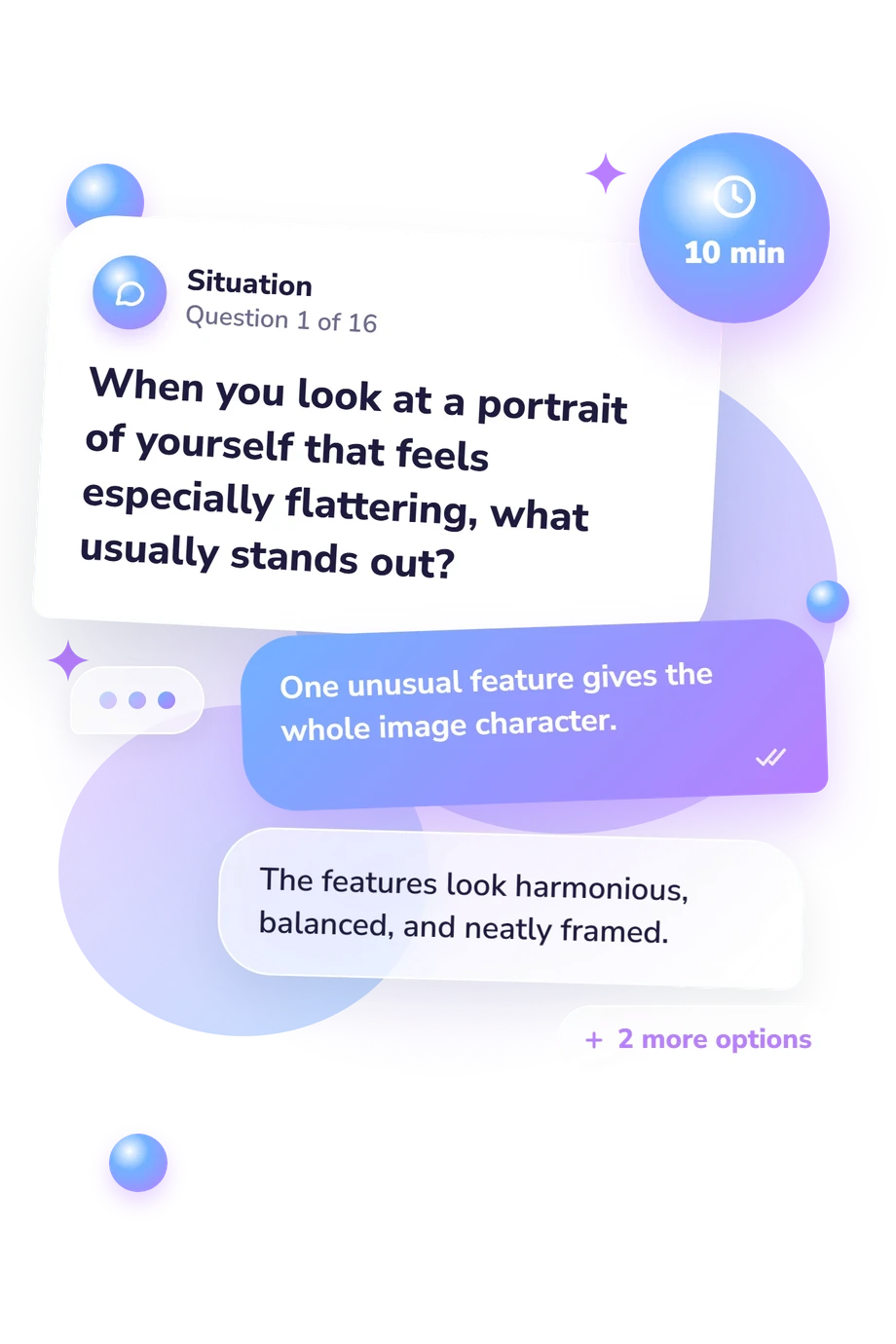
- One unusual feature gives the whole image character.
- The features look harmonious, balanced, and neatly framed.
- The face looks fresh, relaxed, and minimally styled.
- Strong definition creates a bold, camera-ready effect.
- “That looks elegant and completely timeless.”
- “You still look like yourself—just especially fresh.”
- “That is bold, polished, and seriously glamorous.”
- “I would never have imagined that look, but it works on you.”
- I look polished, composed, and evenly presented.
- I look relaxed, lively, and recognizably like myself.
- My features look bold and dramatically defined.
- The angle reveals something unusual and visually interesting.
Which Beauty Standard Do I Fit Quiz - Description and methodology of the test
People who want to understand why certain looks feel more natural than others can use the Which Beauty Standard Do I Fit Quiz to map aesthetic preferences rather than judge attractiveness. The result is useful for anyone exploring personal style, makeup, photography, or visual self-expression. The beauty standards quiz compares reactions to balance, individuality, glamour, and ease to profile the styling priorities that feel most congruent.
What This Assessment Explores
Four lenses organize impression, feature treatment, effort, and impact:
- Classic & Balanced (0-12) reflects symmetry, proportion, and enduring polish; Supporting Accent (0-4), Flexible Classic (5-8), and Strong Classic Affinity (9-12) indicate affinity.
- Distinctive & Editorial (0-12) reflects unusual features, contrast, and expressive styling; Subtle Individuality (0-4), Creative Blend (5-8), and Strong Editorial Affinity (9-12) indicate affinity.
- Glamorous & Sculpted (0-12) reflects definition, precision, and camera-ready impact; Selective Drama (0-4), Adaptable Glamour (5-8), and Strong Glamorous Affinity (9-12) indicate affinity.
- Natural & Effortless (0-12) reflects visible texture, comfort, and an unfussy impression; Occasional Ease (0-4), Relaxed Blend (5-8), and Strong Natural Affinity (9-12) indicate affinity.
Used for self-reflection, the beauty preference quiz highlights priorities, not attractiveness. The highest scale is strongest; any scale within one point creates a blend.
Methodology and Scientific Basis
Each question presents four answer choices about reactions to styling, photographs, features, or overall impression. The options point toward classic balance, natural ease, sculpted glamour, or distinctive expression, and the respondent selects the response that feels most personally accurate. The beauty style quiz displays the four scale scores for comparison: the highest represents the strongest affinity, while any score within one point forms a blended result.
Conceptually, the questionnaire is consistent with Perceptions of Beauty Standards Scale (Paudel et al., 2025), but it is not an adaptation of that instrument. Cash and Szymanski’s 1995 body-image ideals measure adds context for desired appearance dimensions, while Rhodes (2006) connects facial beauty research with balance, feature cues, and visual salience.
These works provide conceptual context, not evidence that this online questionnaire has their norms or validation. The questionnaire itself is not presented as standardized, and its labels are interpretive bands rather than population cutoffs. Scores can shift with mood, setting, culture, current trends, and self-perception, so the result is best read as a snapshot of present preferences. It is not a diagnosis.
- Paudel, Shishir, Anisha Chalise, Shaina Tamrakar, and Dhurba Khatri. “Unpacking beauty norms and body image: Development and validation of the perceptions of beauty standards scale.” SAGE Open Medicine, vol. 13, 2025, article 20503121251324085. 10.1177/20503121251324085
- Cash, Thomas F., and Marcela L. Szymanski. “The Development and Validation of the Body-Image Ideals Questionnaire.” Journal of Personality Assessment, vol. 64, no. 3, 1995, pp. 466-477. 10.1207/s15327752jpa6403_6
- Rhodes, Gillian. “The Evolutionary Psychology of Facial Beauty.” Annual Review of Psychology, vol. 57, 2006, pp. 199-226. 10.1146/annurev.psych.57.102904.190208
Updated: