
What Should I Eat Quiz
How the Scales are Structured
Who Usually Takes This Test?
See How You Compare
Below is a preview of how scores are typically distributed across each scale.
Example Questions From the Test
- Strongly disagree
- Disagree
- Not sure
- Agree
- Strongly disagree
- Disagree
- Not sure
- Agree
- Strongly disagree
- Disagree
- Agree
- Strongly agree
What Should I Eat Quiz - Description and methodology of the test
Choosing a meal can be difficult when appetite, energy, and available time pull in different directions. The What Should I Eat Quiz is for people who want a practical snapshot before deciding what to cook, order, or assemble. It also works as a what do i want to eat quiz when the hardest part is identifying the craving itself. Results organize the flavors, effort, and fullness that feel appealing now.
What This Assessment Explores
The questionnaire captures current preference, not a permanent eating identity. Items compare sweet and savory cravings, willingness to prepare food, and desire for light or hearty meals. That focus makes the what to eat quiz useful when appetite and circumstances both matter.
The result contains three dimensions:
- Craving: Sweet-Savory (0-20) shows whether sweet or savory foods are more appealing: Sweet-leaning 0-8, Balanced 9-11, Savory-leaning 12-20.
- Effort & Time Available (0-20) shows willingness to cook, from quick no-cook choices to multi-step meals: Quick & Minimal Effort 0-6, Moderate Effort 7-13, More Time & Cooking 14-20.
- Meal Heaviness (0-20) shows preference for light, fresh food or hearty comfort food: Light & Fresh 0-6, Balanced 7-13, Hearty & Comforting 14-20.
Together, these dimensions point toward a fitting meal style without prescribing one dish.
Methodology and Scientific Basis
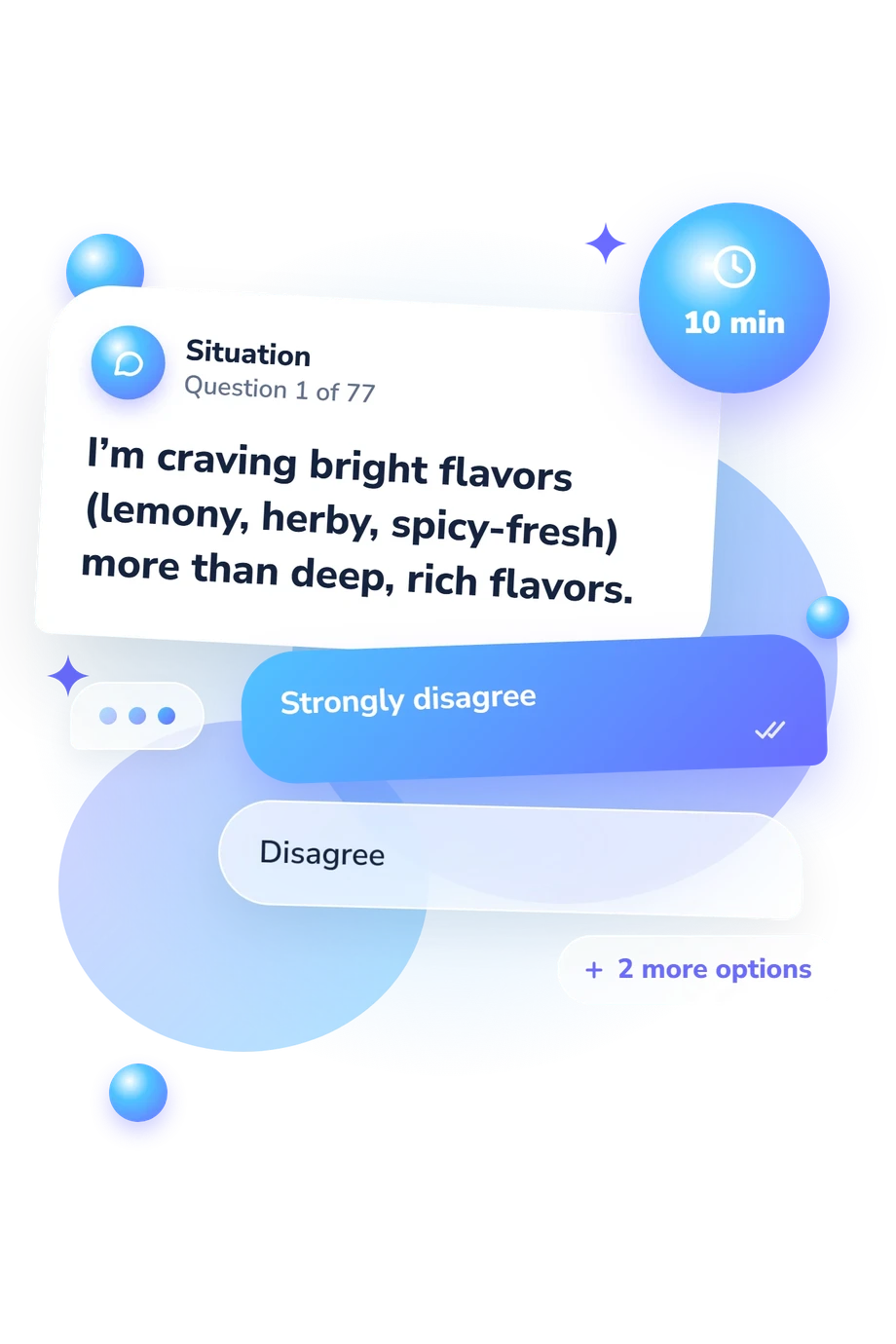
Each item presents a short statement about a current preference, with agreement choices such as Strongly disagree, Disagree, Not sure, Agree, and, for some items, Strongly agree. The wording moves between cravings, preparation demands, and meal qualities, so the respondent reports a present-moment reaction rather than a general food philosophy.
Responses are combined into the three displayed 0-20 dimensions and interpreted through the supplied bands. The displayed bands organize practical meal-selection guidance; they are not population norms or clinical cutoffs. As a meal choice quiz, the tool is most useful as a snapshot that can change with hunger, schedule, mood, and available food.
Its content is conceptually consistent with the Food Cravings Questionnaire-State (FCQ-S), which treats cravings as state-related experiences, and with the Food Choice Questionnaire, which examines motives involved in selecting food. The Food-Craving Inventory provides another relevant comparison for craving themes. These sources support the constructs named here, but this questionnaire is not an adaptation, validation, or standardized administration of any of them.
Because answers are self-reported, current context, self-awareness, and response bias can shift the result; a broader assessment would be needed for claims beyond immediate meal preference.
- Antonio Cepeda-Benito, David H. Gleaves, Tara L. Williams, and Stephen A. Erath (2000). The development and validation of the state and trait food-cravings questionnaires. Behavior Therapy, 31(1), 151-173. 10.1016/S0005-7894(00)80009-X
- Andrew Steptoe, Tessa M. Pollard, and Jane Wardle (1995). Development of a Measure of the Motives Underlying the Selection of Food: the Food Choice Questionnaire. Appetite, 25(3), 267-284. 10.1006/appe.1995.0061
- Marney A. White, Brooke L. Whisenhunt, Donald A. Williamson, Frank L. Greenway, and Robert G. Netemeyer (2002). Development and Validation of the Food-Craving Inventory. Obesity Research, 10(2), 107-114. 10.1038/oby.2002.17
Updated: