
Table Tennis Quiz
How the Scales are Structured
Who Usually Takes This Test?
See How You Compare
Below is a preview of how scores are typically distributed across each scale.
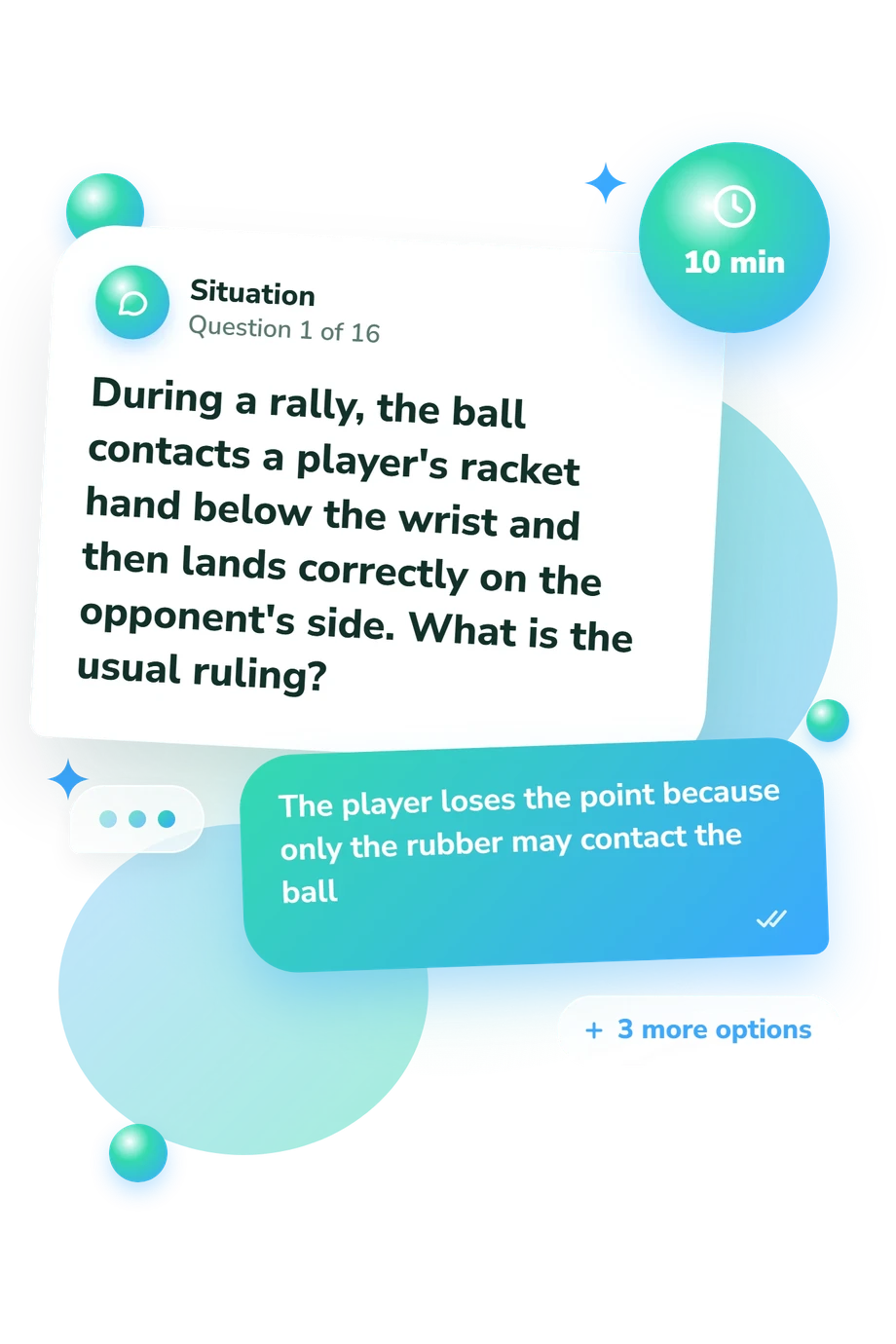
Example Questions From the Test
- Player A continues serving until losing a rally
- The receiver chooses who serves next
- Player B serves once, then service returns to Player A
- Service passes to Player B for the next two points
- Play continues until someone reaches 15
- The next point decides the game
- A player must gain a two-point lead
- Each player receives one final serve
- At least 6 cm
- At least 10 cm
- At least 16 cm
- At least 25 cm
Table Tennis Quiz - Description and methodology of the test
Players, coaches, students, and curious followers can use this assessment to check whether their understanding of table tennis rules matches common match situations. The table tennis quiz focuses on practical knowledge rather than athletic technique, so it suits anyone seeking a structured review. By testing table tennis knowledge, this assessment highlights secure understanding and details worth revisiting, from legal serves to scoring and equipment.
What This Assessment Measures
Applied knowledge is the focus: situations ask what should happen in a rally, serve, doubles exchange, or match rather than how well someone performs. The table-tennis quiz questions and answers test recognition of rules when details such as score, ball contact, or table position change. The result describes practical understanding, not performance.
The main themes are:
- Rules and rulings show how legal contacts, lets, edges, and table contact affect a point.
- Scoring and match format measure game totals, deuce, service rotation, and match progression.
- Serving and doubles cover tosses, diagonal placement, alternating shots, and order of play.
- Equipment and technique check table dimensions and the usual effect of topspin.
The displayed Table Tennis Knowledge score ranges from 0-16: Foundation (0-6), Developing (7-12), and Strong (13-16). These bands indicate increasing breadth and reliability; Strong is a trivia result, not an official playing qualification.
Methodology and Evidence Base
Each item offers four answer choices, and the respondent selects the option that best matches the stated rule or practice. The chosen responses are summarized as one knowledge score rather than separate personality dimensions. The displayed range supports the result bands, but it does not by itself establish how individual answers are weighted.
Its coverage of official rules makes it useful for reviewing table tennis laws and match situations. Current ITTF statutes and match-official guidance supply the rule context for service, scoring, lets, doubles order, and equipment. The closest named research comparison is Table Tennis Knowledge Test (Doğan et al., 2025). This questionnaire is conceptually consistent with that work, not presented as an adaptation of the published instrument.
The displayed bands are descriptive categories for this questionnaire, and the cited study should not be read as validation of this online version. Results may also reflect prior coaching, familiarity with formal wording, guessing, and the situation imagined while answering. Use the outcome to choose topics for review, especially when a missed rule deserves closer attention.
- Vedat Doğan, Erhan Devrilmez, and Fatih Dervent. Validity and Reliability of Table Tennis Knowledge Test for Secondary School Students: Methodological Study. Turkiye Klinikleri Journal of Sports Sciences. 2025;17(3):189-197. 10.5336/sportsci.2025-109653
- International Table Tennis Federation. ITTF Statutes 2026. Lausanne: International Table Tennis Federation; 2026.
- International Table Tennis Federation. Handbook for Match Officials. 18th ed. February 2026. Lausanne: International Table Tennis Federation; 2026.
Updated: