
Smartphone Quiz
How the Scales are Structured
Who Usually Takes This Test?
See How You Compare
Below is a preview of how scores are typically distributed across each scale.
Example Questions From the Test
- A stronger cellular signal in the places you visit.
- A larger amount of working memory, or RAM.
- Regular backups to a trusted cloud service or another device.
- A browser history that is never cleared.
- Remove or offload unneeded apps and large files.
- Close apps that are currently running in the background.
- Reduce the screen brightness.
- Switch from Wi-Fi to cellular data.
- Place it under a pillow so the heat does not reach you.
- Unplug it, move it to a cooler ventilated place, and let it cool.
- Run a demanding game to test whether performance is affected.
- Put it in a freezer for rapid cooling.
Smartphone Quiz - Description and methodology of the test
For readers deciding whether they can safely manage everyday device tasks, this cell phone quiz offers a focused check of practical choices involving security, connectivity, storage, privacy, and care. The smartphone quiz is intended for people who want to identify which situations deserve attention before they rely on a feature or setting. Its result can guide targeted review of unfamiliar functions and safer habits.
What This Assessment Explores
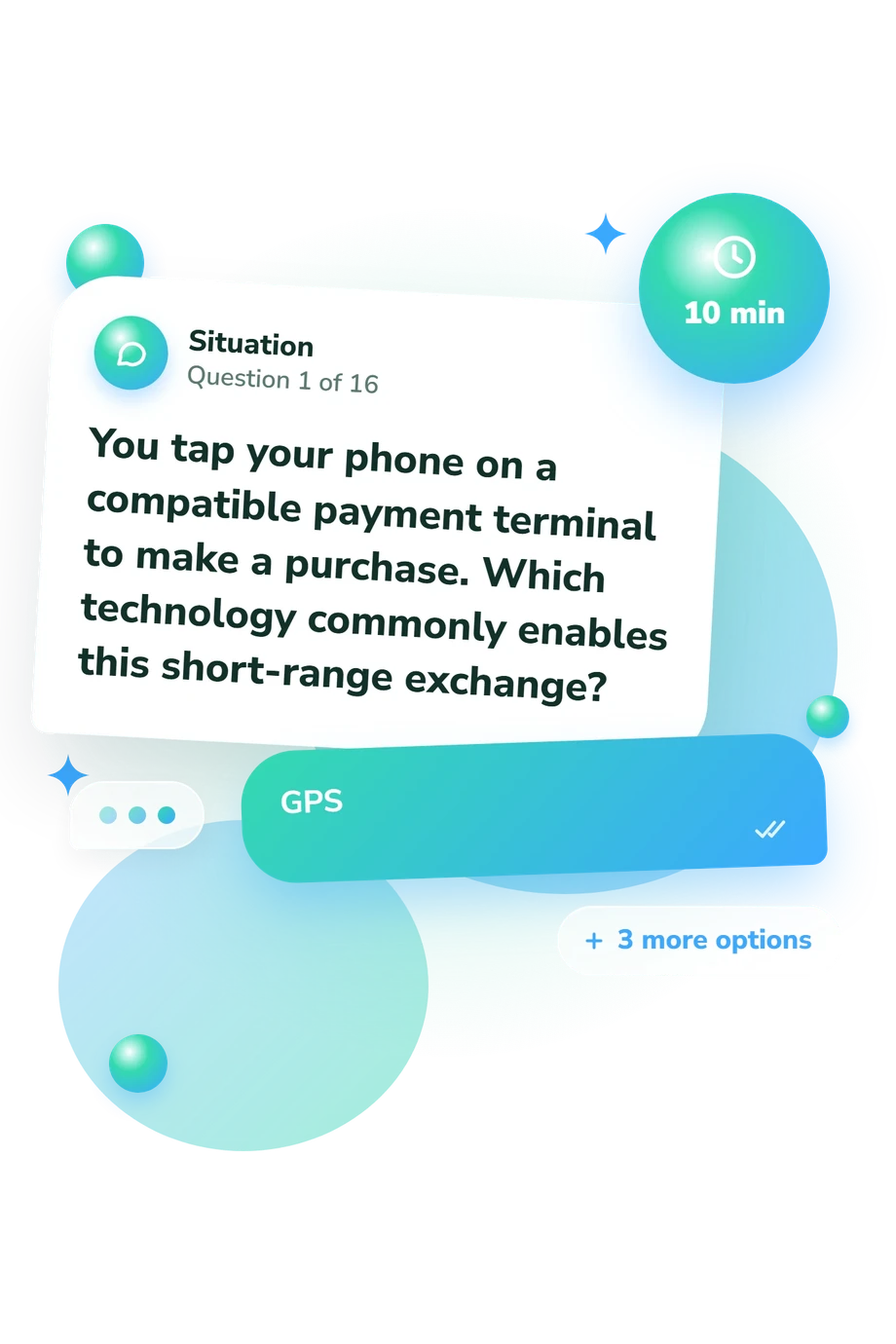
The scenarios ask what action or explanation best fits familiar situations, moving beyond vocabulary. They cover payments, backups, storage, suspicious links, device heat, location services, water resistance, account protection, operating systems, wireless connections, updates, and permissions. The questions emphasize practical judgment about everyday smartphone use, making the assessment a smartphone knowledge test.
The main thematic groups represented by the questions are:
- Device fundamentals show understanding of operating systems, caches, location, and short-range communication.
- Connectivity and storage indicate how you manage Wi-Fi, cellular data, backups, files, and apps.
- Security, privacy, and care reflect recognition of risky links, account protection, permissions, updates, heat, water exposure, and resale steps.
These themes feed Smartphone Knowledge (0-16): Foundation to Build (0-6) indicates essentials needing review; Developing Knowledge (7-12) reflects solid everyday understanding with room to strengthen weaker areas; Smartphone Savvy (13-16) indicates strong, well-rounded knowledge.
Methodology and Evidence Base
Each item presents a brief scenario or direct question with four answer choices. Selecting the best action or explanation samples applied knowledge rather than confidence ratings or open-ended reflection. The displayed result is the score across the questionnaire’s items, organized into the listed bands.
The content is conceptually consistent with the Smartphone Proficiency Questionnaire (Du et al., 2024), especially its focus on functional smartphone knowledge. Security and privacy themes also overlap with MISAS (Erdoğdu et al., 2021) and the review by Breitinger et al. (2020). This smartphone skills test is not presented as an adaptation of those instruments, and their research does not validate this online questionnaire.
Interpretation can be affected by guessing, attention, and familiarity with the situations. The online questionnaire is not accompanied by published population norms, a reliability estimate, or independent validation, so the result describes performance on these items rather than overall smartphone ability. Current circumstances may influence choices; use the outcome to identify topics for review, especially accounts, links, permissions, and personal data.
- Du, N., Zhao, Q., Zhang, C., Ma, G., & Zhuang, X. (2024). The Development of the Smartphone Proficiency Questionnaire for Chinese Older Adults (SPQ-COA). Journal of Applied Gerontology, 43(12), 1893-1904. 10.1177/07334648241257796
- Erdoğdu, F., Gökoğlu, S., & Kara, M. (2021). “What about users?”: Development and validation of the mobile information security awareness scale (MISAS). Online Information Review, 45(2), 406-421. 10.1108/OIR-04-2020-0129
- Breitinger, F., Tully-Doyle, R., & Hassenfeldt, C. (2020). A survey on smartphone user’s security choices, awareness and education. Computers & Security, 88, 101647. 10.1016/j.cose.2019.101647
Updated: