
Refrigeration Quiz
How the Scales are Structured
Who Usually Takes This Test?
See How You Compare
Below is a preview of how scores are typically distributed across each scale.
Example Questions From the Test
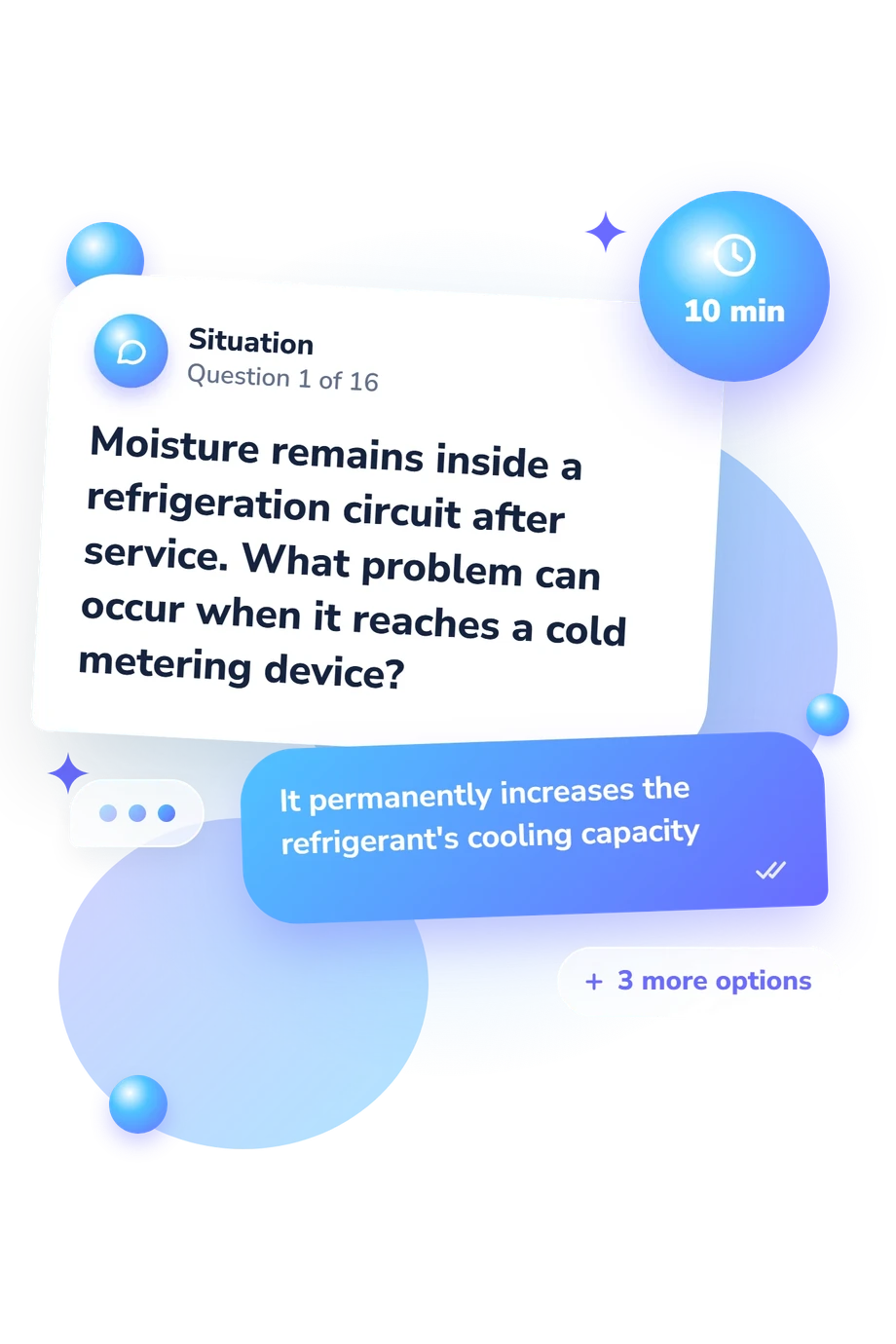
- It permanently increases the refrigerant's cooling capacity
- It can freeze and create an intermittent refrigerant restriction
- It raises airflow resistance across the condenser fins
- It eliminates the need for system evacuation
- To absorb heat as low-pressure refrigerant boils
- To reject heat as high-pressure vapor condenses
- To raise refrigerant pressure by compressing liquid
- To store refrigerant until the thermostat calls
- Liquid subcooling
- Evaporator temperature difference
- Suction superheat
- Compression ratio
Refrigeration Quiz - Description and methodology of the test
Designed for learners, technicians in training, and anyone reviewing HVAC/R fundamentals, this refrigeration quiz checks whether you can connect cycle principles with real operating conditions. The result shows which concepts deserve more study and whether your current knowledge is ready for deeper troubleshooting work. This refrigeration training quiz also organizes review across components, measurements, airflow, efficiency, safety, and refrigerant handling.
What This Assessment Measures
The questions examine how a vapor-compression system moves heat and how component behavior changes in common operating conditions. They cover compressor, evaporator, condenser, and metering-device functions; pressure-temperature relationships; superheat, subcooling, airflow, efficiency, moisture, and heat transfer.
For learners, trainees, maintenance students, and technically curious readers, this refrigeration knowledge test offers a structured check of fundamentals. Rather than testing isolated definitions, it asks you to apply concepts to short operating situations. The displayed scale is Refrigeration Knowledge (0-16), with these result bands:
- Foundation (0-6) indicates recognition of core ideas, with review needed for the cycle, component functions, and pressure-temperature relationships.
- Developing (7-12) indicates many operating principles are understood, while troubleshooting and applied reasoning can improve.
- Strong (13-16) indicates a well-developed grasp of refrigeration operation and common system behavior.
Methodology and Evidence Base
Each item presents a practical multiple-choice situation with four answer choices. The themes cover cycle and component roles, measurements, system conditions, efficiency, heat transfer, and safe refrigerant handling. Each correct answer adds one point, making the total a direct count of correct responses rather than a weighted psychological score.
Its technical content is conceptually consistent with Silberstein et al. (2021); Fenton et al. (2019) and the 2022 ASHRAE Handbook likewise support the treatment of cycles, heat transfer, pressures, and component behavior. United States Environmental Protection Agency guidance provides the recovery and handling context. The questionnaire is not presented as an adaptation of one published instrument, and no normative sample, reliability estimate, or standardized certification threshold is established.
When used for focused review, the questionnaire can function as a refrigeration practice test, but performance depends on prior study, attention, and recognizing the best option under test conditions. Read the result as an educational snapshot, not proof of field competence. Electricity, pressure, rotating machinery, and regulated refrigerants create real hazards, so safe work still requires manufacturer procedures and qualified assistance where required.
- Silberstein, Eugene, Jason Obrzut, John Tomczyk, Bill Whitman, and Bill Johnson. Refrigeration & Air Conditioning Technology. 9th ed. Cengage Learning, 2021. ISBN 9780357122273.
- Fenton, Donald L., Christopher W. Callahan, and Atef Mohamed Elansari. “Refrigeration.” In Postharvest Technology of Perishable Horticultural Commodities, 209-270. Elsevier, 2019. 10.1016/B978-0-12-813276-0.00007-9.
- ASHRAE. 2022 ASHRAE Handbook-Refrigeration. Atlanta, GA: ASHRAE, 2022.
- United States Environmental Protection Agency. Recovering, Recycling, and Reclaiming of Refrigerants. Updated August 26, 2026.
Updated: