
Ratio Quiz Grade 6
How the Scales are Structured
Who Usually Takes This Test?
See How You Compare
Below is a preview of how scores are typically distributed across each scale.
Example Questions From the Test
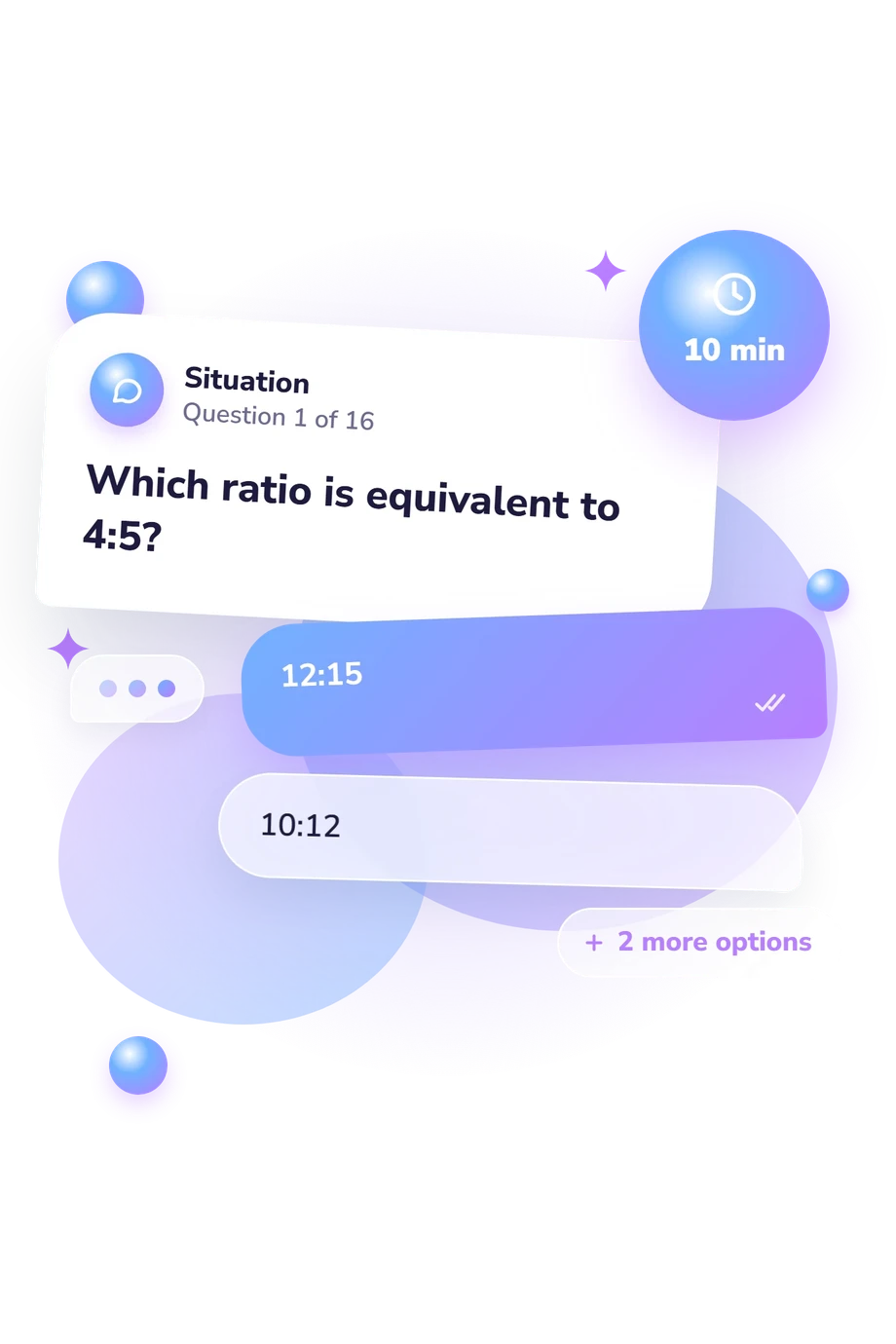
- 12:15
- 10:12
- 8:15
- 16:25
- 5 cups
- 10 cups
- 6 cups
- 12 cups
- 12
- 15
- 14
- 18
Ratio Quiz Grade 6 - Description and methodology of the test
Students, families, and educators can use the Ratio Quiz Grade 6 to check how well a learner applies ratio ideas in familiar and practical situations. As a grade 6 ratio assessment, it offers a clear snapshot of current understanding, including performance in notation, equivalence, proportional thinking, and everyday rates. The result summarizes performance across the sampled skills and indicates an overall level.
What This Assessment Measures
Rather than testing arithmetic alone, the questionnaire checks how learners interpret relationships between quantities. Its situations cover equivalent ratios, simplest forms, ordered notation, part-to-whole comparisons, scale drawings, unit rates, constant rates, mixtures, prices, and proportional changes. Tasks ask for unknown values, compare ratios, or transfer relationships to new contexts.
For ratio practice for sixth grade, the result summarizes performance across the sampled skills and indicates an overall level. It does not isolate which ideas are secure, so worked examples may help for review. The Grade 6 Ratio Knowledge scale (0-16) is reported in these bands:
- Foundations to build (0-6) indicates that core ratio ideas need review.
- Developing knowledge (7-12) shows growing understanding with more practice needed in unfamiliar situations.
- Strong knowledge (13-16) indicates reliable Grade 6 understanding of notation, equivalence, rates, and proportional problem-solving.
Methodology and Evidence Base
Each item uses four-option multiple choice. The learner selects the mathematically correct response, such as a simplified ratio, missing quantity, unit rate, or valid comparison. The scoring rule assigns one point to each correct answer, making the total a count of correct responses.
Content is conceptually consistent with Misailidou and Williams (2003), whose work highlights proportional reasoning and diagnostic patterns in children’s responses. Ben-Chaim, Keret, and Ilany (2012) provide a complementary framework for ratio and proportion, while the Common Core mathematics standards place ratios, rates, and proportional reasoning within Grade 6 learning. Together, these sources provide context for the ratio, rate, proportional, and comparison skills represented by the questions.
As a grade 6 ratios test, it is best interpreted as a curriculum-oriented summary of performance on these questions. A higher band indicates stronger performance across the sampled skills, while a lower band indicates that the sampled ratio knowledge needs further review. Attention, wording, calculation slips, and prior instruction can affect performance, so worked solutions or classroom discussion can add useful context.
- Misailidou, Christina, and Julian Williams. "Diagnostic assessment of children's proportional reasoning." The Journal of Mathematical Behavior 22, no. 3 (2003): 335-368. 10.1016/S0732-3123(03)00025-7
- National Governors Association Center for Best Practices and Council of Chief State School Officers. Common Core State Standards for Mathematics. Washington, DC: Authors, 2010.
- Ben-Chaim, David, Yaffa Keret, and Bat-Sheva Ilany, editors. Ratio and Proportion. Rotterdam: SensePublishers, 2012. 10.1007/978-94-6091-784-4
Updated: