
Present Continuous and Present Simple Quiz
How the Scales are Structured
Who Usually Takes This Test?
See How You Compare
Below is a preview of how scores are typically distributed across each scale.
Example Questions From the Test
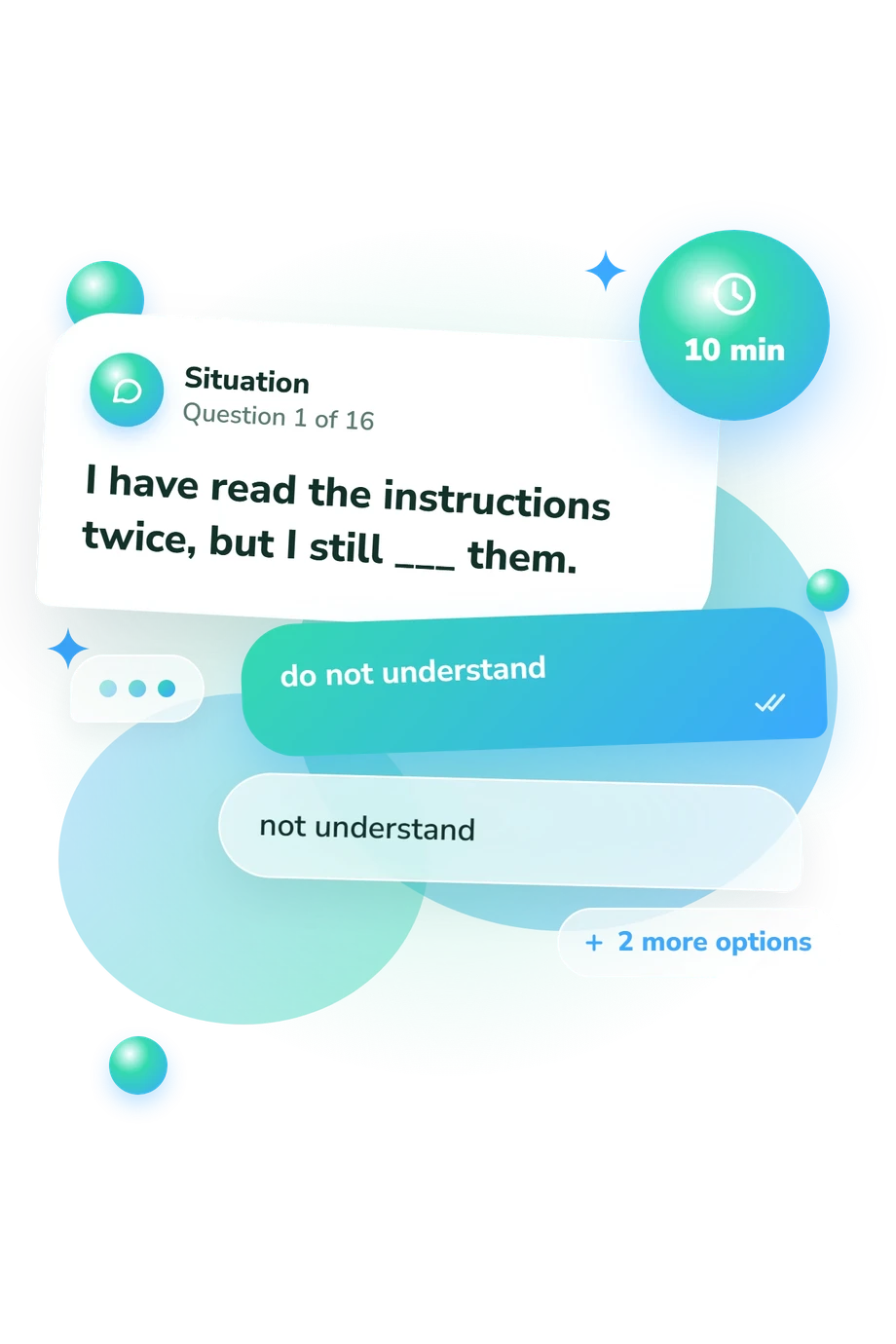
- do not understand
- not understand
- am not understand
- am not understanding
- do you wear
- are you wearing
- you are wearing
- does you wear
- is leave
- leaves
- leaving
- leave
Present Continuous and Present Simple Quiz - Description and methodology of the test
Designed for learners who want a clearer grasp of everyday English tense choices, the present continuous and present simple quiz checks whether you can match form to meaning. It suits independent study, classroom revision, or a quick check before using these forms. As a present simple or continuous quiz, it highlights distinctions that still cause hesitation and points to useful practice areas.
What This Assessment Explores
The questions examine how meaning and context determine the choice between the present simple and present continuous. They cover routines, facts, timetables, temporary situations, actions in progress, future plans, stative meanings, and irritated repetition. The focus is practical tense control for English learners.
The result reports one scale, Present Simple and Present Continuous Knowledge (0-16). Its displayed bands are:
- Foundations to Review (0-6) shows that core contrasts need review.
- Developing Knowledge (7-12) shows good control with uncertainty in less familiar contexts.
- Strong Knowledge (13-16) shows consistent distinctions across common and nuanced uses.
Questions in this simple present vs present progressive quiz ask you to apply the present-simple and present-progressive contrast in everyday contexts. The result gives a broad knowledge level and indicates whether you may need to revisit the present-simple and present-continuous contrast.
Methodology and Evidence Base
Each item presents a sentence or situation with four answer choices. You select the form that matches its meaning, including statements, questions, negatives, temporary arrangements, timetables, stative verbs, and irritated repetition. The format tests grammar in context rather than isolated rules.
The questionnaire presents a total score within the displayed bands and does not specify whether individual answers receive different weights.
This present simple and present continuous test is a focused learning check: interpret the result as performance on these tense items, not as a complete measure of English proficiency; the single total cannot show whether a difficulty lies with routines, temporary situations, stative verbs, or future plans.
Its content is conceptually consistent with Carter and McCarthy (2006), while Murphy (2019) and Huddleston and Pullum (2002) offer complementary accounts of tense, aspect, verb meaning, and usage. It is not presented as an adaptation of those publications, but applies related grammatical distinctions in its own item set.
Reviewing missed contrasts and practising them in varied sentences makes the result more useful.
- Carter, Ronald, and Michael McCarthy. Cambridge Grammar of English: A Comprehensive Guide to Spoken and Written English Grammar and Usage. Cambridge University Press, 2006. ISBN 9780521588461.
- Murphy, Raymond. English Grammar in Use: A Self-study Reference and Practice Book for Intermediate Learners of English. 5th ed. Cambridge University Press, 2019. ISBN 9781108457651.
- Huddleston, Rodney, and Geoffrey K. Pullum. The Cambridge Grammar of the English Language. Cambridge University Press, 2002. DOI 10.1017/9781316423530
Updated: