
Positive Intelligence Test
How the Scales are Structured
Who Usually Takes This Test?
See How You Compare
Below is a preview of how scores are typically distributed across each scale.
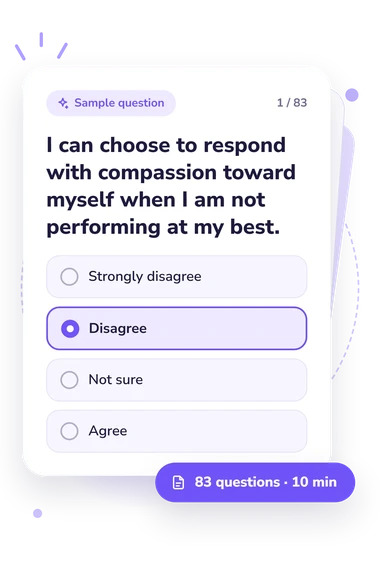
Example Questions From the Test
- Strongly disagree
- Disagree
- Not sure
- Agree
- Strongly disagree
- Disagree
- Not sure
- Agree
- Strongly disagree
- Disagree
- Not sure
- Agree
Positive Intelligence Test - Description and methodology of the test
People who want to understand how they respond under pressure can use the positive intelligence test to examine recurring mental habits rather than isolated moods. It is suited to people reflecting on self-criticism, control, avoidance, worry, empathy, and constructive action. The profile produced by this PQ test turns these everyday reactions into a view of skills worth strengthening.
What This Assessment Explores
This questionnaire examines Saboteur and Sage responses. Questions touch on blame, perfectionism, comparison, approval-seeking, catastrophizing, avoidance, compassion, grounding, adaptability, and action under uncertainty. It suits people considering this positive intelligence quiz who want a structured view of these habits.
The result shows three views:
- PQ Score (Sage vs. Saboteur), 0-100, reflects how often you operate from the Sage mindset versus being driven by Saboteur patterns; higher scores indicate stronger mental fitness and more frequent Sage responses, while lower scores suggest Saboteurs more often control you: Saboteur-dominant 0-39; Balanced 40-69; Sage-dominant 70-100.
- Saboteur Activation, 0-10, measures frequency and intensity of reactive patterns: Low 0-3; Moderate 4-7; High 8-10.
- Sage Strength, 0-10, measures consistent, reliable access to Sage perspectives during stress: Less accessible 0-3; Developing 4-6; Strong 7-10.
Together, they show whether stress narrows attention or leaves room for purposeful choice.
Methodology and Evidence Base
Among representative items, each statement describes a reaction or coping choice with responses: Strongly disagree, Disagree, Not sure, or Agree. The sampled items cover Saboteur-leaning experiences such as blame, comparison, control, avoidance, and defensiveness, alongside Sage capacities such as self-compassion, curiosity, grounding, empathy, reframing, and solution-focused action. This positive intelligence assessment is a self-report snapshot, not a performance task.
Scoring follows the Sage-versus-Saboteur model in Positive Intelligence Assessments by Shirzad Chamine and Julie Barnhart and in Chamine’s 2012 framework. Answers are combined into the displayed outputs, but no point-by-point weighting rule is published, so answer values should not be inferred from the ranges.
Conceptually, the questionnaire is consistent with the Sage-versus-Saboteur model but is not an adaptation of the published instrument. Puah and colleagues’ 2024 longitudinal study of a Positive Intelligence program reported outcomes involving perceived stress, self-compassion, and rumination among occupational therapy students; this supports the program, not the validity of this online version.
The displayed bands are descriptive guides for reading the profile, not clinical cutoffs; results can shift with current stress, mood, self-awareness, and socially desirable responding.
- Chamine, Shirzad, and Melissa Barnhart. Research Foundation for Positive Intelligence Assessments. Positive Intelligence Whitepaper Series. Positive Intelligence, LLC, 2022.
- Puah, Shermain, Ching Yee Pua, Jing Shi, and Sok Mui Lim. The Effectiveness of a Digital Mental Fitness Program (Positive Intelligence) on Perceived Stress, Self-Compassion, and Ruminative Thinking of Occupational Therapy Undergraduate Students: Longitudinal Study. Journal of Medical Internet Research, vol. 26, 2024, e49505. 10.2196/49505.
- Chamine, Shirzad. Positive Intelligence: Why Only 20% of Teams and Individuals Achieve Their True Potential and How You Can Achieve Yours. Greenleaf Book Group Press, 2012. ISBN 9781608322787.