
Math Properties Quiz
How the Scales are Structured
Who Usually Takes This Test?
See How You Compare
Below is a preview of how scores are typically distributed across each scale.
Example Questions From the Test
- Commutative property of multiplication
- Distributive property
- Multiplicative inverse property
- Associative property of multiplication
- Associative property of multiplication
- Distributive property
- Multiplicative identity property
- Additive inverse property
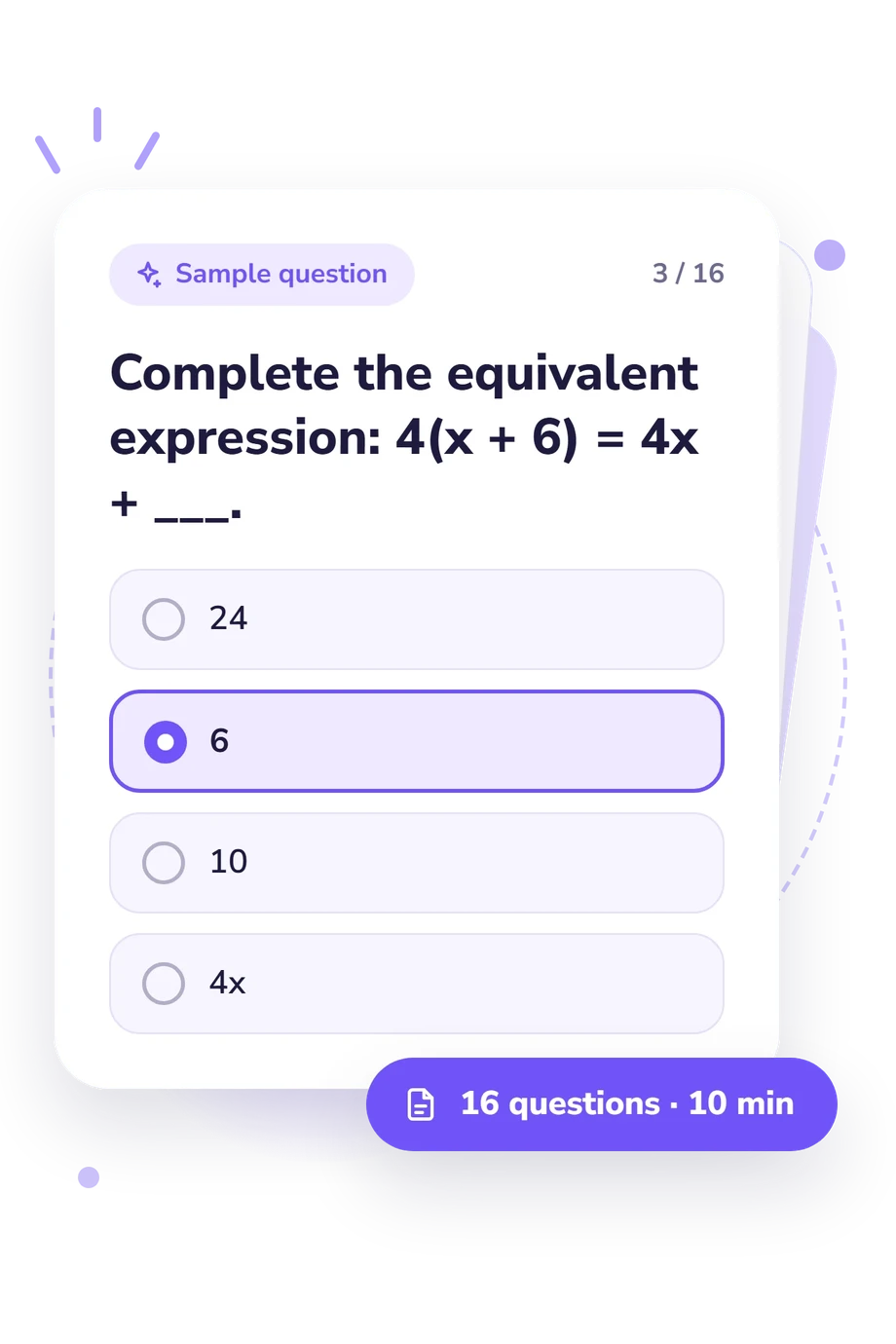
- 24
- 6
- 10
- 4x
Math Properties Quiz - Description and methodology of the test
Used as an arithmetic properties test, this assessment gives students, teachers, and learners a focused way to check how operations behave. It suits revision of foundational arithmetic and introductory algebra, especially when a learner wants to distinguish a naming problem from difficulty applying a rule. The math properties quiz links each result to recognizable work with expressions. Its purpose is to guide targeted practice and identify rules needing more attention.
What This Assessment Measures
Questions test whether a learner can recognize and apply rules for addition and multiplication, then use them with subtraction, division, zero, opposites, reciprocals, equivalent expressions, factoring, and error correction. The intended reader is anyone reviewing foundational arithmetic or introductory algebra; the focus is property knowledge.
These tasks form a mathematical properties quiz, and the score shows how accurately the learner identifies and applies the tested rules. This educational summary does not measure overall mathematical ability.
The result is organized into these bands:
- Math Properties Knowledge (0-16) gives one point for each correct answer and summarizes the properties covered.
- Foundations to review (0-6) means the main property names and effects on expressions need revisiting.
- Developing knowledge (7-12) indicates recognition of many properties, with practice useful for unfamiliar forms.
- Strong knowledge (13-16) indicates consistent identification and application of the major properties tested.
Methodology and Scientific Basis
Each item presents a short arithmetic or algebraic situation with four answer choices. The choices ask for a property name, an equivalent expression, a valid transformation, or an error explanation. This selected-response format samples recall and application without requiring written work.
For algebraic properties practice, the questionnaire uses a criterion-referenced score: each correct response earns one point, and the total reflects the number answered correctly. The displayed bands describe performance on these tasks rather than a population comparison, showing which property rules merit further practice.
Its conceptual frame is consistent with Im and Varma (2024), Wong (2017), and Robinson (2017), whose work connects arithmetic operation understanding with achievement and explains additive and multiplicative concepts. These sources support the relevance of the skills, but this questionnaire is not presented as an adaptation or validation of their studies.
Interpretation should stay close to the tasks. Performance can vary with recent instruction, attention, language comprehension, and carefulness; these context effects make the result most useful as a focused learning signal for choosing practice topics and revisiting rules that remain uncertain.
- Im, Soo-hyun, and Sashank Varma. "The application of arithmetic principles predicts mathematical achievement in college students." Learning and Instruction, 91, 101889, 2024. 10.1016/j.learninstruc.2024.101889
- Wong, Terry Tin-Yau. "The unique and shared contributions of arithmetic operation understanding and numerical magnitude representation to children's mathematics achievement." Journal of Experimental Child Psychology, 164, 68-86, 2017. 10.1016/j.jecp.2017.07.007
- Robinson, Katherine M. "The Understanding of Additive and Multiplicative Arithmetic Concepts." In Acquisition of Complex Arithmetic Skills and Higher-Order Mathematics Concepts, edited by David C. Geary, Douglas B. Berch, Robert J. Ochsendorf, and K. M. Koepke, 21-46. Academic Press, 2017. 10.1016/B978-0-12-805086-6.00002-3
Updated: