
Management Quiz
How the Scales are Structured
Who Usually Takes This Test?
See How You Compare
Below is a preview of how scores are typically distributed across each scale.
Example Questions From the Test
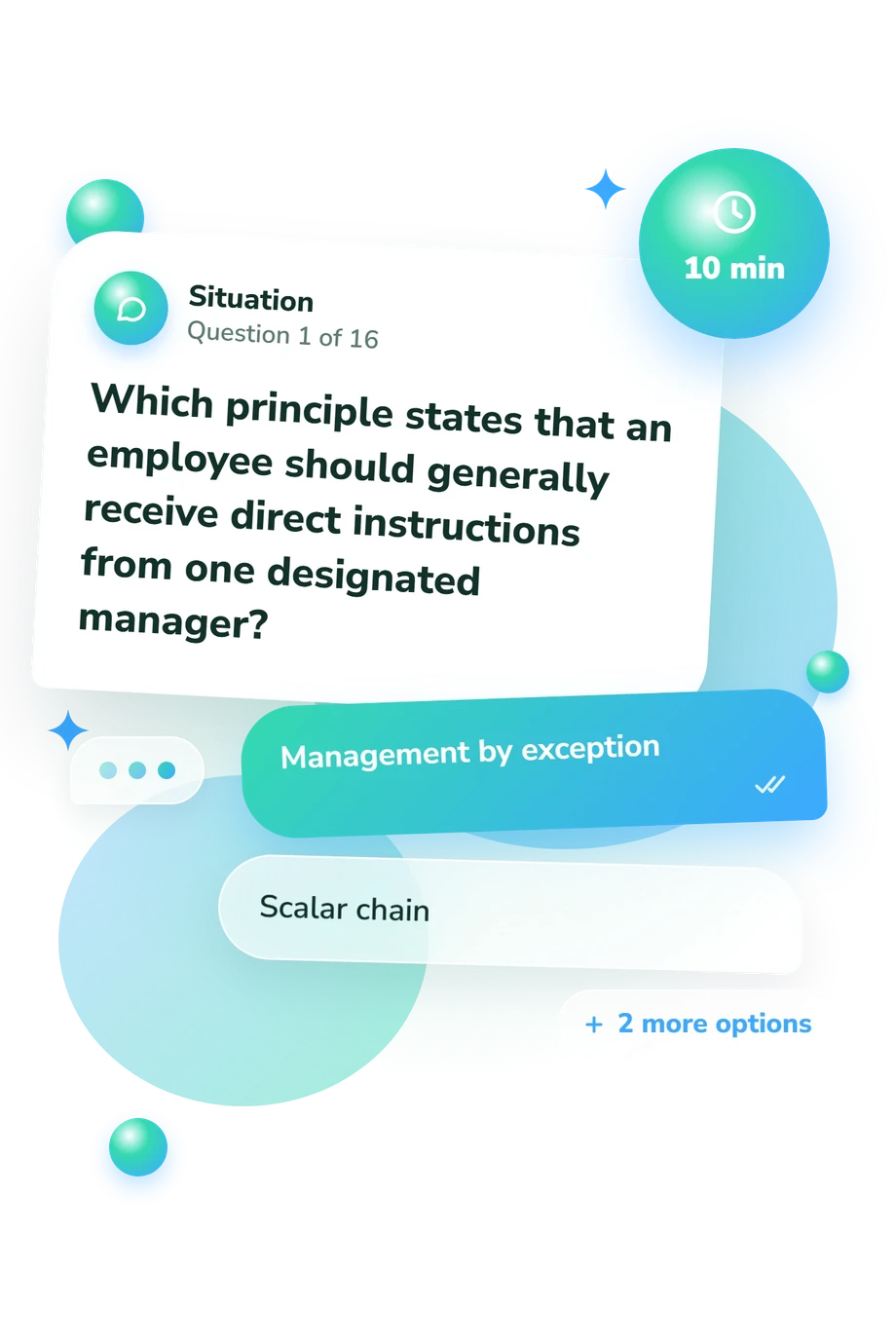
- Management by exception
- Scalar chain
- Division of work
- Unity of command
- The number of employees who report directly to the manager
- The number of hierarchy levels below senior management
- The variety of products controlled by one department
- The geographic area served by the organization
- Organizing
- Planning
- Leading
- Controlling
Management Quiz - Description and methodology of the test
Readers who want to test their grasp of everyday management principles can use these management quiz questions and answers to examine how they would handle planning, structure, motivation, control, and workplace judgment. The assessment suits learners, developing supervisors, and professionals refreshing core concepts through a management quiz with answers designed to point to knowledge areas worth revisiting. Its result is educational and practical rather than a measure of job performance.
What This Assessment Explores
Instead of measuring charisma or seniority, the questionnaire asks whether a respondent can recognize sound management principles in workplace situations. Its management quiz questions with answers cover planning, organizing, leading, controlling, goals, motivation, structure, delegation, conflict, and change. It suits learners and people refreshing foundational supervisory knowledge.
The main areas are:
- Planning and goals show whether you can identify objectives, SMART targets, and appropriate advance actions.
- Organization and leadership indicate how you understand authority, structure, feedback, participation, delegation, and motivation.
- Control and performance test whether you can compare results with standards and notice early warnings.
- Judgment examines responses to sunk costs, conflicts of interest, resistance, and competing workplace interests.
The displayed result is Management Knowledge, scored from 0-16: Foundations to Build (0-6), Developing Knowledge (7-12), and Strong Knowledge (13-16). It describes knowledge shown here, not professional certification.
Methodology and Scientific Basis
Each item presents a management principle or short workplace scenario followed by four response options. The respondent selects the answer that best matches established management reasoning rather than reporting a personal preference. In the management questions and answers format, the items sample factual recall and applied judgment, including unity of command, matrix reporting, SMART goals, delegation, and conflict resolution.
Conceptually, the questionnaire is consistent with Bright and Cortes (2019), whose treatment links core functions with organizational design and practical decisions. Fayol provides a classical reference point for planning, authority, unity of command, and control. Goal-setting items correspond with Locke and Latham (2002), while meaningful discretion is consistent with Ryan and Deci (2000). These sources clarify the concepts assessed; they do not make this online questionnaire a validated adaptation of those works.
Scoring summarizes selected answers and assigns the displayed educational performance band. The bands are descriptive, not norm-referenced clinical cutoffs. Prior study, guessing, wording, and unfamiliar workplace contexts can affect performance, so the result is best read as a snapshot of knowledge rather than a measure of management effectiveness.
- Bright, David S., and Anastasia H. Cortes. Principles of Management. OpenStax, Houston, Texas, 2019.
- Fayol, Henri. General and Industrial Management. Translated by Constance Storrs. Pitman, London, 1949.
- Locke, Edwin A., and Gary P. Latham. "Building a Practically Useful Theory of Goal Setting and Task Motivation: A 35-Year Odyssey." American Psychologist 57, no. 9 (2002): 705-717. 10.1037/0003-066X.57.9.705
- Ryan, Richard M., and Edward L. Deci. "Self-Determination Theory and the Facilitation of Intrinsic Motivation, Social Development, and Well-Being." American Psychologist 55, no. 1 (2000): 68-78. 10.1037/0003-066X.55.1.68
Updated: