
Is My Poop Healthy Quiz
How the Scales are Structured
Who Usually Takes This Test?
See How You Compare
Below is a preview of how scores are typically distributed across each scale.
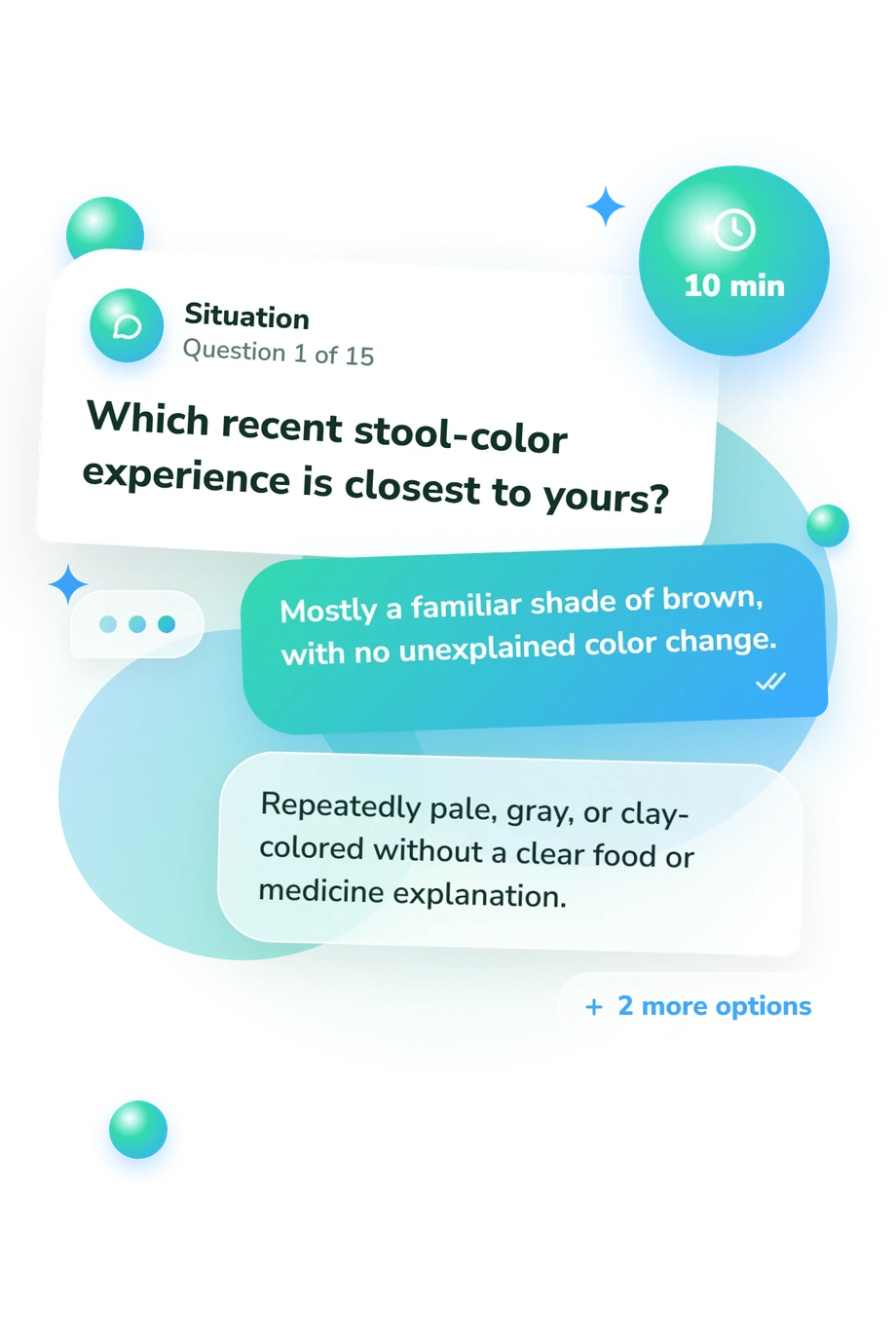
Example Questions From the Test
- Mostly a familiar shade of brown, with no unexplained color change.
- Repeatedly pale, gray, or clay-colored without a clear food or medicine explanation.
- Black and tarry, maroon, or visibly bloody without a known food explanation.
- A short-lived green or food-related color that disappeared when the food or supplement passed.
- None of the listed contexts applies, and the change has resolved.
- A recent routine, diet, or medication adjustment may explain a mild change, and I otherwise feel well.
- The change persists after starting a medicine or supplement, or I have a digestive condition that may need review.
- Severe watery diarrhea began during or after antibiotics, or symptoms are rapidly worsening while I am pregnant, immunocompromised, very frail, or recently hospitalized.
- A small amount of mucus on one isolated occasion.
- Nothing unusual that I can see.
- A substantial amount of blood, blood clots, or black tar-like material, even once.
- Repeated mucus or small blood streaks, including after straining.
Is My Poop Healthy Quiz - Description and methodology of the test
For people reviewing a recent change in bowel habits, an online tool called is my poop healthy quiz offers a structured way to decide which observations deserve attention. This bowel health quiz is intended for readers comparing stool appearance, timing, consistency, urgency, discomfort, and related physical symptoms with their usual pattern. That baseline comparison helps readers judge whether a variation is settling or continuing.
What the Test Measures
The assessment tracks departures from usual bowel patterns: colour, form, mucus or blood, consistency, timing, urgency, incomplete emptying, pain, hydration, appetite, energy, fever, nausea, and vomiting. It separates brief changes linked with food, travel, routine, or medicines from persistent or worsening experiences.
The three displayed scales organize the result:
- Accompanying Body Signals (0-15) measures related physical symptoms: Baseline response (0), Context to monitor (1-2), or Prompt assessment advised (3-15).
- Bowel Pattern and Passage (0-15) measures timing, consistency, urgency, control, straining, and passage: Baseline response (0), Pattern to watch (1-2), or Guidance recommended (3-15).
- Stool Appearance Changes (0-15) measures colour, form, mucus, blood, greasiness, and flushability: Baseline response (0), Worth noticing (1-2), or Medical review warranted (3-15).
Together, the three scales show which area contributes to the reader's stool health profile instead of collapsing responses into one label.
Methodology and Evidence Base
Each question in this bowel movement questionnaire offers four response choices covering usual or resolved experiences, ongoing changes, and urgent warning signs. Respondents compare observations with their norm; choices flag bleeding, dehydration, or neurological symptoms.
Selected responses produce three scale totals, but the questionnaire does not document how answers map to points. The bands are reflective summaries, not validated severity or diagnostic cutoffs; they cannot establish medical health. Any concerning endorsed experience matters independently of the total, and a single red-flag response overrides the total and should be acted on.
Stool-form items are conceptually consistent with the Bristol Stool Form Scale (Lewis and Heaton, 1997), which links form with intestinal transit. Pain, altered bowel habits, urgency, and symptoms overlap with the Rome IV questionnaire (Palsson et al., 2016). This version is neither a standardized administration nor a validated adaptation of those instruments. Its red-flag choices include bleeding, weakness, or fainting, symptoms for which NIDDK advises medical attention.
Because the questionnaire relies on self-report, honest answers matter; food, medicines, stress, illness, and context can influence them. Persistent experiences warrant medical advice.
- Lewis, S. J., and Heaton, K. W. “Stool Form Scale as a Useful Guide to Intestinal Transit Time.” Scandinavian Journal of Gastroenterology, 32(9), 1997, 920-924. 10.3109/00365529709011203
- Palsson, O. S., Whitehead, W. E., van Tilburg, M. A. L., et al. “Development and Validation of the Rome IV Diagnostic Questionnaire for Adults.” Gastroenterology, 150(6), 2016, 1481-1491. 10.1053/j.gastro.2016.02.014
- National Institute of Diabetes and Digestive and Kidney Diseases. “Symptoms & Causes of GI Bleeding.” National Institutes of Health, 2024.
Updated: