
Do Guys Find Me Attractive Quiz
How the Scales are Structured
Who Usually Takes This Test?
See How You Compare
Below is a preview of how scores are typically distributed across each scale.
Example Questions From the Test
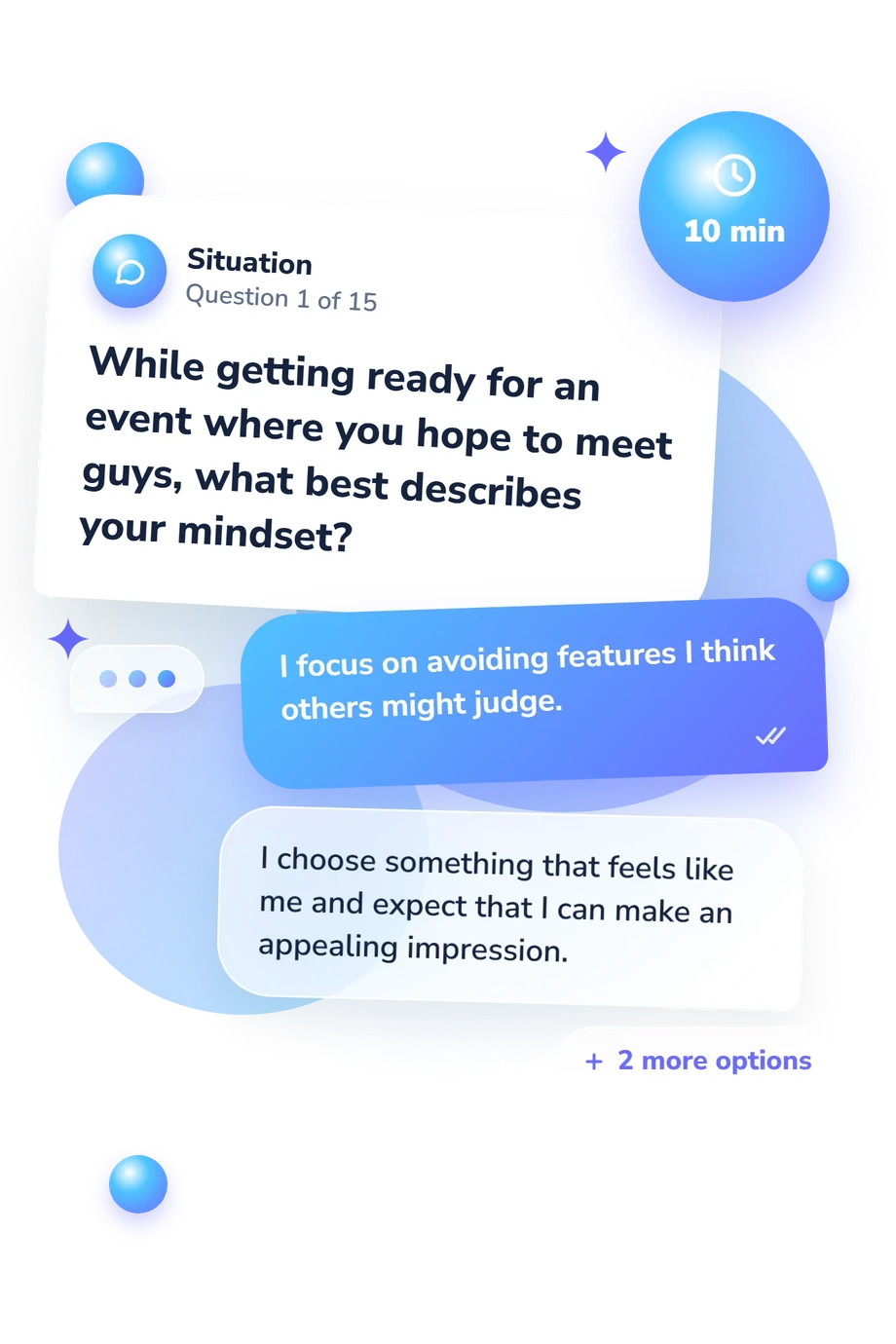
- I focus on avoiding features I think others might judge.
- I choose something that feels like me and expect that I can make an appealing impression.
- I feel good once I find the right look, though I may need reassurance first.
- I mainly rely on what has received positive reactions before.
- I feel disappointed, but I know one setting does not settle how attractive I am.
- I begin comparing our looks and wondering what I lack.
- I take it as evidence that I am less attractive.
- I can recognize my friend’s appeal without treating the moment as a ranking of my own.
- It feels comfortable, and either of us can restart the conversation naturally.
- I usually interpret it as a sign that the interaction has run its course.
- It feels a little awkward at first, but we often recover.
- I fill the silence quickly so the interaction keeps moving.
Do Guys Find Me Attractive Quiz - Description and methodology of the test
People who want a more nuanced view of their social appeal may use the do guys find me attractive quiz to reflect on confidence, visible interest, and mutual ease. This attractiveness quiz is intended for self-reflection when appearance beliefs and interpersonal signals feel difficult to separate. The result offers a structured profile of patterns to consider and discuss.
What This Assessment Explores
Readers exploring attraction can use this questionnaire to separate self-image from social signals and interpersonal ease. Items touch on comparison, compliments, rejection, eye contact, initiative, conversation, humor, and attention after an encounter.
Here are the three result dimensions:
- Attractiveness Self-Perception (0-15) reflects how steadily you recognize your appeal without needing universal approval: Self-doubt prominent (0-5), Confidence varies (6-10), or Grounded self-regard (11-15).
- Observed Interest Signals (0-15) reflects how often you notice outward signs without treating them as proof: Limited visible evidence (0-5), Mixed signals (6-10), or Repeated signals (11-15).
- Reciprocal Connection (0-15) reflects shared rhythm, comfort, and responsiveness, not appearance alone: Connection takes time (0-5), Situational chemistry (6-10), or Easy reciprocity (11-15); it may still be friendly.
A profile from the do guys find you attractive quiz suggests whether uncertainty centers on self-view, attention, or connection.
Methodology and Evidence Base
Each item presents a social situation with four response options; you select the description closest to your usual experience. The responses cover self-evaluation, visible interest, and reciprocal interaction rather than a yes-or-no judgment.
The questionnaire combines answers into three profiles and assigns each to its band. Because each option’s point value is not documented, the ranges should not be used to reverse-engineer scoring. Observable patterns keep the does he think im cute quiz question grounded: a result cannot establish another person’s private thoughts.
Muehlenhard et al. (1986) is the closest match for verbal and nonverbal interest cues considered here. This questionnaire is consistent with that work, not an adaptation. Hoffmann et al. (2024) supports reading shared eye contact as one context-dependent signal, while Edlund and Sagarin’s Mate Value Scale provides background on perceived desirability rather than the scoring method.
As an online self-reflection questionnaire, it is not presented as a standardized clinical measure. Mood, self-awareness, selective attention, and ambiguous behavior can shape responses, so interpret the profile as a prompt about your patterns and circumstances.
- Muehlenhard, Charlene L., Mary A. Koralewski, Sandra L. Andrews, and Cynthia A. Burdick. “Verbal and nonverbal cues that convey interest in dating: Two studies.” Behavior Therapy 17, no. 4 (1986): 404-419. 10.1016/S0005-7894(86)80071-5
- Hoffmann, Alexandra, Sabrina Schiestl, Philipp Sinske, Matthias Gondan, Pierre Sachse, and Thomas Maran. “Sharing and Receiving Eye-Contact Predicts Mate Choice After a 5-Minute Conversation: Evidence from a Speed-Dating Study.” Archives of Sexual Behavior 53, no. 3 (2024): 959-968. 10.1007/s10508-023-02806-0
- Edlund, John E., and Brad J. Sagarin. “The Mate Value Scale.” Personality and Individual Differences 64 (2014): 72-77. 10.1016/j.paid.2014.02.005
Updated: