
Cat Arteries Quiz
How the Scales are Structured
Who Usually Takes This Test?
See How You Compare
Below is a preview of how scores are typically distributed across each scale.
Example Questions From the Test
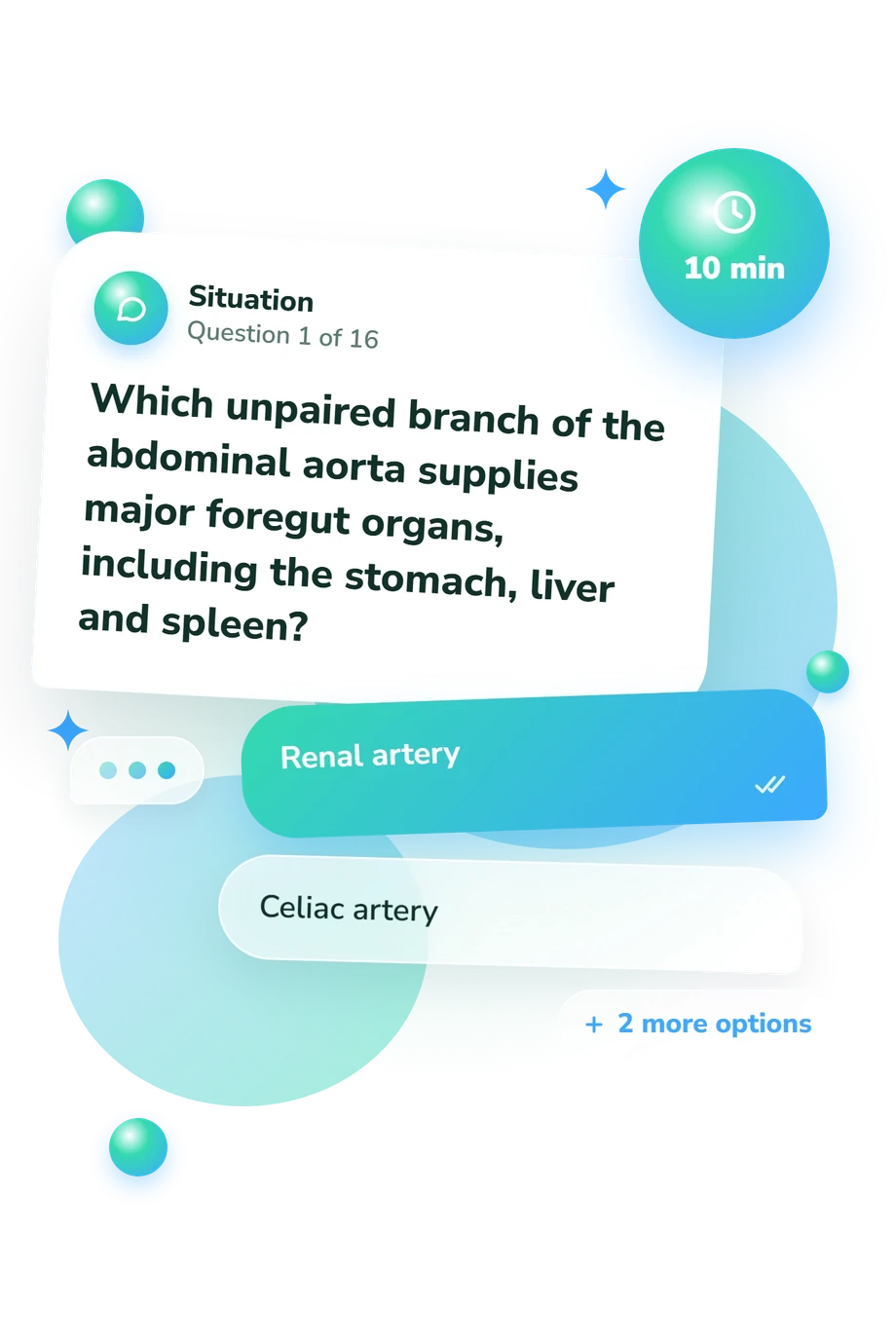
- Renal artery
- Celiac artery
- Caudal mesenteric artery
- External iliac artery
- Saphenous artery
- Cranial tibial artery
- Caudal femoral artery
- Popliteal artery
- Hepatic, splenic and left gastric arteries
- Cranial mesenteric, caudal mesenteric and colic arteries
- Internal iliac, external iliac and median sacral arteries
- Renal, adrenal and gonadal arteries
Cat Arteries Quiz - Description and methodology of the test
Students, veterinary technicians in training, and anatomy enthusiasts can use the Cat Arteries Quiz to check whether they can reason through feline arterial pathways rather than recall isolated names. The result highlights how securely the major vessels are connected in your knowledge and points toward topics worth revisiting. This feline arterial anatomy quiz suits structured study, practical review, or a quick self-check before dissection.
What This Assessment Explores
Feline arterial anatomy is tested through routes from the aortic arch toward the head, forelimbs, abdominal organs, hindlimbs, and paws. Items ask you to identify origins, branches, continuations, and downstream vessels in anatomy prompts or dissection or blood-flow situations. The result shows how well you connect vessel names with position and direction, rather than recall labels.
Learners can use this cat vessels quiz to build an integrated map of feline circulation.
Cat Arteries Knowledge runs from 0-16: Foundation 0-6, Developing 7-12, Strong 13-16. It is an educational anatomy result, not clinical competence.
Three content areas organize the questions:
- Aortic origins show whether you can follow the arch, brachiocephalic trunk, and carotid routes.
- Abdominal branches show whether you can match vessels with organs and regional territories.
- Limb and pulmonary pathways show whether you can track name changes and blood-flow direction.
Methodology and Scientific Basis
Each item presents a stem with four answer choices: identify a branch, select a continuation, or infer a downstream vessel. One point per correct answer makes the total an educational count of correct answers; bands describe performance on these anatomy questions.
The questionnaire’s routes and branch relationships are conceptually consistent with anatomy described by Sebastiani and Fishbeck (2005), the edition edited by Singh (2018), and variation studies by Jang et al. (2025) and More et al. (2016), but it is not a direct adaptation of any one source.
In this cat dissection blood vessels quiz, tracing an artery from a trunk to a regional continuation tests route knowledge. Other items distinguish systemic from pulmonary flow, connect branches with organs or limbs, and follow artery-name changes across regions. You may identify vessels arising directly from the aortic arch, where a vessel enters a limb, or which artery lies downstream from an injured route. These prompts emphasize route tracing over isolated memorization. Preparation, attention, and terminology familiarity can affect performance, so review missed routes in a lab text or with instructor feedback.
- Aurora M. Sebastiani and Dale W. Fishbeck. Mammalian Anatomy: The Cat. 2nd ed. Englewood, Colorado: Morton Publishing Company; 2005.
- Young-Jin Jang, Pill Soon Jeong, Hyun-Jin Tae, Byung-Yong Park, In-Shik Kim, and Dongchoon Ahn. Morphology of subclavian artery branching patterns in cats (Felis catus). Journal of Veterinary Science. 2025;26(3):e35. 10.4142/jvs.25014
- Sunil More, Alastair Watson, and Larry E. Stein. Bicarotid Trunk in the Domestic Cat. Anatomia, Histologia, Embryologia. 2016;45(5):350-356. 10.1111/ahe.12202
- Baljit Singh, editor. Dyce, Sack, and Wensing's Textbook of Veterinary Anatomy. 5th ed. St. Louis, Missouri: Saunders; 2018.
Updated: