
Candle Scent Quiz
How the Scales are Structured
Who Usually Takes This Test?
See How You Compare
Below is a preview of how scores are typically distributed across each scale.
Example Questions From the Test
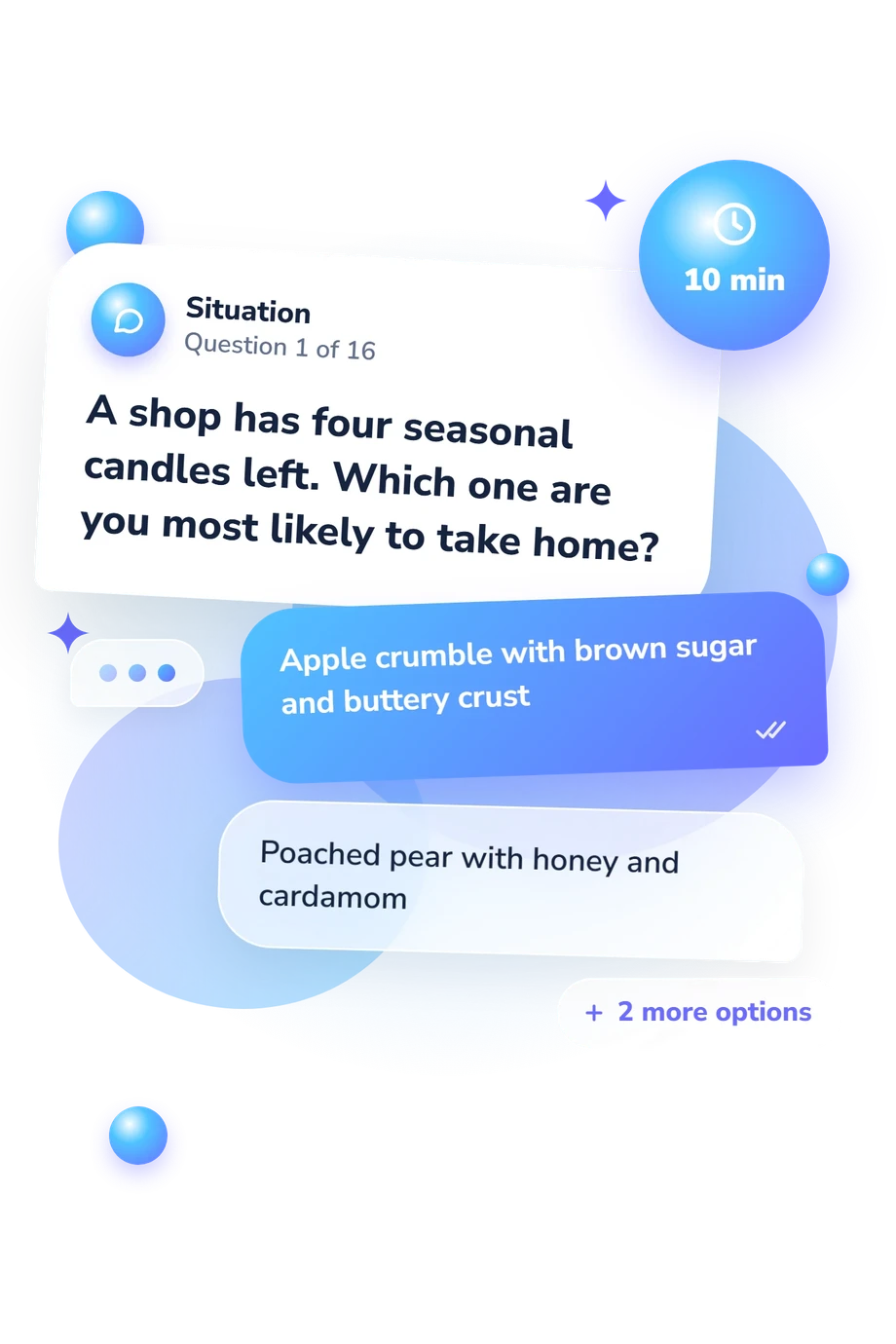
- Apple crumble with brown sugar and buttery crust
- Poached pear with honey and cardamom
- Orange peel with clove and a trace of vanilla
- Forest moss with pine needles and stone
- A lively garden blend of jasmine, freesia, and rose
- A calm blend of lavender and cotton blossom
- A light blend of neroli, bergamot, and green tea
- A grounded blend of cedar, smoke, and amber
- Sea salt, lime leaf, and bergamot
- Cucumber, mint, and white tea
- Fig, moss, and sandalwood
- Caramel, tonka bean, and cream
Candle Scent Quiz - Description and methodology of the test
People who enjoy choosing fragrances for rooms can use the candle scent quiz to identify the scent families that feel most natural to them. Rather than judging taste as right or wrong, it organizes everyday preferences into a readable profile, making this candle quiz useful for reflecting on mood, atmosphere, and the notes you may want to explore next.
What This Assessment Explores
Anyone curious about the fragrance direction they choose for a room, gift, ritual, or everyday atmosphere can use this candle fragrance quiz. It focuses on preference rather than expertise and separates four result dimensions:
- Floral Expression (0-12) measures affinity for petals, blossoms, and garden notes: Floral Accent (0-4), Curated Bouquet (5-8), Floral Match (9-12).
- Fresh Citrus Spark (0-12) measures bright, airy, green, and clean affinity: Subtle Spark (0-4), Selective Brightness (5-8), Fresh Citrus Match (9-12).
- Gourmand & Cozy Comfort (0-12) measures edible warmth from vanilla, caramel, cocoa, coffee, and spice: Hint of Sweetness (0-4), Selective Indulgence (5-8), Gourmand & Cozy Match (9-12).
- Woody & Earthy Grounding (0-12) measures woods, forest, herbs, resins, smoke, and mineral earthiness: Earthy Accent (0-4), Balanced Grounding (5-8), Woody & Earthy Match (9-12).
The highest result marks your strongest affinity; results within one point indicate a blended match.
Methodology and Evidence Base
Items use everyday scent scenarios: choosing a seasonal candle, matching notes to a room, comparing labels, and deciding how much sweetness, citrus, floral, smoky, or resinous character feels right. Selecting one option makes the method a relative-preference task rather than a knowledge test.
Responses are organized into four fragrance directions and compared as totals. The highest total marks the clearest match, while near-ties indicate a mixed profile; the displayed bands describe increasing affinity, not clinical cutoffs. The candle scent profile therefore summarizes taste and atmosphere without claiming that one fragrance family is better than another.
Conceptually, the questionnaire is consistent with Lenochová et al. (2012), which reports that fragrance choice varies across people and odor blends. Zarzo and Stanton (2009) support multidimensional odor perception, while Licon et al. (2018) identify pleasantness and trigeminal sensation as salient dimensions. The questionnaire is not an adaptation of those studies; they support its rationale, not its validation or standardization.
Because it is a self-report profile rather than a standardized diagnostic instrument, results may shift with mood, memory, surroundings, familiarity, and self-awareness; treat them as a reflective snapshot.
- Lenochová, P., Vohnoutová, P., Roberts, S. C., Oberzaucher, E., Grammer, K., & Havlíček, J. (2012). Psychology of Fragrance Use: Perception of Individual Odor and Perfume Blends Reveals a Mechanism for Idiosyncratic Effects on Fragrance Choice. PLOS ONE, 7(3), e33810. 10.1371/journal.pone.0033810
- Zarzo, M., & Stanton, D. T. (2009). Understanding the underlying dimensions in perfumers' odor perception space as a basis for developing meaningful odor maps. Attention, Perception, & Psychophysics, 71(2), 225-247. 10.3758/APP.71.2.225
- Licon, C. C., Manesse, C., Dantec, M., Fournel, A., & Bensafi, M. (2018). Pleasantness and trigeminal sensations as salient dimensions in organizing the semantic and physiological spaces of odors. Scientific Reports, 8, 8444. 10.1038/s41598-018-26510-5
Updated: