
Best Friend or Boyfriend Quiz
How the Scales are Structured
Who Usually Takes This Test?
See How You Compare
Below is a preview of how scores are typically distributed across each scale.
Example Questions From the Test
- I already know whether I would accept or decline
- I would answer, but first clarify what they mean by dating
- I would want a longer conversation before giving an answer
- I would ask for time because my own feelings are not settled
- Friendly gestures such as a quick hug or playful high-five
- Warm closeness that could still feel completely platonic
- Affection that gently tests whether there is mutual chemistry
- Clearly romantic affection, such as holding hands or kissing
- Very stable; I know which direction I want
- Mostly stable, with only occasional doubts
- They shift depending on our recent interactions
- They remain genuinely unsettled or difficult to name
Best Friend or Boyfriend Quiz - Description and methodology of the test
People weighing a close friendship against possible romance can use this best friend or boyfriend quiz to organize feelings that are difficult to name. It is intended for someone who wants structured reflection on attraction, companionship, uncertainty, and the direction a connection may be taking. Its result separates your current affinities from the concern behind does my boyfriend like my best friend quiz, keeping the focus on your perspective.
What This Assessment Explores
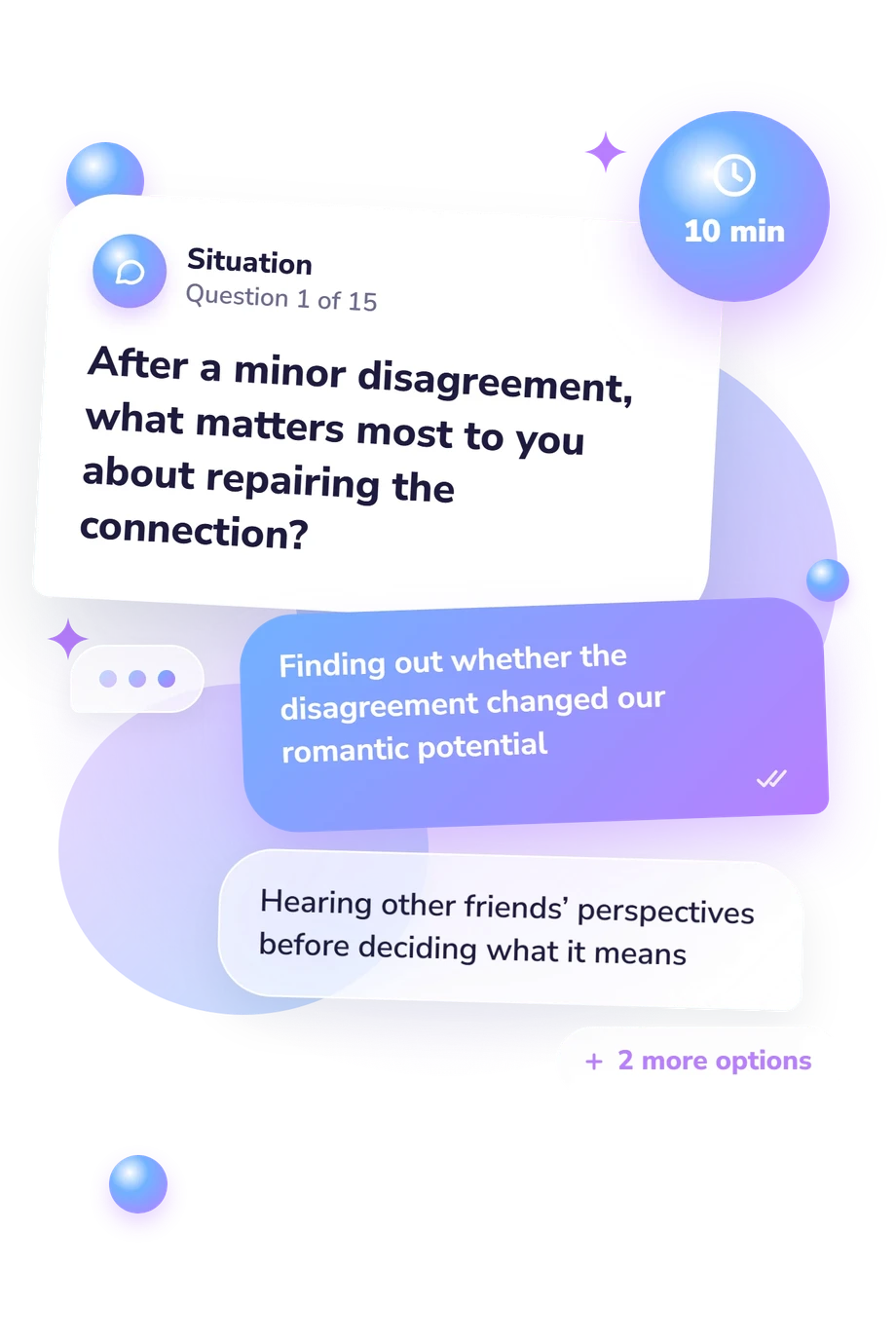
The questions use situations involving disagreement, affection, private time, future roles, disclosure, and changes in their dating life. They distinguish platonic attachment, romantic interest, and uncertainty about what the bond means. Because the result can hold friendship and romance together, this friend or boyfriend quiz suits someone who wants reflection without forcing one label.
The outcomes cover these dimensions:
- Best Friend Energy (0-15) measures platonic closeness: Different Direction (0-5), Meaningful Friendship (6-10), or Strong Best-Friend Energy (11-15).
- Romantic Partner Energy (0-15) measures dating interest: Mostly Nonromantic (0-5), Romantic Possibility (6-10), or Strong Boyfriend Energy (11-15).
- Take More Time (0-15) measures the need for clarity: Direction Feels Clear (0-5), Open Questions (6-10), or More Time Fits Best (11-15).
Methodology and Scientific Basis
Each item presents a relational situation with four response choices. Rather than placing every answer on a single platonic-to-romantic line, the choices cover friendship-oriented and romantic responses alongside mixed signals, context, timing, and certainty. Prompts address conflict repair, affection, future contact, disclosure, private time, and reactions to dating changes.
The result displays three scores, but each response's contribution is not specified. The highest displayed score marks the strongest current affinity; scores within one point may appear together as a blended result. This arrangement lets friendship affinity and romantic interest coexist while keeping a need for clarity visible.
Conceptually, this questionnaire is consistent with Reeder (2000), which distinguishes attraction from cross-sex friendship, alongside Stinson, Cameron, and Hoplock (2022) on the friends-to-lovers pathway. Mendelson and Aboud’s McGill Friendship Questionnaires support attention to friendship quality, while Rubin (1970) frames romantic love. These sources provide conceptual context for related constructs; they do not document validation or norms for this questionnaire.
The result offers a relationship clarity quiz through self-report. Current mood, limited context, and self-awareness may influence answers, especially as the relationship changes.
- Reeder, Heidi M. (2000). 'I Like You... as a Friend': The Role of Attraction in Cross-Sex Friendship. Journal of Social and Personal Relationships, 17(3), 329-348. 10.1177/0265407500173002
- Stinson, Danu Anthony, Cameron, Jessica J., and Hoplock, Lisa B. (2022). The Friends-to-Lovers Pathway to Romance: Prevalent, Preferred, and Overlooked by Science. Social Psychological and Personality Science, 13(2), 562-571. 10.1177/19485506211026992
- Mendelson, Morton J., and Aboud, Frances E. (1999). Measuring Friendship Quality in Late Adolescents and Young Adults: McGill Friendship Questionnaires. Canadian Journal of Behavioural Science, 31(2), 130-132. 10.1037/h0087080
- Rubin, Zick (1970). Measurement of Romantic Love. Journal of Personality and Social Psychology, 16(2), 265-273. 10.1037/h0029841
Updated: