
Am I Allergic to My Dog Quiz
How the Scales are Structured
Who Usually Takes This Test?
See How You Compare
Below is a preview of how scores are typically distributed across each scale.
Example Questions From the Test
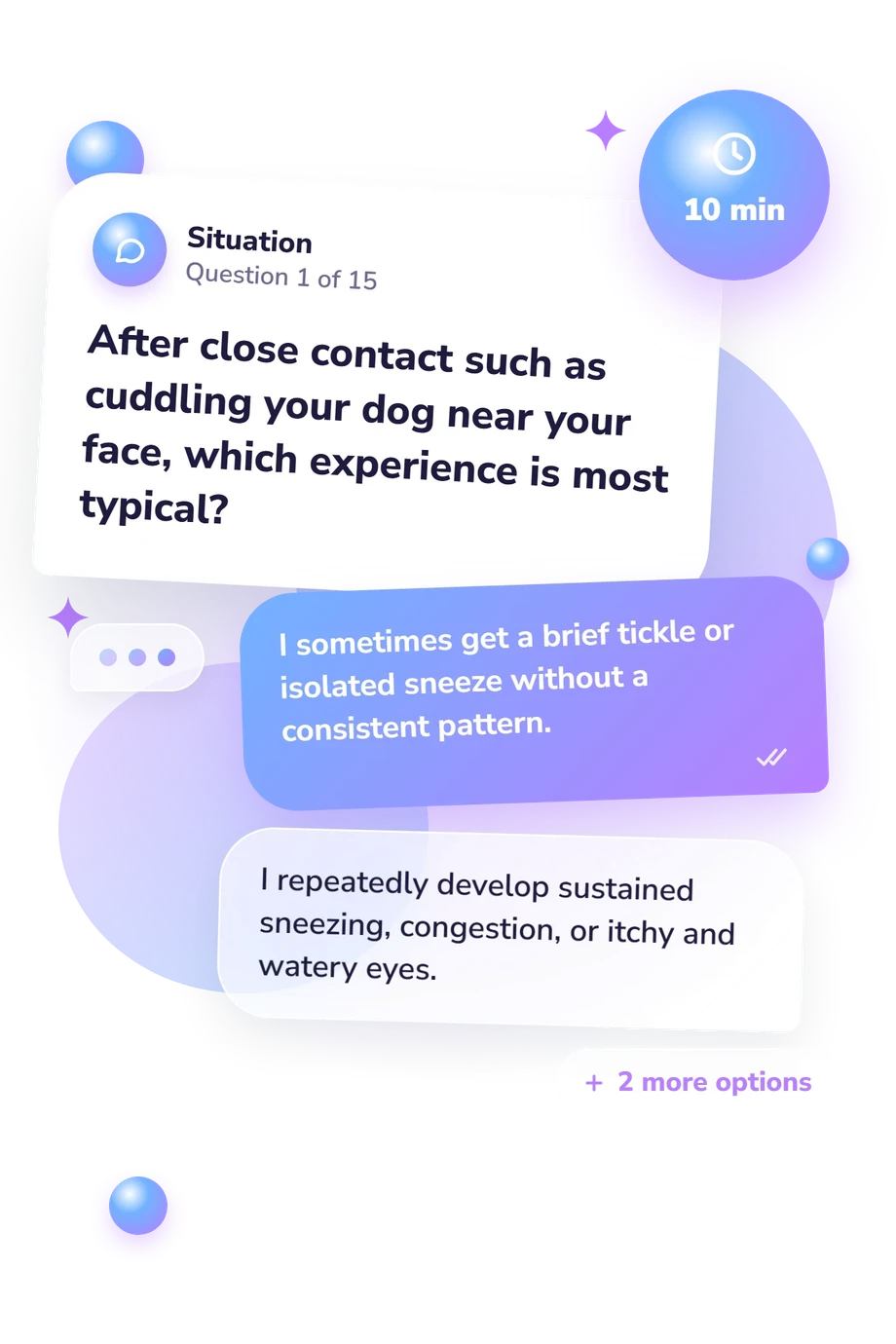
- I sometimes get a brief tickle or isolated sneeze without a consistent pattern.
- I repeatedly develop sustained sneezing, congestion, or itchy and watery eyes.
- I have no noticeable eye or nose response.
- I rapidly develop intense symptoms that force me to stop contact or leave the area.
- I develop raised welts, marked swelling, or a rapidly spreading reaction.
- My skin sometimes feels mildly itchy, but no clear mark develops.
- There is no noticeable skin reaction.
- A repeatable itchy, red patch or small hives appear where the saliva touched.
- There is no reaction to track in the first place.
- Any mild sensation changes unpredictably, so the trigger remains unclear.
- The reaction repeatedly settles after washing and avoiding contact, then returns with exposure.
- The reaction has continued spreading or worsening despite ending contact.
Am I Allergic to My Dog Quiz - Description and methodology of the test
People who notice possible dog allergy symptoms need a way to organize what happens during contact, afterward, and in dog-used spaces. This questionnaire offers a structured self-reflection route for separating recurring patterns from isolated or uncertain sensations. The Am I Allergic to My Dog Quiz highlights which response pattern, if any, most closely matches the experiences described.
What This Assessment Explores
For readers asking whether they may be allergic to dogs, it compares reactions after direct contact with symptoms in dog-used spaces. It suits people noticing possible patterns but not yet knowing whether symptoms are consistent. The three result dimensions are:
- Breathing and Whole-Body Warning Signs (0-15) measures endorsed breathing changes or multi-system reactions: No indicator endorsed (0), Isolated clue (1-2), or Prompt action indicated (3-15).
- Nose and Eye Exposure Pattern (0-15) measures recurring sneezing, congestion, itching, or watering: No indicator endorsed (0), Isolated clue (1-2), or Pattern to assess (3-15).
- Skin and Contact Pattern (0-15) measures exposure-linked itching, hives, swelling, or rashes: No indicator (0), Isolated clue (1-2), or Pattern to assess (3-15).
Together, the scores show which pattern deserves attention and what observations may be useful to discuss.
Methodology and Scientific Basis
Each item offers four choices, from no noticeable reaction through mild or inconsistent experiences to recurring patterns and red-flag reactions. Items address cuddling, saliva, brushing, bedding, rooms, activity, and combined symptoms, keeping timing, setting, and recovery central to interpretation.
Scores are summarized separately for the three domains; because the questionnaire does not specify how many points each answer adds, the bands should be read as summaries rather than a reconstructed formula. They are unvalidated reflective summaries, not severity or diagnostic cutoffs, and a concerning response matters independently of the total.
Conceptually, it is consistent with a Korean pet-exhibition study examining dog-exposure symptoms alongside allergen-specific IgE. Research on dog saliva allergens supports attention to saliva as an allergen source, while a dog-and-cat allergy consensus adds clinical context for dog- and cat-allergy presentations. This dog allergy test is not an adaptation of those studies or a standardized clinical scale. Self-report is sensitive to memory, context, alternative triggers, and self-awareness; severe breathing difficulty, throat or tongue swelling, faintness, confusion, blue or gray lips, or rapid worsening requires emergency action.
- Kang SY, Yang MS, Park SY, Kim JH, Won HK, Kwon OY, Lee JH, Kang YW, Jung JW, Song WJ, Kim SH, Lee SM, Lee SP. The role of allergen-specific IgE in predicting allergic symptoms on dog and cat exposure among Korean pet exhibition participants. World Allergy Organization Journal. 2020;13(12):100488. 10.1016/j.waojou.2020.100488
- Polovic N, Wadén K, Binnmyr J, Hamsten C, Grönneberg R, Palmberg C, Milcic-Matic N, Bergman T, Grönlund H, van Hage M. Dog saliva - an important source of dog allergens. Allergy. 2013;68(5):585-592. 10.1111/all.12130
- Dávila I, Domínguez-Ortega J, Navarro-Pulido A, Alonso A, Antolín-Amerigo D, González-Mancebo E, Martín-García C, Núñez-Acevedo B, Prior N, Reche M, Rosado A, Ruiz-Hornillos J, Sánchez MC, Torrecillas M. Consensus document on dog and cat allergy. Allergy. 2018;73(6):1206-1222. 10.1111/all.13391
Updated: