
Women Quiz
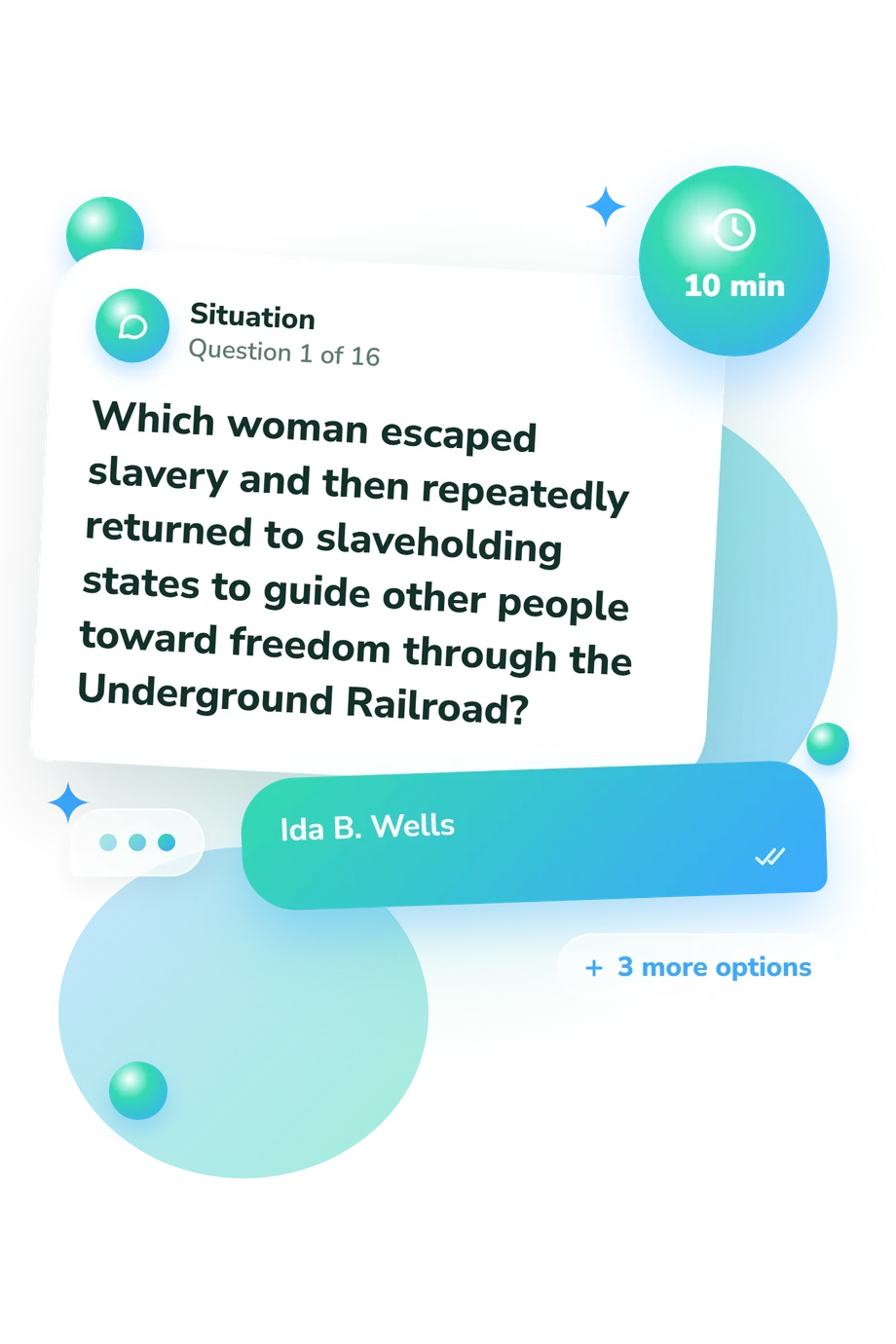
How the Scales are Structured
Who Usually Takes This Test?
See How You Compare
Below is a preview of how scores are typically distributed across each scale.
Example Questions From the Test
- Unsafe workplaces and inadequate fire protections
- Restrictions on women attending universities
- The absence of women from military nursing
- Unequal access to agricultural land grants
- Equal inheritance rights for agricultural land
- Access to education, especially for girls
- Paid parental leave for factory workers
- Representation of women in international sports
- Olympe de Gouges
- Madame de Staël
- George Sand
- Simone de Beauvoir
Women Quiz - Description and methodology of the test
Designed for readers who want to check their grasp of women’s history, the Women Quiz turns familiar names, landmark texts, legal changes, and social movements into a focused self-assessment. The female quiz questions suit learners, teachers, and curious adults who want to identify secure knowledge and topics that deserve more study. The result gives a compact snapshot of historical knowledge without claiming to represent the whole field.
What This Assessment Explores
Rather than concentrating on one country or period, the questionnaire samples people, documents, reforms, movements, scientific achievements, and historical connections across centuries. The women’s quiz questions ask you to place facts in context instead of recalling isolated names.
The thematic groups show what the result touches:
- Figures and achievements measure recognition of women’s contributions in science, activism, leadership, and culture.
- Rights and participation reflect knowledge of voting, education, equality claims, and international protections.
- Laws and institutions connect formal rules with workplaces, schools, treaties, and civic life.
- Ideas and movements test links among declarations, books, campaigns, and social change.
The Women’s History Knowledge scale runs from 0-16: Foundation to build (0-6), Developing knowledge (7-12), or Strong knowledge (13-16). This quiz total reflects the represented material, not intelligence or the whole history of women.
Methodology and Evidence Base
Each item presents four answer options and asks for the best match among people, texts, laws, events, or historical relationships. The displayed result condenses performance into one quiz total; interpretation should stay within the supplied bands.
The closest published reference is the WH scale described by Ortega-Sánchez and Heras Sevilla. This online self-reflection quiz is conceptually consistent with that work, not an adaptation or standardized administration of it. Their later study examines reliability and predictors of women’s-history knowledge, while Crocco’s work presents the subject as a connected field rather than a catalogue of exceptional individuals. This women's history quiz applies that breadth as a short knowledge check.
Multiple-choice results have limits. Reich’s research indicates that scores can reflect item wording, recognition, guessing, and test-taking strategies alongside historical understanding. Prior education and cultural exposure affect familiarity with names and events, and one total cannot represent every period, region, or form of reasoning. Use the result to choose learning priorities, alongside deeper reading or discussion.
- Ortega-Sánchez, Delfín, and Davinia Heras Sevilla. "Design and Initial Validation of the Scales Epistemology, Methodology and Gender in Taught History (EMG), and Women in History (WH) for the Evaluation of Gender Competence of Social Science Teachers in Training." Universal Journal of Educational Research, 8(5), 1831-1841, 2020. 10.13189/ujer.2020.080519
- Ortega-Sánchez, Delfín, and Davinia Heras Sevilla. "Predictors of Knowledge about Women's History: Reliability and Results of the Women in History (WH) Scale for Future Spanish Teachers." Journal of Social Studies Education Research, 14(4), 1-23, 2023.
- Crocco, Margaret Smith. "Teaching About Women in World History." The Social Studies, 102(1), 18-24, 2011. 10.1080/00377996.2011.532731
- Reich, Gabriel A. "Imperfect Models, Imperfect Conclusions: An Exploratory Study of Multiple-Choice Tests and Historical Knowledge." Journal of Social Studies Research, 37(1), 3-16, 2013. 10.1016/j.jssr.2012.12.004
Updated: