
Political Science Quiz
How the Scales are Structured
Who Usually Takes This Test?
See How You Compare
Below is a preview of how scores are typically distributed across each scale.
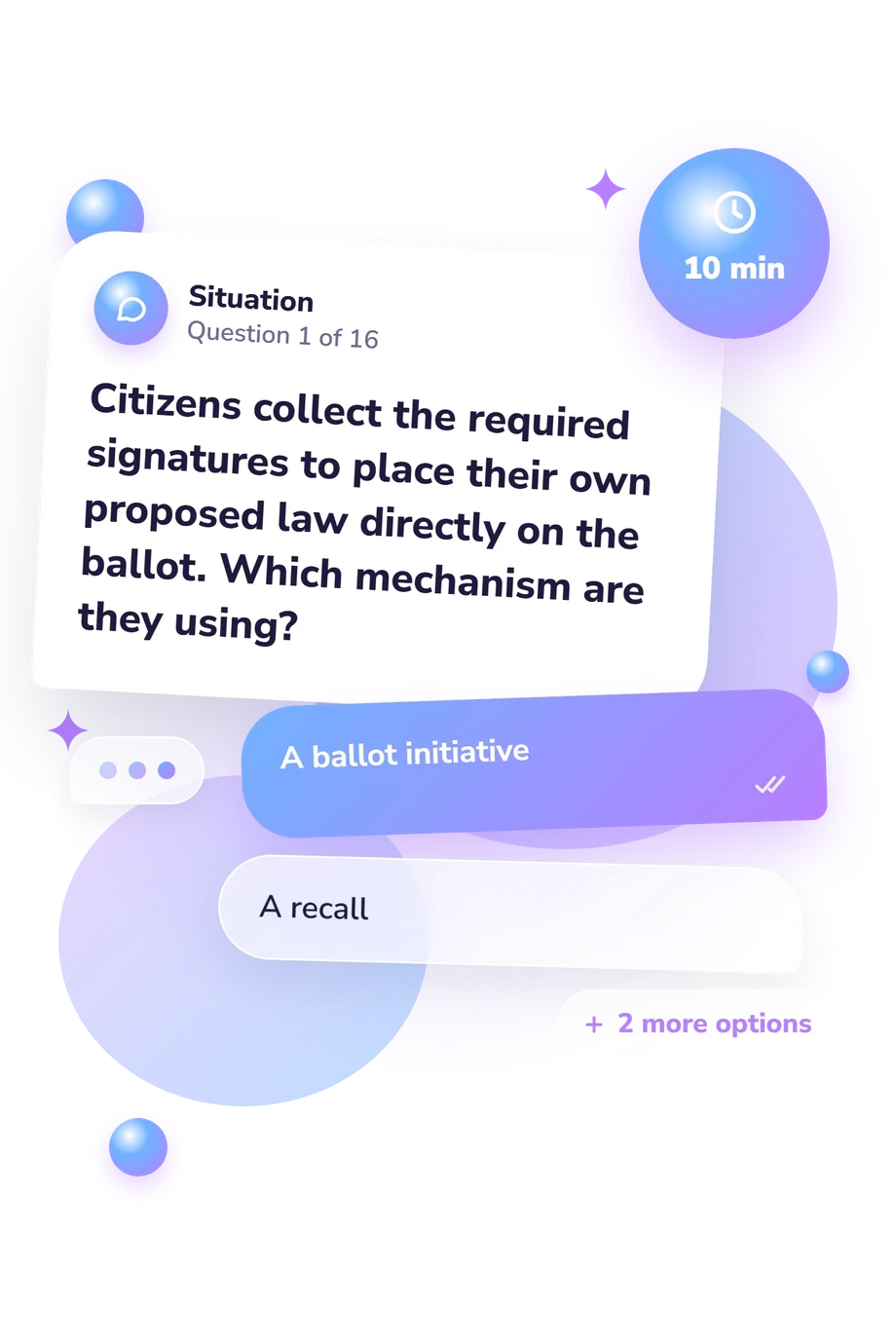
Example Questions From the Test
- A ballot initiative
- A recall
- A legislative filibuster
- A vote of no confidence
- Judicial review
- Executive privilege
- Legislative oversight
- Administrative discretion
- It is supplied only by private businesses
- It is non-excludable and non-rival in consumption
- One person's use substantially reduces what remains for others
- Its benefits are limited to taxpayers
Political Science Quiz - Description and methodology of the test
Readers who want to check their grasp of government concepts can use this political science quiz as a focused knowledge screen rather than a measure of political identity. It suits learners, curious citizens, and anyone revising core civics ideas. Its questions in this quiz on political science cover institutions, rights, elections, authority, and collective action, showing which concepts feel secure and which deserve further study.
What This Assessment Explores
Short situations and definitions make this a political science test of how well you can connect familiar terms with institutional examples. It examines whether you can recognize how governments distribute authority, protect rights, organize elections, and respond to collective-action problems. The result reflects performance across these knowledge domains, not a personal ideology or partisan preference.
The main thematic groups are:
- Institutions and constitutional powers show how authority is divided, checked, and exercised.
- Rights and political authority distinguish liberties, equal treatment, legitimacy, sovereignty, and the rule of law.
- Elections and representation show how voting systems and district design shape outcomes.
- Collective action and policy change explain why people may withhold contributions and why added veto points can slow reform.
Together, these areas give the reader a compact profile of conceptual recognition across core political science and civics topics.
Methodology and Scientific Basis
Each item presents a situation or definition with four alternatives, and you select the best answer. The result aggregates performance into one knowledge scale rather than measuring political attitudes.
The closest evidence is Delli Carpini and Keeter (1993), who describe political knowledge through recall and recognition of information about institutions, processes, and public affairs. Their 1996 book links knowledge with participation and judgment. This questionnaire is conceptually consistent with that work, not an adaptation or validation of it. Downs (1957) supports the median-voter concept, while Tsebelis (2002) supplies the veto-player framework for policy obstacles to change.
Answers selected for this quiz on political science feed the Political Science Knowledge scale, scored from 0-16. Its bands are Foundations to Build (0-6), Developing Knowledge (7-12), and Strong Knowledge (13-16); they describe performance on this set of concepts, not a universal rank.
Because this online version has no stated published norms, results may shift with prior coursework, wording, guessing, attention, and context, so the score is best read as a focused snapshot of knowledge rather than a complete measure of political understanding.
- Delli Carpini, Michael X., and Scott Keeter. “Measuring Political Knowledge: Putting First Things First.” American Journal of Political Science 37, no. 4 (1993): 1179-1206. 10.2307/2111549.
- Delli Carpini, Michael X., and Scott Keeter. What Americans Know about Politics and Why It Matters. Yale University Press, 1996. ISBN 0-300-06256-7.
- Tsebelis, George. Veto Players: How Political Institutions Work. Princeton University Press, 2002. ISBN 0-691-09989-8.
- Downs, Anthony. An Economic Theory of Democracy. Harper & Row, 1957. ISBN 0-06-041750-1.
Updated: