
Which Sex and the City Character Are You Quiz
How the Scales are Structured
Who Usually Takes This Test?
See How You Compare
Below is a preview of how scores are typically distributed across each scale.
Example Questions From the Test
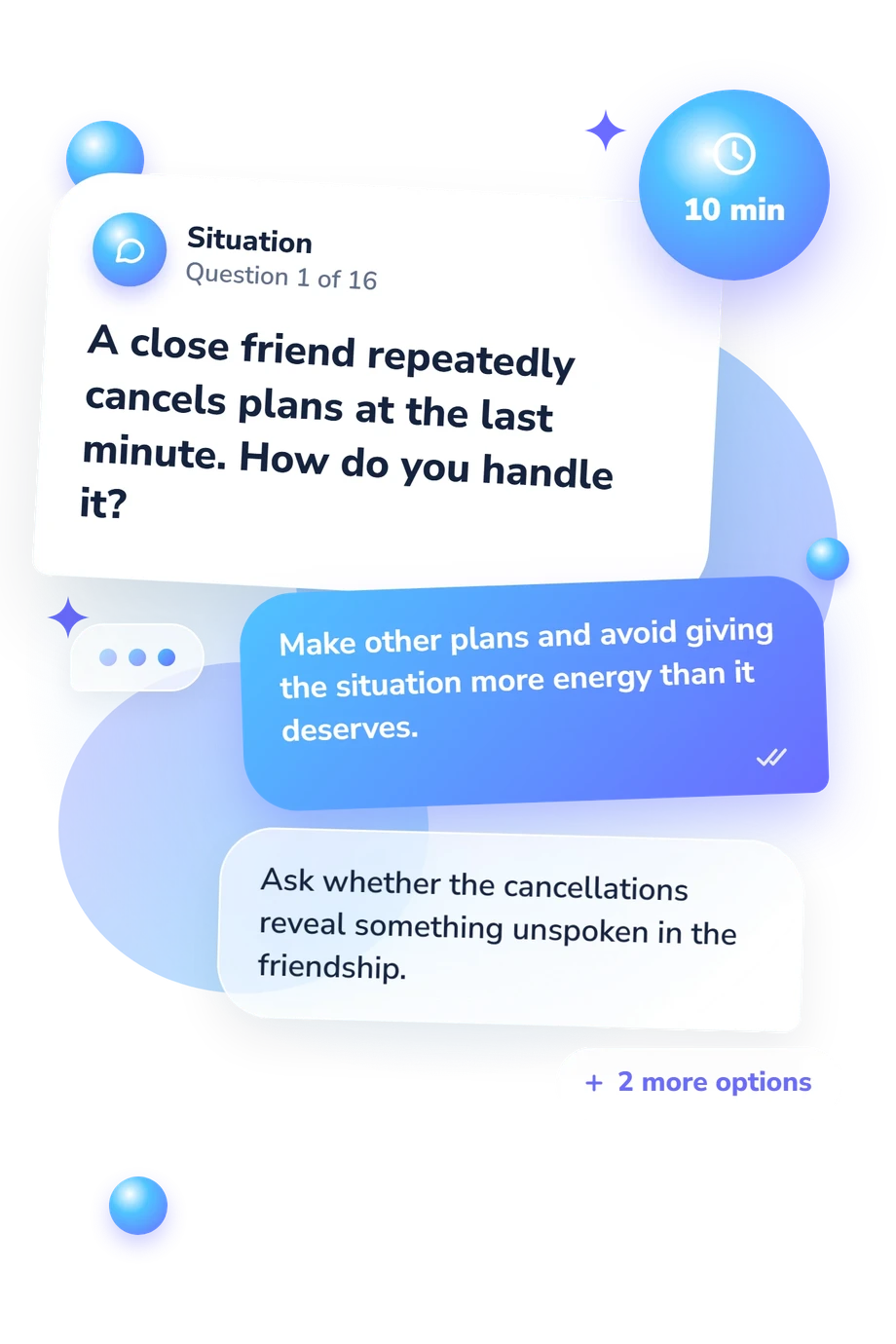
- Make other plans and avoid giving the situation more energy than it deserves.
- Ask whether the cancellations reveal something unspoken in the friendship.
- Explain directly that the pattern is frustrating and ask for a practical change.
- Give them another chance because maintaining the bond matters to me.
- Respond directly if I am interested and enjoy the chemistry without overcomplicating it.
- Enjoy the banter while paying attention to every subtle signal and possible meaning.
- Shift toward a substantive conversation to see whether we think well together.
- Prefer a more formal introduction before deciding whether to engage.
- Chemistry that keeps revealing new emotional layers.
- A clear shared commitment and compatible vision of home and family.
- Intellectual equality and the ability to solve problems directly.
- Honesty that leaves both partners room to remain fully independent.
Which Sex and the City Character Are You Quiz - Description and methodology of the test
Fans who want a playful way to connect their own instincts with the social world of the series can use the Which Sex and the City Character Are You Quiz as a comparative character exercise. This test connects choices about relationships, style, ambition, commitment, and independence with four fictional profiles, helping answer which Sex and the City character best matches each pattern and whether the result is blended.
What This Assessment Explores
Cancelled plans, uncertain dates, work disruptions, home choices, and friendship debates let this character affinity quiz compare responses with four profiles, bringing out contrasts between narrative curiosity, commitment, pragmatism, autonomy, social confidence, and emotional interpretation. The result identifies your strongest character affinity, while scores within one point produce a blended profile.
The four profiles are:
- Carrie Bradshaw (0-12) reflects narrative curiosity, expressive style, and relationship fascination: Different wavelength (0-4), Shared notes (5-8), Strong affinity (9-12).
- Charlotte York (0-12) reflects warmth, romantic optimism, polished sensibility, and enduring commitment: Different wavelength (0-4), Shared notes (5-8), Strong affinity (9-12).
- Miranda Hobbes (0-12) reflects analysis, ambition, directness, independence, and practical competence: Different wavelength (0-4), Shared notes (5-8), Strong affinity (9-12).
- Samantha Jones (0-12) reflects bold autonomy, candor, social fearlessness, and pleasure-positive confidence: Different wavelength (0-4), Shared notes (5-8), Strong affinity (9-12).
Methodology and Evidence Base
Each item presents a situation with four response options covering romance, friendship, work, appearance, home, or conflict. Choosing the most natural reaction creates a comparative self-report profile: the output shows relative affinities across the four characters.
The highest score is the strongest affinity, and scores within one point form a blended result. The questionnaire is an online character comparison with four character-affinity scores; its scoring is separate from Macey (2008), which identifies recurring archetypal patterns in the series. Adriaens and Van Bauwel (2014) and Doudaki (2012) add context on gender, identity, and postfeminist tensions; Bushnell (1996) provides the original fictional world.
These cultural sources do not validate the items or scoring; the questionnaire remains a separate online design with four character-affinity scores. Its displayed bands are descriptive affinity labels tied to the score ranges, while responses may vary with current mood, selective self-presentation, and self-awareness; read the result as a prompt for noticing preferences rather than a measure of broader personality.
- Macey, Deborah Ann. (2008). Ancient Archetypes in Modern Media: A Comparative Analysis of Golden Girls, Living Single, and Sex and the City. Doctoral dissertation, University of Oregon.
- Adriaens, Fien, & Van Bauwel, Sofie. (2014). Sex and the City: A Postfeminist Point of View? Or How Popular Culture Functions as a Channel for Feminist Discourse. The Journal of Popular Culture, 47(1), 174-195. 10.1111/j.1540-5931.2011.00869.x
- Bushnell, Candace. (1996). Sex and the City. New York: Atlantic Monthly Press.
- Doudaki, Vaia. (2012). Sex and the City: In the ambivalent playground of postmodern identity. The Journal of International Communication, 18(1), 5-17. 10.1080/13216597.2012.670126
Updated: