
Mechanical Engineering Quiz
How the Scales are Structured
Who Usually Takes This Test?
See How You Compare
Below is a preview of how scores are typically distributed across each scale.
Example Questions From the Test
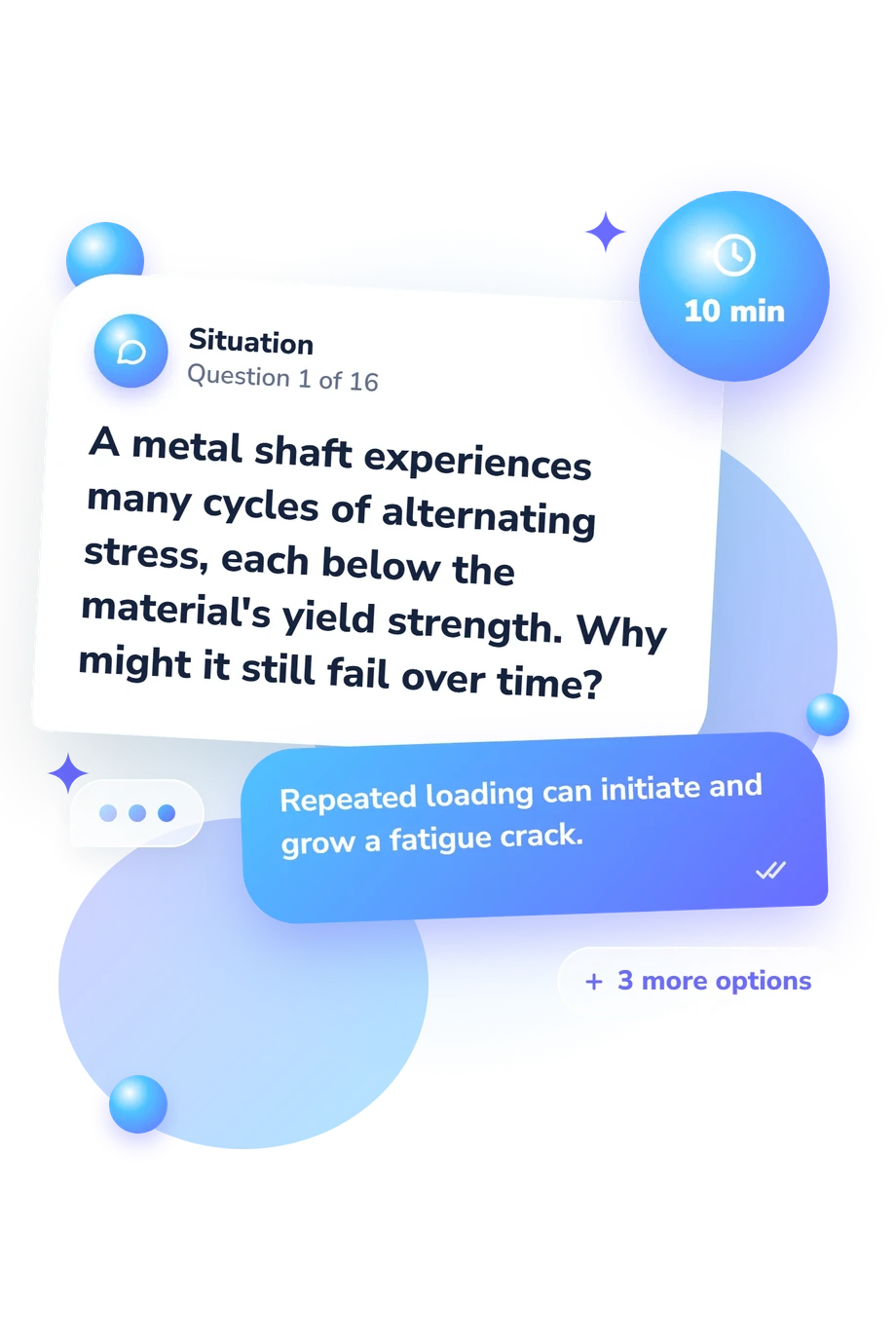
- Repeated loading can initiate and grow a fatigue crack.
- Elastic loading instantly removes the material's tensile strength.
- Yield strength applies only when a component is not moving.
- Any stress below yield permanently increases the shaft's diameter.
- Compressor work input divided by heat rejected
- Heat rejected divided by heat removed from the cooled space
- Heat removed from the cooled space divided by work input
- Heat removed from the cooled space divided by heat rejected
- It is uniform along the entire beam.
- At both supports
- At the quarter-span points only
- At the center of the span
Mechanical Engineering Quiz - Description and methodology of the test
Designed for learners, students, and practitioners, this mechanical engineering quiz checks how well you connect core principles with practical situations. It suits anyone reviewing classroom fundamentals, refreshing workplace knowledge, or testing reasoning before deeper study. The questions and answers in this quiz about mechanical engineering emphasize selecting the governing principle rather than recalling isolated definitions. The result points to topics that may deserve further review.
What This Assessment Measures
The questionnaire samples broad conceptual knowledge rather than one narrow specialty. Its situations connect mechanics, materials, thermal systems, fluid flow, equipment, controls, and building services, so it suits readers checking how principles transfer to practical engineering problems.
Used as a mechanical engineering online quiz, it reports Mechanical Engineering Knowledge on a 0-16 scale: Foundation gaps (0-6), Developing knowledge (7-12), and Strong knowledge (13-16). The result reflects performance on these concepts, not design certification.
The question themes cover four connected areas:
- Mechanics and strength show how you apply equilibrium, fatigue, resonance, bending, and stress concentration.
- Thermal systems show how you reason about expansion, condensation, heat exchangers, and equipment performance.
- Fluid flow and machines show how velocity, resistance, pumps, fans, and operating points interact.
- Building services show how HVAC control, insulation, fire dampers, and related safeguards work.
Methodology and Evidence Base
This is a knowledge-based multiple-choice questionnaire. Each item presents a short engineering situation followed by four answer choices, and the respondent selects the option that best resolves it. The displayed total summarizes performance across the sampled items; no separate weighting or item-level scoring rule is stated for the questionnaire. As a mechanical engineering test, it works as a compact snapshot of conceptual performance.
Bird and Ross (2020) provide the closest broad framework for mechanics, materials, fluids, and thermal principles represented here. The questionnaire is conceptually consistent with that work, but it is not presented as an adaptation of the book. ASHRAE (2021) supports psychrometrics, HVAC operation, condensation, and building-system practice, while Budynas and Nisbett (2020) support stress, fatigue, equilibrium, and design reasoning.
Interpret the band as an educational indication of current conceptual coverage and review priorities. The questionnaire is not a standardized instrument with population norms, reported reliability coefficients, or a validation sample. Performance can vary with recent study, wording interpretation, and test-taking context, so the result should guide review rather than stand for complete engineering competence.
- Bird, John, and Carl Ross. Mechanical Engineering Principles. 4th ed. Routledge, 2020. 10.1201/9780429287206
- ASHRAE. 2021 ASHRAE Handbook-Fundamentals. ASHRAE, 2021.
- Budynas, Richard G., and J. Keith Nisbett. Shigley’s Mechanical Engineering Design. 11th ed. McGraw-Hill Education, 2020.
Updated: