
Spanish Time Quiz
How the Scales are Structured
Who Usually Takes This Test?
See How You Compare
Below is a preview of how scores are typically distributed across each scale.
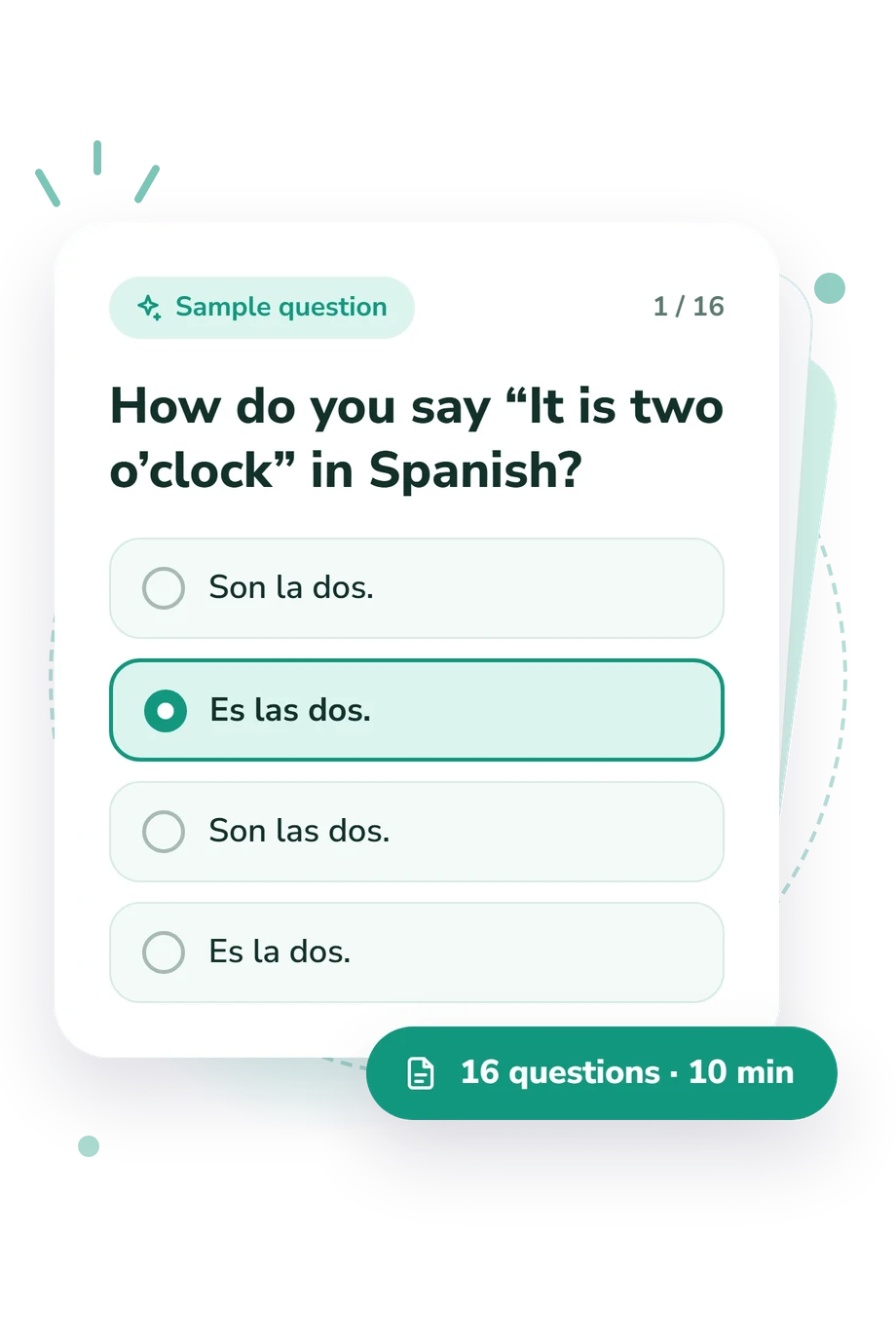
Example Questions From the Test
- Son la dos.
- Es las dos.
- Son las dos.
- Es la dos.
- Son las nueve menos diez.
- Son las diez menos diez.
- Son las once menos diez.
- Son las diez y diez.
- 1:05
- 12:05
- 1:55
- 12:55
Spanish Time Quiz - Description and methodology of the test
People learning Spanish often understand numbers before they can use them naturally in conversation. This quiz about telling time in Spanish suits learners preparing for travel, study, or everyday interactions who want to identify useful next steps. The Spanish Time Quiz offers a focused result for deciding what to review without measuring overall Spanish ability.
What This Assessment Explores
The questionnaire examines practical command of telling and interpreting time in Spanish, not broad vocabulary or general grammar. It suits learners checking comprehension: reading digital times, asking when something starts, describing duration, and choosing expressions for different parts of the day.
Four connected areas are covered:
- Hour forms show whether singular and plural expressions are used correctly, especially with one o’clock.
- Minute expressions show how well you handle y cuarto, y media, and menos constructions.
- Day-period vocabulary shows whether morning, evening, noon, and midnight phrases clarify the intended time.
- Schedules and duration show how clock language works in classes, reservations, meetings, and travel plans.
The result from this quiz gives a practical profile of Spanish clock expressions: stronger performance suggests reliable interpretation, while a lower band points to patterns worth reviewing rather than defining your overall Spanish ability.
Methodology and Evidence Base
Each item offers four answer choices and tests recognition plus application. The items provide Spanish telling-time practice by asking you to select the form that fits hour agreement, clock conventions, context, and intended meaning across familiar situations; distractors reflect common errors involving a nearby time, grammar, or day period.
The questionnaire is conceptually consistent with Arnaiz and Wilkie (2006), whose discussion supports hour agreement and ordinary time expressions. Kattán-Ibarra and Pountain support distinctions among y, menos, cuarto, media, and parts of the day. These sources provide linguistic context for the items, not a proficiency level or norm for this result.
The online scoring converts selected responses into a total on the Spanish Time Knowledge scale from 0-16. Results fall into Foundations (0-6), Developing accuracy (7-12), or Strong command (13-16). These bands describe consistency with the tested conventions: stronger bands indicate more reliable control of the target forms.
As a self-report questionnaire, the result can be affected by attention, recent study, and familiarity with particular wording. Use the bands to guide practice with the conventions covered here, not as a standardized proficiency judgment.
- Arnaiz, Carmen, and Irene Wilkie. Basic Spanish: A Grammar and Workbook. 1st ed. Routledge, 2006. 10.4324/9780203001608.
- Kattán-Ibarra, Juan, and Christopher J. Pountain. Modern Spanish Grammar: A Practical Guide. 2nd ed. Routledge, 2004. 10.4324/9780203428313.
- American Council on the Teaching of Foreign Languages. ACTFL Proficiency Guidelines 2024. ACTFL, 2024.
Updated: