
Gerund and Infinitive Quiz
How the Scales are Structured
Who Usually Takes This Test?
See How You Compare
Below is a preview of how scores are typically distributed across each scale.
Example Questions From the Test
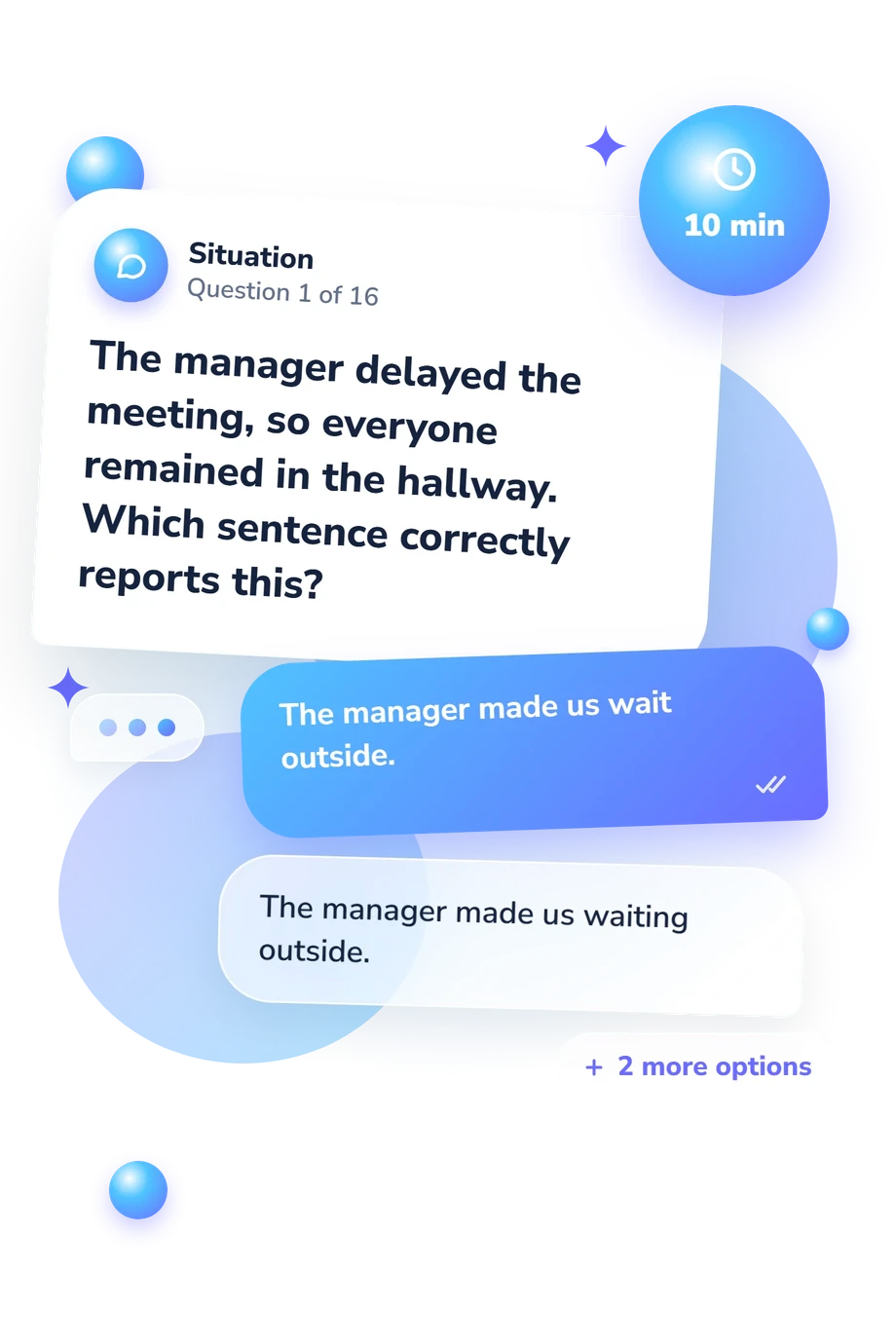
- The manager made us wait outside.
- The manager made us waiting outside.
- The manager made us to waiting outside.
- The manager made us to wait outside.
- The printer needs to repairing.
- The printer needs be repairing.
- The printer needs being repair.
- The printer needs repairing.
- Priya would rather to staying home.
- Priya would rather to stay home.
- Priya would rather staying home.
- Priya would rather stay home.
Gerund and Infinitive Quiz - Description and methodology of the test
Anyone who wants to write more accurately in English can use this assessment to check choices that often cause hesitation. The gerund and infinitive quiz shows how accurately you select forms after particular verbs, expressions, and sentence patterns. It is especially useful when familiar meanings invite a wrong construction. The gerund vs infinitive quiz can help learners target review before revising everyday, academic, or professional writing.
What This Assessment Measures
Questions test whether you can select gerunds, full infinitives, or bare infinitives when grammar or meaning requires one form. They suit learners and writers checking recurring choices in practical English.
The questions cover three recurring item themes:
- Gerund patterns show how you handle forms after verbs and prepositions, such as enjoying reading or objecting to being charged.
- Full infinitive patterns show whether you form sequences such as decide to leave, promise to send, or be allowed to take.
- Bare infinitives and contrasts show whether you distinguish make someone wait, would rather stay, and stop to buy from stop buying.
Together, these themes make this gerund-and-infinitive quiz a focused check of form and meaning. Gerund and Infinitive Knowledge (0-16) is the single overall score, classified as Foundational (0-6), Developing (7-12), or Strong (13-16).
Methodology and Evidence Base
Each item presents a sentence or situation with four choices. You select the completion that fits the surrounding verb, preposition, or intended meaning, so the task tests constructional knowledge rather than isolated vocabulary. Some options differ only slightly in form but change the grammatical result or message.
The method is a structured grammar self-check, not a direct reproduction of a published test. The assessment functions as an infinitive or gerund quiz, and its item themes are conceptually consistent with the two grammar accounts: Huddleston and Pullum (2012) explain complementation and non-finite clauses, while Huddleston and Pullum (2002) provide the broader grammatical framework. The questionnaire is not an adaptation or standardized administration of either book.
Scoring is descriptive: the result reflects how many answers are correct. As an infinitive or gerund quiz, it helps locate patterns to review. Performance may vary with familiarity, attention, and context, and the displayed bands describe this item set rather than general English proficiency.
- Rodney Huddleston and Geoffrey K. Pullum. A Student's Introduction to English Grammar. 2nd ed. Cambridge University Press, 2012. 10.1017/CBO9780511815515
- Rodney Huddleston and Geoffrey K. Pullum. The Cambridge Grammar of the English Language. Cambridge University Press, 2002. 10.1017/9781316423530
Updated: