
Am I Judgemental Quiz
How the Scales are Structured
Who Usually Takes This Test?
See How You Compare
Below is a preview of how scores are typically distributed across each scale.
Example Questions From the Test
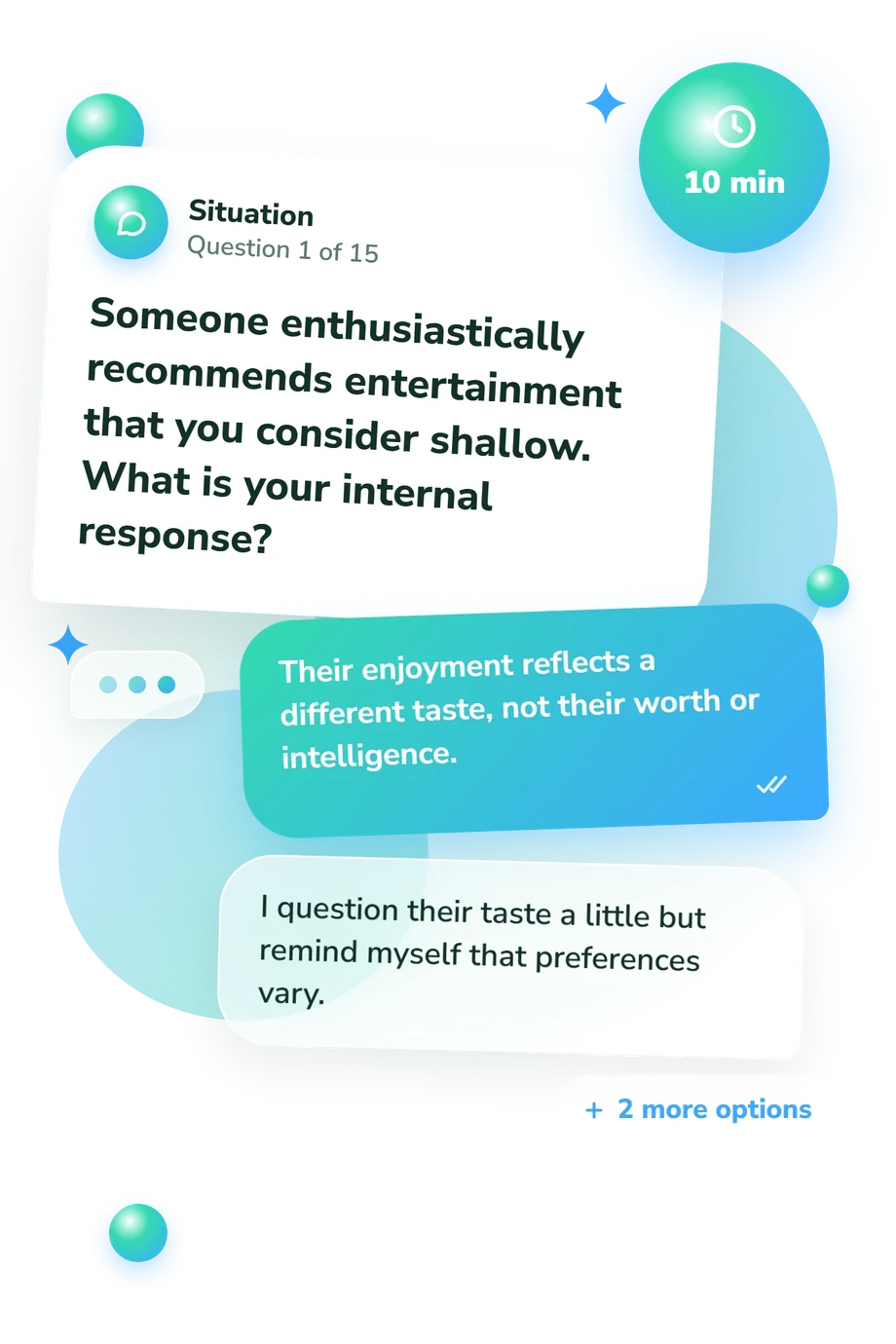
- Their enjoyment reflects a different taste, not their worth or intelligence.
- I question their taste a little but remind myself that preferences vary.
- I find myself taking their opinions less seriously in general.
- I conclude that their interests reveal a shallow or unsophisticated person.
- I register the mess without assuming what it says about them.
- I wonder whether they are disorganised, while recognising I know nothing about their situation.
- I expect they probably neglect other responsibilities too.
- I decide they are inconsiderate and unlikely to be a good neighbour.
- I try to understand what matters to them before deciding whether to share my concern.
- I say that I would choose differently and explain why if they want my view.
- I give my honest criticism because friends should challenge bad decisions.
- I make it clear that the choice changes how I see their character.
Am I Judgemental Quiz - Description and methodology of the test
People who want to examine how they evaluate other people may use this questionnaire to look beyond a single “good” or “bad” label. The Am I Judgemental Quiz focuses on everyday reactions, from interpreting mistakes and disagreements to deciding what another person’s choices reveal. It can suit anyone wondering whether their reactions are judgemental; this quiz about whether you are judgemental turns social assumptions into specific patterns to reflect on.
What This Assessment Explores
The items examine how quickly an observation becomes a negative judgement, how criticism enters conversation, and whether context changes your view. Situations include taste, lateness, mistakes, disagreement, online opinions, responsibility, and visible differences. Its value lies in showing judgemental tendencies in interpersonal expression, rapid conclusions, and flexibility with standards. The three result dimensions are:
- Judgement in Interaction (0-15) shows how strongly negative evaluations shape what you say and do with others; Measured expression (0-5), Candid evaluator (6-10), and Judgement-forward expression (11-15) are the displayed bands.
- Rapid Conclusions (0-15) shows how readily negative conclusions form before context; Deliberate observer (0-5), Quick evaluator (6-10), and Fast conclusions (11-15) are the displayed bands.
- Standards and Flexibility (0-15) shows how flexibly personal rules and values are applied when assessing others; Context-sensitive standards (0-5), Selective flexibility (6-10), and Rigid standards (11-15) are the displayed bands.
Methodology and Evidence Base
Each item presents a familiar social situation with four ordered responses. Options move from allowing uncertainty or context to making broader, more negative inferences about another person. Choosing the closest response makes this a self-report reflection exercise, not a task with right answers. As a judging others test, it can reveal where interpretation shifts from behaviour to character.
Results are presented separately for the three dimensions, with labels tied to the displayed ranges rather than universal or clinical thresholds.
Conceptually, the structure is consistent with the First Impression Interaction Procedure (King & Pate, 2002), and it can be read alongside Webster and Kruglanski’s work on need for cognitive closure and Martin and Rubin’s measure of cognitive flexibility. These references support comparison, not a claim that this is an adaptation or standardized copy.
Interpret the result as a snapshot of reactions represented by the items. The scenarios also probe whether you separate behaviour from character and allow context to modify your standards. Current mood, self-awareness, and the wish to appear fair can influence self-report.
- King, Alan R., and Allison N. Pate. (2002). Individual differences in judgmental tendencies derived from first impressions. Personality and Individual Differences, 33(1), 131-145. 10.1016/S0191-8869(01)00140-4
- Webster, Donna M., and Arie W. Kruglanski. (1994). Individual differences in need for cognitive closure. Journal of Personality and Social Psychology, 67(6), 1049-1062. 10.1037/0022-3514.67.6.1049
- Martin, Matthew M., and Rebecca B. Rubin. (1995). A New Measure of Cognitive Flexibility. Psychological Reports, 76(2), 623-626. 10.2466/pr0.1995.76.2.623
Updated: