
Hinduism Quiz
How the Scales are Structured
Who Usually Takes This Test?
See How You Compare
Below is a preview of how scores are typically distributed across each scale.
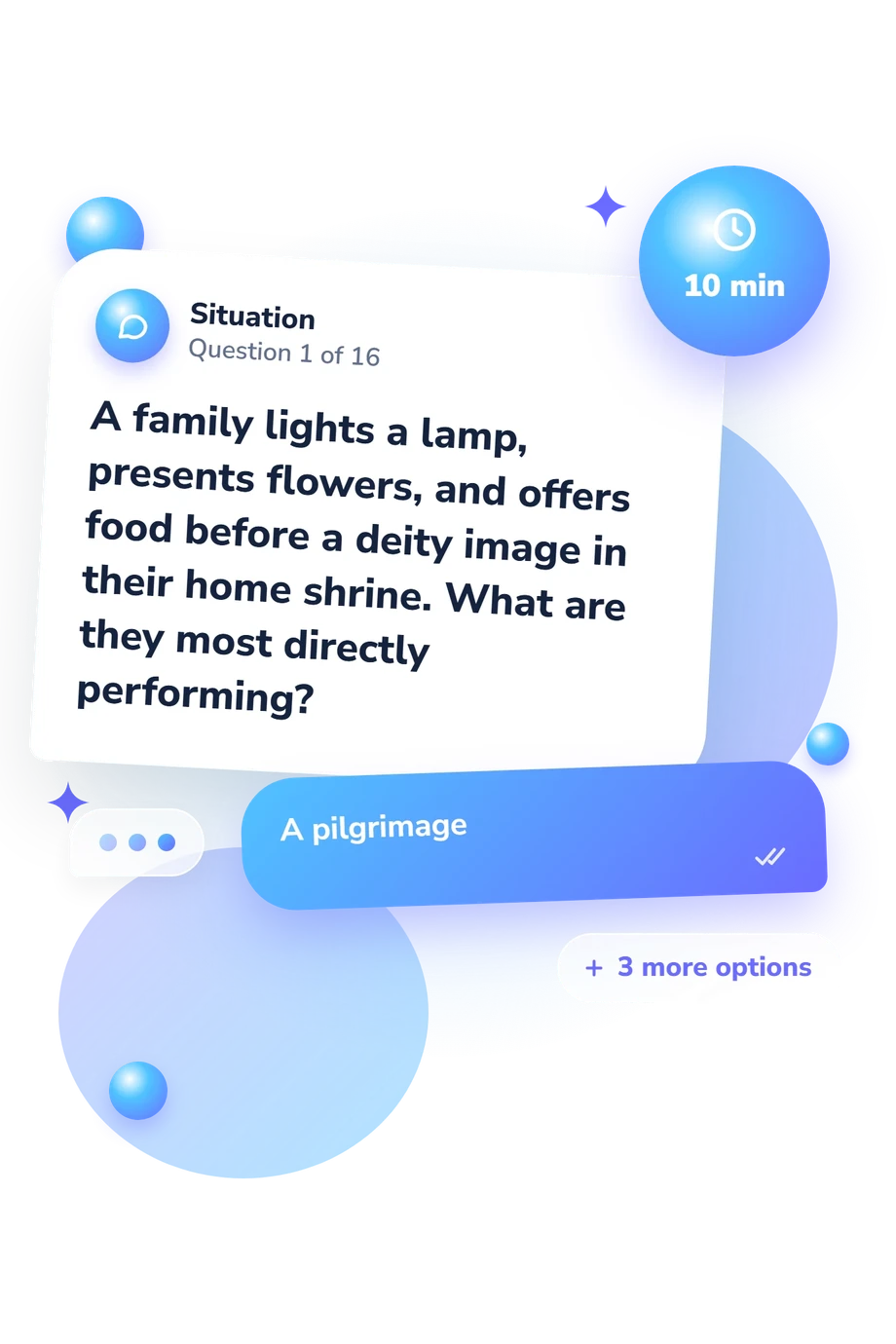
Example Questions From the Test
- The Mahabharata
- The Upanishads
- The Ramayana
- The Rigveda
- Arjuna
- Shiva
- Rama
- Yudhishthira
- Rules for constructing temple towers
- The royal genealogies of ancient kingdoms
- Procedures for organizing festival processions
- The relationship between atman and Brahman
Hinduism Quiz - Description and methodology of the test
People seeking a structured starting point for learning about Hindu traditions can use the Hinduism Quiz to gauge how confidently they work with core material. The result offers a snapshot that can guide further study without judging religious identity or personal observance. This Hindu quiz can help learners choose reading goals and reflect on which parts of their current understanding feel secure.
What This Assessment Explores
The questions sample material rather than belief. They test knowledge of Hinduism by connecting terms with texts, figures, practices, and ethical ideas, asking readers to recognize information and distinguish concepts. The result is intended for learners and readers; questions in this quiz about Hinduism provide a map of Hindu traditions.
The thematic groups are:
- Texts and narratives show whether you can place major scriptures and epic figures in context.
- Beliefs and concepts indicate recognition of karma, moksha, avatar, atman, Brahman, and samsara.
- Practices, ethics, and traditions show how you connect puja, bhakti, ahimsa, dharma, pilgrimage, festivals, and responsibilities with Hindu life.
The result uses Hinduism Knowledge (0-16). Foundations to build (0-6) signals basic familiarity; Developing knowledge (7-12) shows recognition of many major ideas; Strong knowledge (13-16) reflects a broad grasp of the sampled material, not expertise in every Hindu tradition.
Methodology and Evidence Base
Each item presents a question with four answer choices. Selecting the best match requires distinctions among related terms, texts, figures, and practices. The multiple-choice format checks recognition and conceptual links as you work through these Hindu religion questions, rather than personal devotion or ritual experience.
The content is conceptually consistent with a Pew Research Center study measuring what Americans know about religion. This questionnaire is not an adaptation of that survey, and its score is not a normed comparison with its sample. Because Hindu traditions are internally diverse, concepts sampled here are best understood alongside scholarly perspectives from Julius J. Lipner and Gavin Flood.
The questionnaire presents descriptive result bands and does not claim a population-standardized score. The score can indicate whether broader review may be useful, while the questions may prompt further reading; it does not identify specific weak areas. No population norms or reliability estimate are stated. Responses may reflect prior education, language, attention, and current understanding. A single knowledge score cannot represent every Hindu tradition or measure lived religious commitment; it works best as a starting point for further study.
- Alper, Becka A., Gregory A. Smith, Alan Cooperman, Besheer Mohamed, Philip Schwadel, Elizabeth Podrebarac Sciupac, Kiana Cox, and Claire Gecewicz. What Americans Know About Religion. Pew Research Center, July 23, 2019.
- The Association of Religion Data Archives. American Trends Panel Wave 44 - Religious Knowledge. 2019. 10.17605/OSF.IO/SG6AP.
- Lipner, Julius J. Hindus: Their Religious Beliefs and Practices. 2nd ed., Routledge, 2010.
- Flood, Gavin D. An Introduction to Hinduism. Cambridge University Press, 1996.
Updated: