
Flowers for Algernon Quiz
How the Scales are Structured
Who Usually Takes This Test?
See How You Compare
Below is a preview of how scores are typically distributed across each scale.
Example Questions From the Test
- Charlie plans to open a flower shop named after the experiment
- Charlie asks that someone place flowers on Algernon's grave
- Alice gives Charlie flowers before he returns to the bakery
- Nemur names the completed research project after a flower
- Through progress reports written by Charlie
- Through letters exchanged by the scientists
- Through Alice Kinnian's diary entries
- Through a third-person narrator following Algernon
- Fay Lillman
- Alice Kinnian
- Rose Gordon
- Norma Gordon
Flowers for Algernon Quiz - Description and methodology of the test
Readers who want to revisit Charlie Gordon’s development can use the Flowers for Algernon Quiz to check literary understanding rather than personal traits. It suits students, book-club members, and independent readers deciding whether reading is ready for discussion. This Flowers for Algernon reading quiz lets readers decide whether a focused check would help before returning to the novel. It is useful when a first reading left important changes unclear.
What This Assessment Explores
The assessment measures literary knowledge through questions in the quiz about Flowers for Algernon, covering plot, motives, relationships, narrative form, symbolism, and ethical tension. Instead of testing personality or clinical traits, it asks readers to connect events with meaning, including Charlie’s changing view of the bakery workers, Algernon’s warning, his family history, and the researchers’ conduct.
The Flowers for Algernon Knowledge scale runs from 0-16 correct answers, with these displayed bands:
- Starting Point (0-6) shows that some characters, events, or ideas need review.
- Developing Knowledge (7-12) shows a solid grasp of Charlie’s journey with details still to revisit.
- Strong Knowledge (13-16) shows well-developed understanding of plot, structure, relationships, symbolism, and ethical questions.
The result guides rereading and discussion; it reflects selected content rather than complete literary understanding.
Methodology and Evidence Base
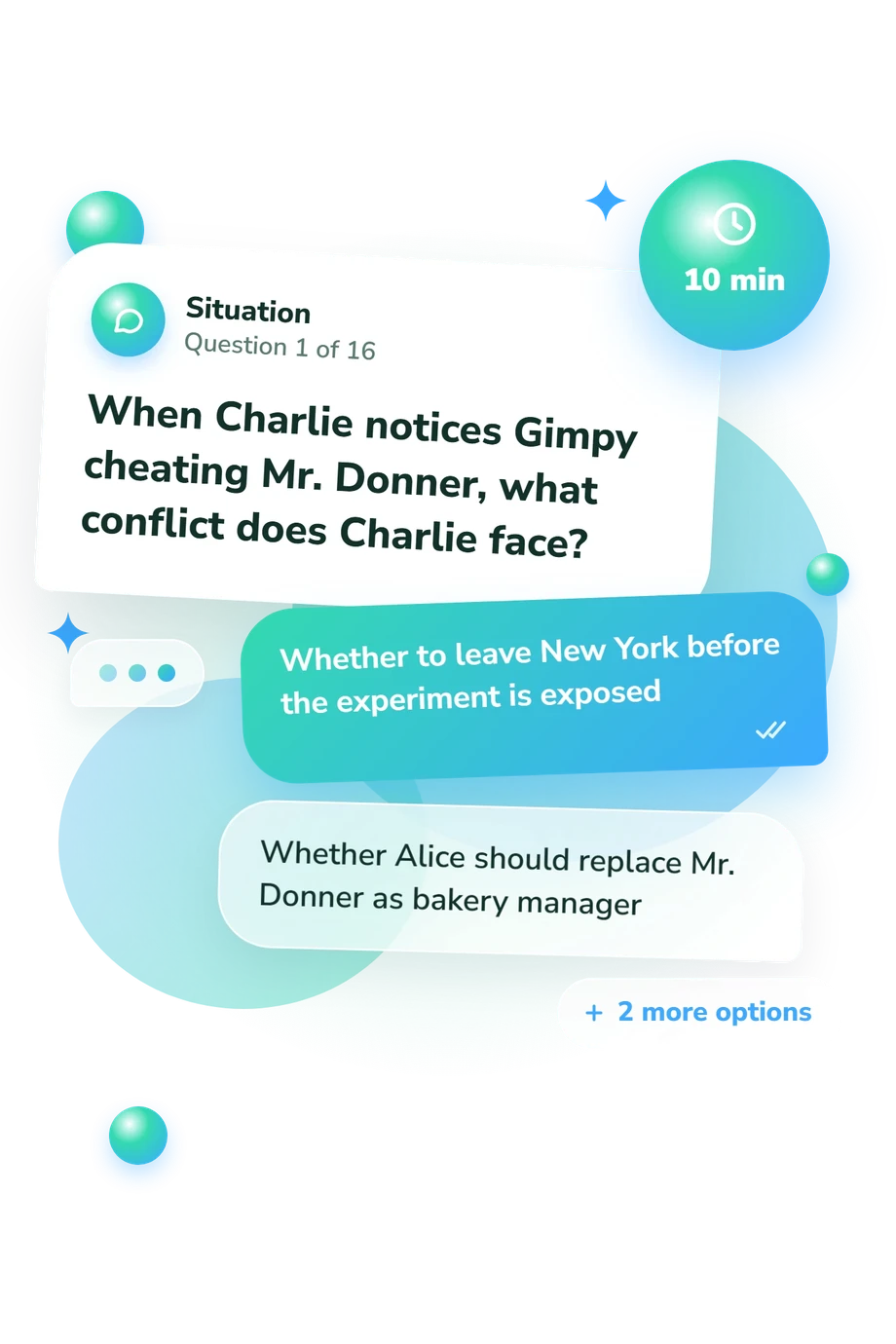
Each item offers four answer choices and asks for the best response to a scene, character, relationship, symbol, or idea. The set combines factual recall with interpretation: readers may identify Gimpy’s conflict, explain Alice Kinnian’s role, recognize the Algernon-Gordon Effect, or connect the title with the ending. As a quiz about the Flowers for Algernon short story, it rewards attention to sequence, context, and consequences.
Scoring is content-based: correct selections contribute to the knowledge result. The bands describe performance on these questions rather than population norms or clinical cutoffs, so they function as a structured reading check of plot, form, and interpretation. Performance can vary with how recently the book was read, guessing, and familiarity with scenes.
Its literary reference point is Keyes’s novel Flowers for Algernon; the 1959 version provides context for its earlier form. The quiz is a content-based reading check whose ethical themes are conceptually consistent with Chen and Wang’s analysis of disability and animality, but that article neither validates the quiz nor establishes its scoring. Use the result to choose passages for rereading and make discussion more precise.
- Keyes, Daniel. Flowers for Algernon. New York: Harcourt, Brace & World, 1966.
- Keyes, Daniel. "Flowers for Algernon." The Magazine of Fantasy and Science Fiction, vol. 16, no. 4, April 1959, pp. 5-30.
- Chen, Jie, and Quan Wang. "Flowers for Algernon: When Disability Meets Animality." Science Fiction Studies, vol. 53, no. 1, 2026, pp. 105-127. 10.1525/sfs.2026.53.1.105
Updated: