
Alcohol Quiz
How the Scales are Structured
Who Usually Takes This Test?
See How You Compare
Below is a preview of how scores are typically distributed across each scale.
Example Questions From the Test
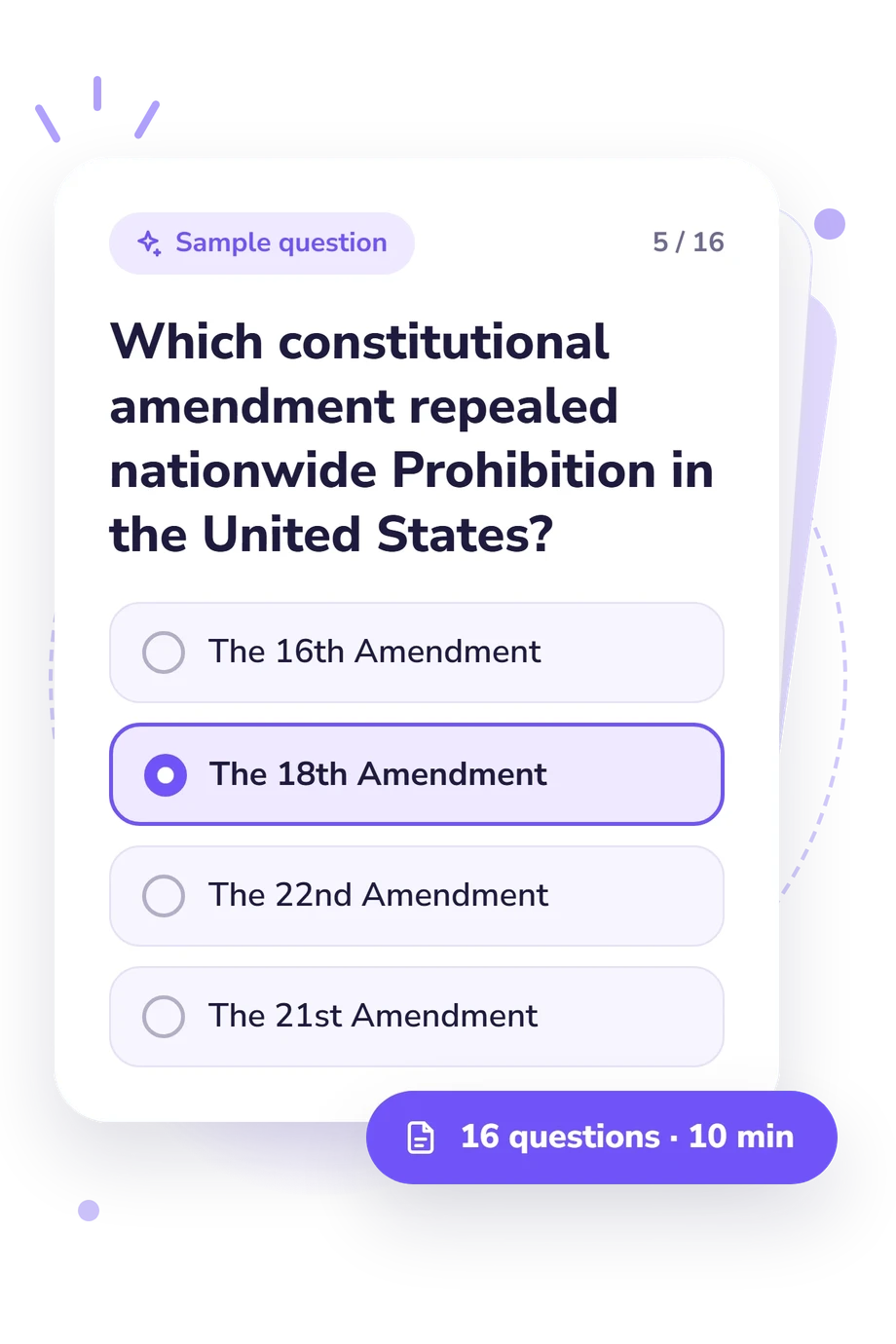
- The 16th Amendment
- The 18th Amendment
- The 22nd Amendment
- The 21st Amendment
- 60% ABV
- 20% ABV
- 40% ABV
- 80% ABV
- The traditional method
- Solera aging
- Continuous distillation
- Cold-compound flavoring
Alcohol Quiz - Description and methodology of the test
People who want to connect familiar drinks with their historical roots can use this alcohol history quiz as a focused learning check about spirits, brewing, wine, and cocktails. The alcohol quiz questions test recognition of dates, production methods, classic formulas, and cultural milestones. It suits curious learners who want to identify gaps before reading more about beverages and their history.
What This Assessment Explores
This assessment measures knowledge of alcohol and cocktail history. Its content spans chronology, production, ingredients, recipe formulas, and cultural history, asking readers to connect Prohibition dates, refrigeration, distillation, fermentation, bitters, fortified wine, and classic recipes with the knowledge result. It suits anyone seeking an alcohol knowledge quiz for learning, revision, or self-checking.
The result uses one educational scale with three displayed bands. Alcohol and Cocktail History Knowledge runs from 0-16:
- Foundations to Build (0-6) shows recognition of some core ideas and highlights major dates, processes, and formulas to review.
- Developing Knowledge (7-12) shows understanding of many milestones and production concepts, with gaps still present.
- Strong Knowledge (13-16) shows a well-developed command of knowledge about alcohol and cocktail history.
These bands describe performance on the tested topics and indicate where further reading may help.
Methodology and Evidence Base
Each item presents a historical or applied scenario followed by four answer choices. The format tests recognition and discrimination: readers may order events, identify equipment or ingredients, or match a person, process, amendment, or drink with its description. These quiz questions about alcohol reward careful reading and factual recall.
The result appears on the displayed 0-16 educational scale and is interpreted through its three bands. This concise, structured knowledge check shows how much of the tested material the respondent recognizes and points to topics for further study.
The evidence base draws on historical and technical reference works. Thomas's 1862 manual supplies a period source for cocktail recipes; Smith's 2014 chapter supplies American beverage context; Okrent's 2010 book supports the Prohibition material; and the original 1806 newspaper source supports the definition used by one question. The questionnaire is not presented as a direct adaptation of any one instrument.
Prior exposure, current attention, wording familiarity, and guessing can affect performance, so the result is an educational snapshot rather than evidence about drinking habits, intoxication, dependence, health, or safety.
- Thomas, Jerry. How to Mix Drinks; or, The Bon-Vivant's Companion, Containing Directions for Mixing All the Beverages Used in the United States, Together with the Most Popular British, French, German, Italian, Russian, and Spanish Recipes. New York: Dick & Fitzgerald, 1862.
- Smith, Andrew F. "The Most Delightful and Insinuating Potations." In Drinking History: Fifteen Turning Points in the Making of American Beverages, pp. 125-140. Columbia University Press, 2014. 10.7312/columbia/9780231151177.003.0008
- Okrent, Daniel. Last Call: The Rise and Fall of Prohibition. New York: Scribner, 2010.
- Zheng, Xiao-Wei, and Bei-Zhong Han. "Baijiu, Chinese Liquor: History, Classification and Manufacture." Journal of Ethnic Foods, 3(1), 19-25, 2016. 10.1016/j.jef.2016.03.001
Updated: