
Nominal Ordinal Interval Ratio Quiz
How the Scales are Structured
Who Usually Takes This Test?
See How You Compare
Below is a preview of how scores are typically distributed across each scale.
Example Questions From the Test
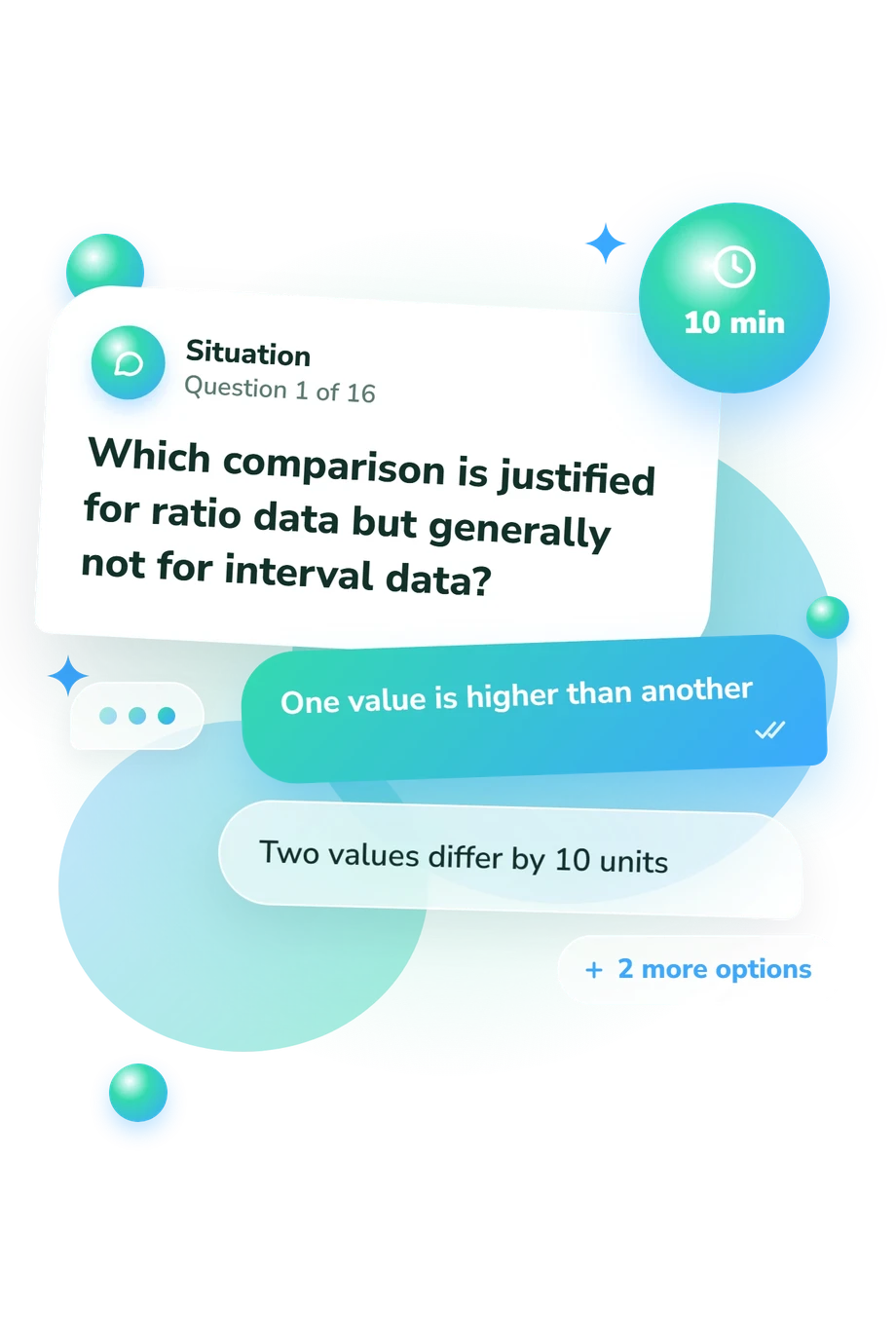
- One value is higher than another
- Two values differ by 10 units
- Three observations can be arranged from lowest to highest
- A 20-kilogram object is twice as heavy as a 10-kilogram object
- Ordinal
- Nominal
- Interval
- Ratio
- Ratio data must be recorded using whole numbers
- Ratio data can only describe physical objects
- Ratio data have a meaningful zero that supports ratio comparisons
- Ratio data have categories in a meaningful order
Nominal Ordinal Interval Ratio Quiz - Description and methodology of the test
For students and researchers, the Nominal Ordinal Interval Ratio Quiz checks whether data are classified by their actual properties. It focuses on distinctions that affect valid comparisons and summaries. This levels of measurement quiz clarifies how labels, ranks, equal differences, and meaningful zero points determine those distinctions. The result directs attention to concepts for review before future statistical analysis.
What This Assessment Explores
Examples include blood groups, ratings, race places, temperatures, duration, mass, and distance. Their appearance can mislead, so classify the comparisons each level permits. The nominal ordinal interval ratio practice quiz applies these concepts to common study situations and supports sound data interpretation.
These examples address common study situations in introductory statistics and research methods, where numerical appearance can invite invalid comparisons. The task is to apply definitions rather than guess from the labels.
The four concepts examined are:
- Nominal data identify unordered categories.
- Ordinal data show rank without equal gaps.
- Interval data preserve equal differences without meaningful zero.
- Ratio data support proportional comparisons because zero is meaningful.
The single Levels of Measurement Knowledge scale spans 0-16: Foundations to Review (0-6), Developing Knowledge (7-12), Strong Knowledge (13-16). These bands describe review, development, or strong application.
Methodology and Scientific Basis
Each item presents a scenario or definition with four answer choices that identify or explain the relevant level. The multiple-choice score is the number correct. This measurement levels practice quiz rewards applying defining properties rather than recognizing terms.
The framework is Stevens's four-level measurement typology, which distinguishes nominal, ordinal, interval, and ratio relations by the transformations and comparisons that remain meaningful. The questionnaire is conceptually consistent with that work, but it is not the published instrument or a standardized adaptation of it.
Velleman and Wilkinson cautioned that rigid typologies can mislead when measurement quality, purpose, distribution, and analysis receive too little attention. The quiz tests textbook distinctions, while real-data decisions require context.
Interpret missed items by their reasoning. Lower performance may reflect confusion about order, equal intervals, or zero points; higher performance suggests consistent application. The score reflects performance on an online knowledge quiz, so guessing, interpretation of wording, and current attention can affect it. The bands describe performance on this questionnaire; one set of items should not be treated as a complete measure of statistical competence.
- Stevens, Stanley Smith. 1946. On the Theory of Scales of Measurement. Science, 103(2684), 677-680. 10.1126/science.103.2684.677
- Velleman, Paul F., and Leland Wilkinson. 1993. Nominal, Ordinal, Interval, and Ratio Typologies are Misleading. The American Statistician, 47(1), 65-72. 10.1080/00031305.1993.10475938
Updated: