
New Year Quiz
How the Scales are Structured
Who Usually Takes This Test?
See How You Compare
Below is a preview of how scores are typically distributed across each scale.
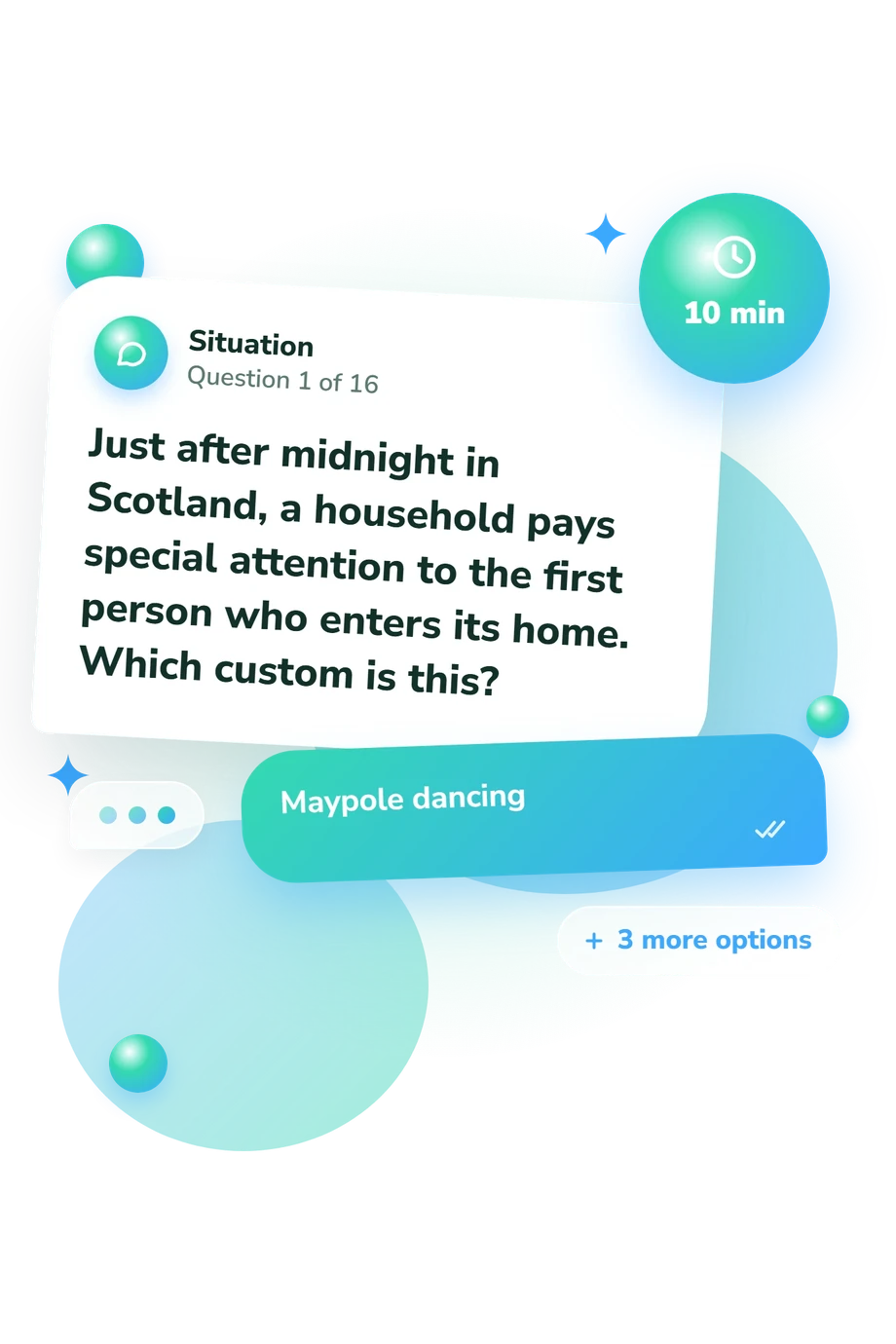
Example Questions From the Test
- Maypole dancing
- Wassailing
- First-footing
- Pancake racing
- The traveler repeats the current date
- The traveler moves the date back by one week
- The traveler advances the date by one day
- The date stays fixed until the next midnight
- Olives and salt
- Apples and honey
- Bread and vinegar
- Rice and pepper
New Year Quiz - Description and methodology of the test
Curious readers can use the new year quiz to explore how customs, calendars, and celebrations express ideas about beginnings. It is an easy quiz about New Year for anyone who enjoys cultural facts, seasonal traditions, or general-knowledge challenges without needing specialist preparation. The result indicates which areas are familiar and which topics may reward further exploration.
What This Assessment Explores
Rather than measuring preferences or holiday enthusiasm, the items assess factual recognition. They cover customs, celebrations, historical references, and calendar principles across countries and traditions. An incorrect answer may reflect an unfamiliar subject, not a stable weakness.
Although it can be approached as a New Year's Day quiz, its scope extends beyond one date. The content groups are:
- Global customs show whether you identify practices involving homes, food, gifts, and midnight rituals.
- Celebration symbols show how objects, songs, bells, and seasonal foods represent particular occasions.
- Calendar concepts show whether you understand lunisolar timing, leap-year rules, seasons, and date changes.
- Historical references show what you recall about figures, events, and traditions associated with January.
New Year Knowledge totals correct answers across the assessment and ranges from 0-16. Building Foundations covers 0-6, Developing Knowledge covers 7-12, and New Year Expert covers 13-16. These bands describe recall, not cultural identity or enthusiasm.
Methodology and Evidence Base
Each question presents four answer choices, and the respondent selects the option that best fits the wording. The set's New Year questions and answers form an objective knowledge check, not a self-report measure of personality or identity.
The total is a direct count of correct responses. The displayed bands describe performance within this questionnaire rather than population norms. The questionnaire presents free questions and answers about New Year, linking factual recall with wider cultural and calendrical context.
Conceptually, the content is consistent with Crump (2008) on worldwide New Year customs, Laing and Frost (2015) on ritual in modern social life, and Reingold and Dershowitz (2018) on calendar calculations and date rules. It is not presented as an adaptation of any one work; these sources support its subject matter and conceptual framing.
Because the questionnaire is not norm-standardized, interpret the result as a snapshot of knowledge. Performance can vary with prior reading, education, language, and whether a tradition is known by another name, so one unfamiliar topic should not become a broad cultural judgment.
- Crump, William D. Encyclopedia of New Year's Holidays Worldwide. Jefferson, NC: McFarland & Company, 2008. ISBN 9780786433933.
- Laing, Jennifer, and Warwick Frost, eds. Rituals and Traditional Events in the Modern World. Abingdon: Routledge, 2015. DOI 10.4324/9781315886879.
- Reingold, Edward M., and Nachum Dershowitz. Calendrical Calculations: The Ultimate Edition. 4th ed. Cambridge: Cambridge University Press, 2018. DOI 10.1017/9781107415058.
Updated: