
Prokaryotic Cell Quiz
How the Scales are Structured
Who Usually Takes This Test?
See How You Compare
Below is a preview of how scores are typically distributed across each scale.
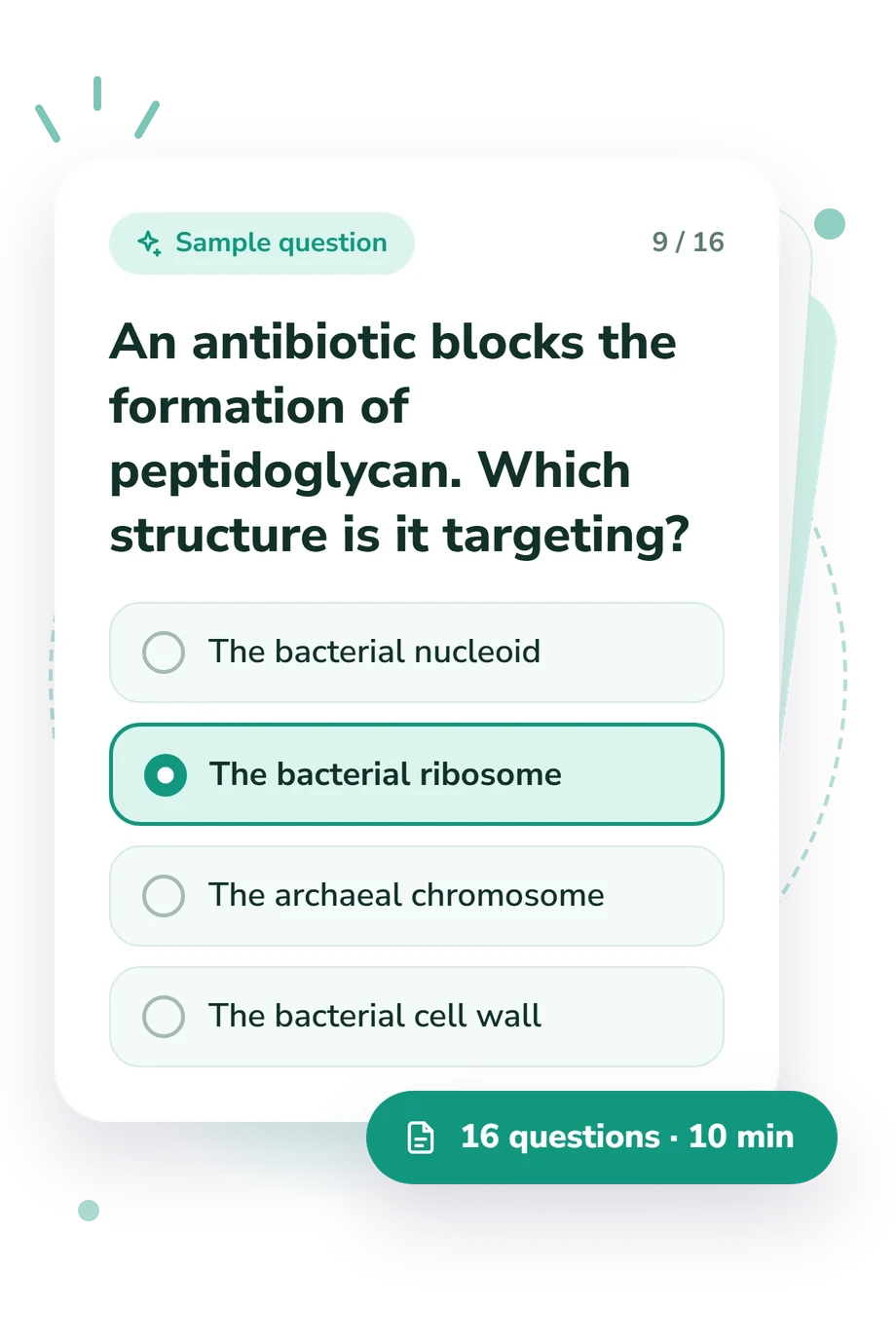
Example Questions From the Test
- Adhering to surfaces and resisting drying
- Copying its main chromosome
- Producing ATP through its plasma membrane
- Building proteins from amino acids
- Their ribosomes are located inside the nucleus
- Their cell walls convert DNA into proteins
- Their proteins are translated directly from DNA without RNA
- No nuclear envelope separates the DNA from cytoplasmic ribosomes
- Inside a membrane-bound nucleus
- In the nucleoid region
- Within the cell wall
- Inside the Golgi apparatus
Prokaryotic Cell Quiz - Description and methodology of the test
For students, learners, and curious readers checking core microbiology before a lesson or review session, this prokaryotic cell quiz offers a way to choose a revision starting point and gauge readiness for further study. Questions in this prokaryotic cell structure quiz help readers review how components function together, making the result useful for deciding what to revisit.
What This Assessment Explores
Questions connect structures with functions, covering motility, attachment, membrane transport, the nucleoid, ribosomes, plasmids, cell walls, conjugation, binary fission, endospores, and archaeal-bacterial differences. Several scenarios test application to osmotic stress, nutrient scarcity, or a damaged appendage rather than simple recall.
This eukaryotic and prokaryotic quiz also tests whether readers can classify cells as eukaryotic or prokaryotic. Prokaryotes lack a membrane-bound nucleus and other membrane-bound organelles, while their cell structures perform distinct roles in small, self-contained cells.
The displayed scale is Prokaryotic Cell Knowledge, scored from 0-16. Its result bands are:
- Foundation-building (0-6) shows that core ideas are partly recognized but major structures and functions need review.
- Developing knowledge (7-12) shows that many essentials are understood, although some distinctions still need reinforcement.
- Strong knowledge (13-16) shows a reliable command of the tested structures, processes, and bacterial-archaeal comparisons.
Methodology and Scientific Basis
Methodologically, each item presents a short biology question, often framed as a cell observation or experimental change, followed by four answer choices. The respondent selects the best-supported option, while the output is a bounded knowledge score grouped into the displayed result bands. No separate subscale weighting or conversion rule is stated, so the result summarizes performance on this questionnaire rather than a broader ability estimate.
Comparisons in the prokaryotic vs eukaryotic quiz test whether readers can distinguish their organization and information flow, consistent with the microbiology framework described by Madigan and colleagues, which covers cell structures, information flow, division, and microbial diversity. Archaeal membrane questions also align with work by Albers and Meyer, and the bacteria-archaea-eukarya comparison is compatible with the three-domain framework proposed by Woese and colleagues. This is an online educational assessment, not an adaptation of those publications.
The questionnaire has no stated population norms or standardization process, so its bands describe performance on this set of questions rather than percentile standing. Performance can reflect prior coursework, wording familiarity, guessing, and current recall. Use the result to target review, then confirm understanding with explanations or additional problems.
- Madigan, Michael T., Kelly S. Bender, Daniel H. Buckley, W. Matthew Sattley, and David A. Stahl. Brock Biology of Microorganisms. 16th ed. Pearson, 2021.
- Albers, Sonja-Verena, and Benjamin H. Meyer. "The archaeal cell envelope." Nature Reviews Microbiology 9, no. 6 (2011): 414-426. 10.1038/nrmicro2576.
- Woese, Carl R., Otto Kandler, and Mark L. Wheelis. "Towards a natural system of organisms: proposal for the domains Archaea, Bacteria, and Eucarya." Proceedings of the National Academy of Sciences 87, no. 12 (1990): 4576-4579. 10.1073/pnas.87.12.4576.
Updated: