
Guess the Superhero Quiz
How the Scales are Structured
Who Usually Takes This Test?
See How You Compare
Below is a preview of how scores are typically distributed across each scale.
Example Questions From the Test
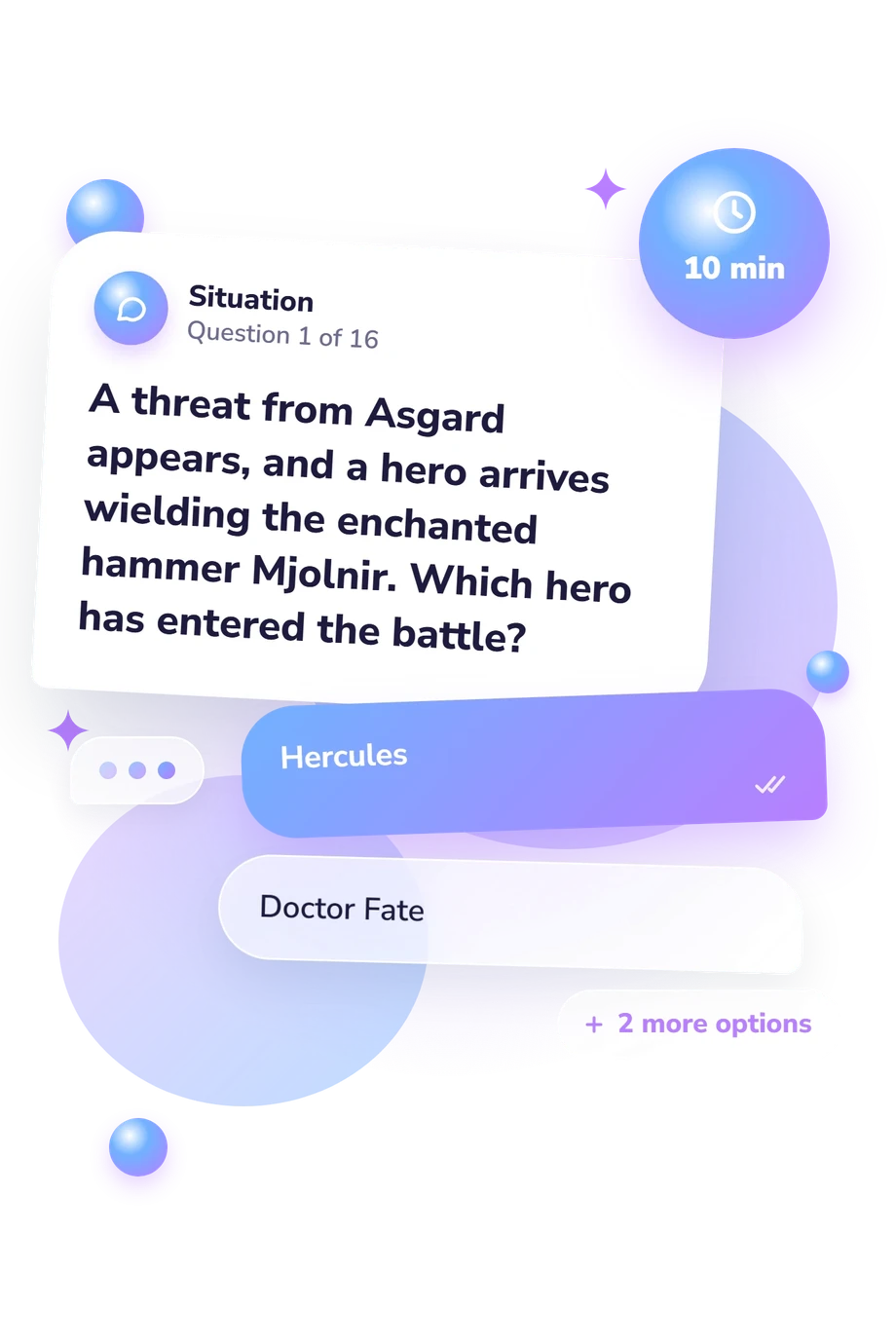
- Hercules
- Doctor Fate
- Shazam
- Thor
- Ant-Man
- The Atom
- Blue Beetle
- Yellowjacket
- Wonder Woman
- Hawkgirl
- Valkyrie
- She-Hulk
Guess the Superhero Quiz - Description and methodology of the test
Readers who enjoy comics, superhero films, and character lore can use the Guess the Superhero Quiz to check how accurately they connect powers, origins, alter egos, and settings with the right identity. It is suitable for casual fans, families, and dedicated followers who want a quick superhero character quiz that turns recognition into a clear personal result. The outcome highlights familiarity with the heroes represented here, not overall expertise in the genre.
What This Assessment Explores
This questionnaire measures recognition of superhero identities through short narrative clues. Items connect a hero with an origin, civilian identity, power, weapon, setting, nation, or institution. As a superhero trivia quiz, it suits people who enjoy comics, films, television, and popular-culture adaptations; the result reflects correct identity matching, not enthusiasm or specialist expertise.
The displayed scale is Superhero Knowledge (0-16), showing how many identities you matched correctly: Emerging Recognition 0-6, Developing Expertise 7-12, and Formidable Knowledge 13-16. These bands describe performance on the included clues, not complete genre knowledge. The main recognition targets are:
- Origins and alter egos show how backstories connect with active identities.
- Powers and equipment show whether distinctive abilities trigger accurate recall.
- Settings and fictional worlds show how places, nations, or institutions support identification.
- Roles and missions show whether a hero’s familiar function completes the match.
Methodology and Evidence Base
Each item gives a short clue and four answer choices. You select the identity that best fits an origin, alias, power, setting, or story detail. Recognizable distractors make the task one of distinguishing familiar heroes, not recalling an answer from scratch.
The total counts correct matches across the item set, while the bands organize performance into descriptive levels. No separate trait score is reported. The displayed bands describe performance on the included clues, so they should not be generalized to overall superhero knowledge.
Its conceptual frame is consistent with Peter Coogan’s recurring superhero conventions: extraordinary abilities, costumes, missions, secret identities, and origin stories. These conventions function as recognition cues; the questionnaire is not an adaptation of his book.
Morgan and Schwebel (2024) is relevant because their study separates superhero knowledge from affiliation and imitation within a broader identification composite. This superhero knowledge test measures recognition. Recall may vary with recent exposure and publisher familiarity, so the result is a narrow snapshot of character recognition rather than a stable personal trait. The result indicates performance on this particular set of character-matching items rather than separate strengths and gaps.
- Morgan, Casie H., and David C. Schwebel. “Superhero Pretense, Superhero Identification, and Risk-Taking in Preschool-Aged Children.” Journal of Pediatric Psychology, vol. 49, no. 4, 2024, pp. 234-243. 10.1093/jpepsy/jsad045
- Coogan, Peter. Superhero: The Secret Origin of a Genre. Austin, TX: MonkeyBrain Books, 2006. ISBN: 9781932265187
Updated: