
Do I Need Bunion Surgery Quiz
How the Scales are Structured
Who Usually Takes This Test?
See How You Compare
Below is a preview of how scores are typically distributed across each scale.
Example Questions From the Test
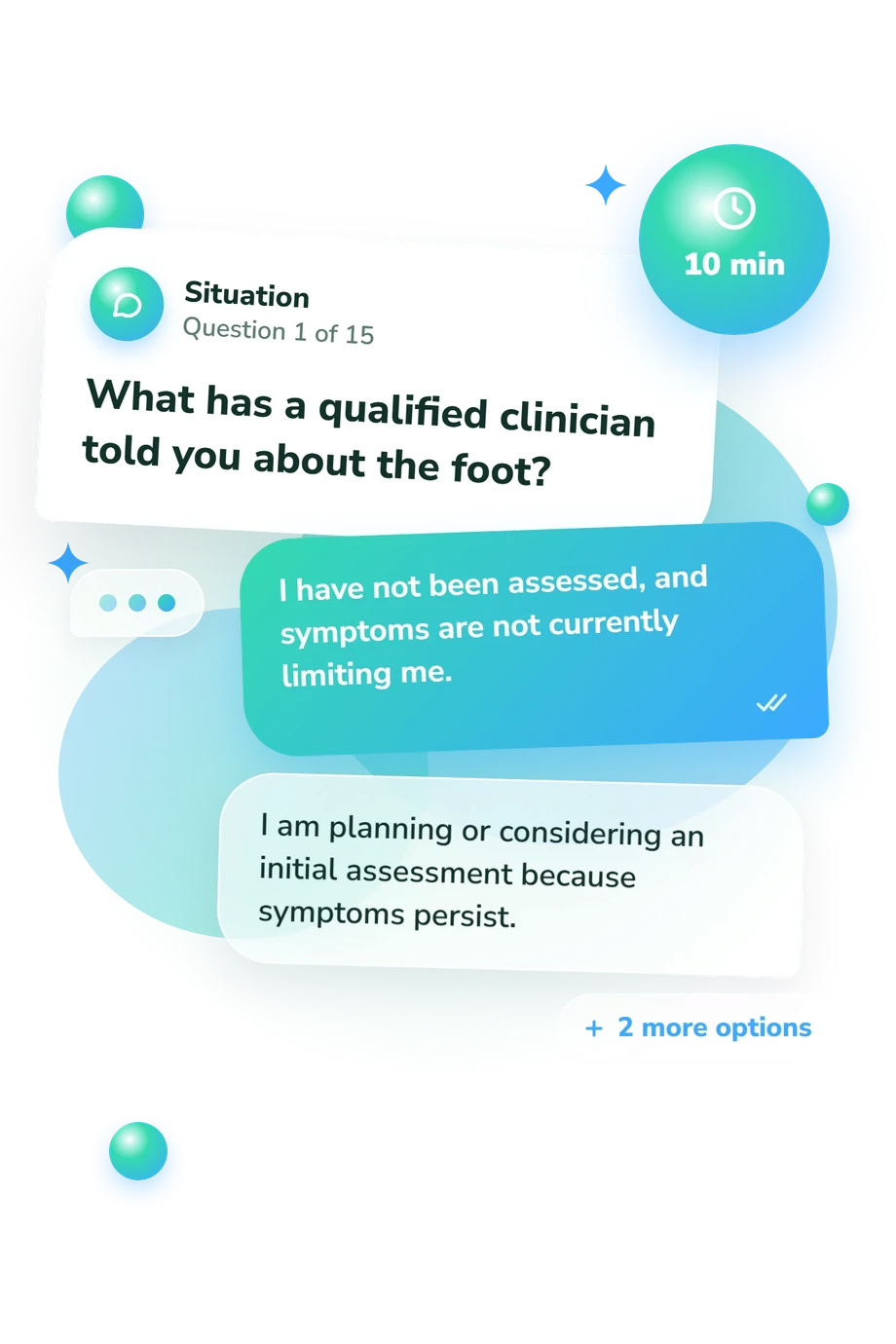
- I have not been assessed, and symptoms are not currently limiting me.
- I am planning or considering an initial assessment because symptoms persist.
- A bunion was confirmed and monitoring or non-surgical care was recommended.
- A clinician has recommended a surgical consultation or symptoms have progressed despite their plan.
- I have not sought it because symptoms are not affecting my life.
- I have not yet had access to it or have only recently started exploring it.
- It has helped, although meaningful symptoms or restrictions remain.
- An adequate plan has not restored acceptable comfort or function.
- I remain unable to do important activities or wear workable footwear.
- Symptoms are manageable with only minor adjustments.
- I do not currently need measures for this problem.
- They help, but recurring pain still shapes my choices.
Do I Need Bunion Surgery Quiz - Description and methodology of the test
People considering whether a bunion needs clinical attention can use the Do I Need Bunion Surgery Quiz to organise symptoms before speaking with a qualified clinician. This bunion surgery assessment is intended for people noticing pain, changing alignment, footwear difficulty, reduced activity, or uncertainty after previous advice. Its profile separates patterns to monitor from findings that call for timely review.
What This Assessment Explores
The questionnaire examines hallux valgus rather than predicting an operation. It covers clinician advice, alignment change, skin or nerve signs, pain, walking, rest, footwear, activities, and response to measures. The result can show which findings belong in a bunion surgery consultation and which symptom patterns merit monitoring or clinical discussion.
The three scales are:
- Clinical Review Indicators (0-15) reads progression, skin or nerve changes, prior assessment, and symptoms that may need care for reasons beyond elective bunion correction; bands: No scored indicator (0-0), Assessment point (1-2), Action band (3-15).
- Pain and Daily Impact (0-15) reads effects on movement, rest, and activities; bands: No scored indicator (0), Point to monitor (1-2), Timely review (3-15).
- Response to Non-Surgical Care (0-15) reads practical measures and relief; bands: No scored indicator (0), Options to revisit (1-2), Treatment discussion (3-15).
The result directs attention to the relevant area for clinical review.
Methodology and Evidence Base
Each item is a self-report scenario with four response choices covering current symptoms, change over time, footwear and other measures, functional limits, and prior clinician input. The choices distinguish little or no present impact from persistent symptoms, incomplete relief, substantial restriction, or warning signs.
Responses feed three 0-15 summaries, but the displayed ranges do not state how each answer contributes points, so allocation should not be inferred. They are unvalidated reflective summaries, not a diagnosis, severity measure, or minimally invasive surgery cutoff. The result can organize topics for a clinical conversation about bunion surgery options and whether further assessment or treatment should be considered.
Its clinical framing is conceptually consistent with Torkki et al. (2001) and the 2024 D.A.F./DGOU guideline. Menz et al. (2023) addresses nonsurgical management, while Dawson et al. (2006) supports attention to patient-reported pain and function. These sources provide context, not validation of this questionnaire.
A single red-flag response overrides the total; fever with spreading redness, an open wound, sudden color change, or inability to bear weight requires urgent care. Current symptoms, recall, and self-awareness can shape self-report.
- Markus Torkki, Antti Malmivaara, Seppo Seitsalo, Veijo Hoikka, Pekka Laippala, and Pekka Paavolainen. "Surgery vs orthosis vs watchful waiting for hallux valgus: A randomized controlled trial." JAMA. 2001;285(19):2474-2480. 10.1001/jama.285.19.2474
- German Association for Foot and Ankle e.V. (D.A.F.) of the German Society of Orthopaedics and Trauma Surgery e.V. (DGOU). "Hallux Valgus, Version 5.1." 2024.
- Hylton B. Menz, Polly Q. X. Lim, Sheree E. Hurn, Karen J. Mickle, Andrew K. Buldt, Matthew P. Cotchett, Edward Roddy, Anita E. Wluka, Bircan Erbas, Mehak Batra, and Shannon E. Munteanu. "Nonsurgical management of hallux valgus: findings of a randomised pilot and feasibility trial." Journal of Foot and Ankle Research. 2023;16:78. 10.1186/s13047-023-00677-1
- Jill Dawson, Jane Coffey, Helen Doll, Grahame Lavis, Paul Cooke, Mark Herron, and Crispin Jenkinson. "A patient-based questionnaire to assess outcomes of foot surgery: validation in the context of surgery for hallux valgus." Quality of Life Research. 2006;15(7):1211-1222. 10.1007/s11136-006-0061-5
Updated: