
Winter Quiz
How the Scales are Structured
Who Usually Takes This Test?
See How You Compare
Below is a preview of how scores are typically distributed across each scale.
Example Questions From the Test
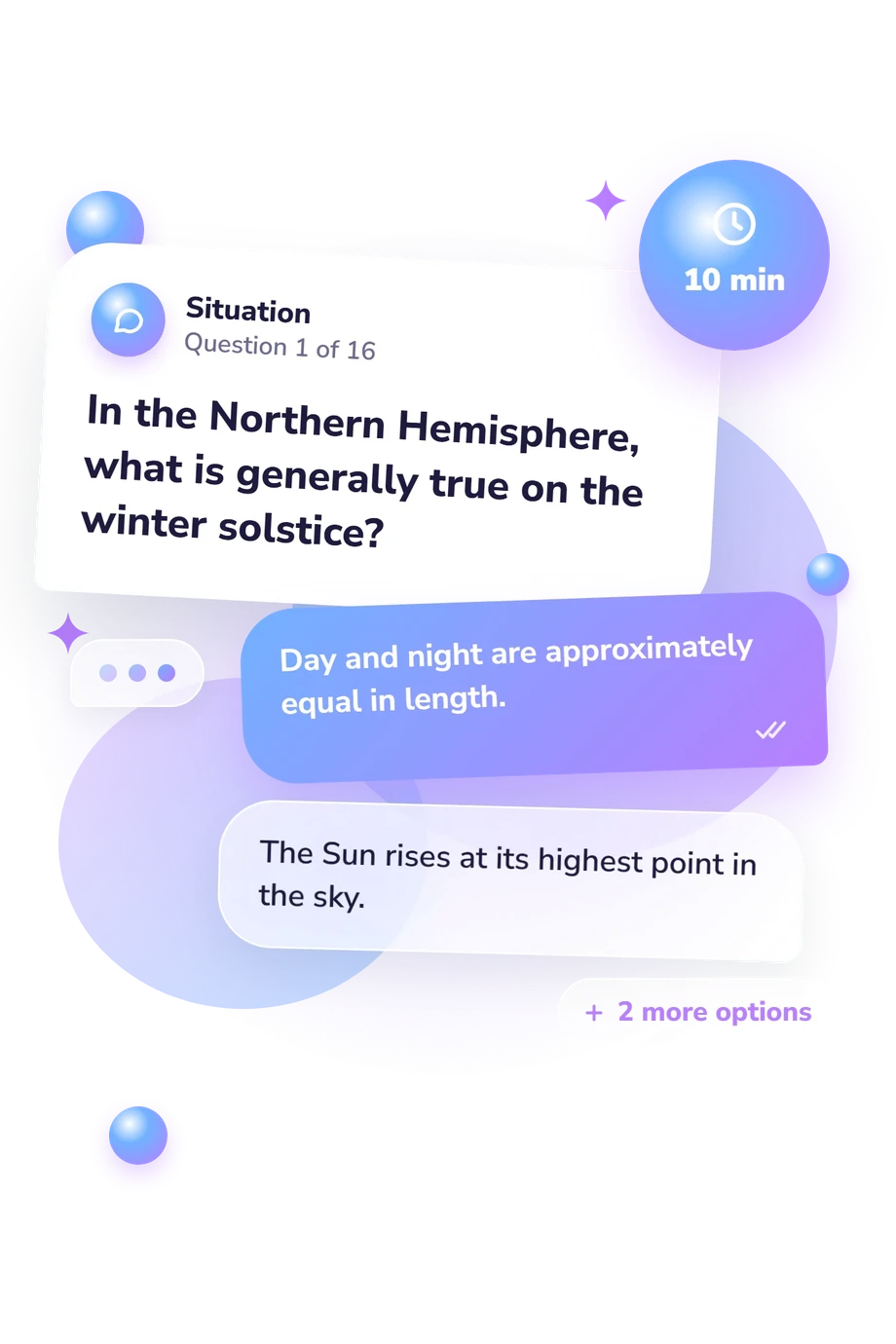
- Day and night are approximately equal in length.
- The Sun rises at its highest point in the sky.
- It is always the coldest day of the year.
- It has the shortest period of daylight and longest night of the year.
- Loose layers generate additional body heat through friction.
- Air trapped between layers slows the transfer of body heat.
- Each layer absorbs cold energy before it reaches the skin.
- Multiple fabrics prevent the body from producing perspiration.
- Tokyo
- Toronto
- Paris
- Buenos Aires
Winter Quiz - Description and methodology of the test
People who enjoy testing practical reasoning about cold-weather situations may find this winter quiz a useful challenge. As a quiz about winter, it asks readers to connect everyday observations with explanations rather than rely only on memorized labels. Families or study partners can discuss the choices together, while individual users receive a score showing which concepts they recognized most securely.
What This Assessment Measures
Questions span seasonal timing, weather, ice, ecology, and activities, from solstices and albedo to frost, snow crystals, hibernation, and winter sports. They test whether familiar observations connect to basic explanations.
Clear wording can support shared use when an adult and a child choose to discuss the items together, although the questions do not make the assessment child-specific. Older learners can also use it for review.
The seasonal knowledge quiz describes knowledge breadth, not personality or outdoor skill. The question themes cover four areas:
- Earth and daylight explain why seasons differ in timing.
- Weather and ice show how freezing, frost, snow, and heat transfer work.
- Plants and animals show how living things cope with cold.
- Snow and activities connect physical science with recreation.
The displayed Winter Knowledge scale runs from 0-16, with one point per correct answer. Winter Beginner 0-6 indicates basic recognition, Frost-Savvy 7-12 developing knowledge, and Winter Expert 13-16 broad understanding.
Methodology and Scientific Basis
Each item offers four multiple-choice options and asks for the best answer to a concrete winter situation. Distractors target sleet-versus-freezing-rain confusion and the idea that Earth’s distance causes winter. One point is awarded for each correct response, and the total is assigned to a result band. Multiple-choice winter questions test explanation as well as recall: each choice applies a concept to a situation, rather than supplying an explanation afterward.
Readers apply concepts to roads, bridges, clothing, snow, lakes, plants, animals, and breath. Snow-related questions make this transfer concrete.
Ecology-related items are conceptually consistent with Studd et al. (2021), whose synthesis links cold-season ecology to physical conditions and living systems; the publication does not validate or standardize this questionnaire, which is not an adaptation of it. Niziol et al. (1995), Lu et al. (2009), and Geiser (2013) support selected items on lake-effect snow, crystals, and hibernation.
These studies provide context, not norming data; results vary with learning, regional experience, attention, and recognition, so bands are best read as topic-specific self-reflection.
- Studd, Emily K., Amanda E. Bates, Andrew J. Bramburger, Timothy Fernandes, Brian Hayden, Hugh A. L. Henry, Murray M. Humphries, Rosemary Martin, Bailey C. McMeans, Eric R. D. Moise, Antóin M. O'Sullivan, Sapna Sharma, Brent J. Sinclair, Alex O. Sutton, Pamela H. Templer, and Steven J. Cooke. "Nine Maxims for the Ecology of Cold-Climate Winters." BioScience, 71(8), 820-830, 2021. 10.1093/biosci/biab032
- Niziol, Thomas A., Warren R. Snyder, and Jeff S. Waldstreicher. "Winter Weather Forecasting throughout the Eastern United States. Part IV: Lake Effect Snow." Weather and Forecasting, 10(1), 61-77, 1995. 10.1175/1520-0434(1995)010<0061:WWFTTE>2.0.CO;2
- Lu, Guoping, Donald J. DePaolo, Qingyang Kang, and Dongwei Zhang. "Lattice Boltzmann Simulation of Snow Crystal Growth in Clouds." Journal of Geophysical Research: Atmospheres, 114, D07305, 2009. 10.1029/2008JD011087
- Geiser, Fritz. "Hibernation." Current Biology, 23(5), R188-R193, 2013. 10.1016/j.cub.2013.01.062
Updated: