
AP Bio Practice Quiz
How the Scales are Structured
Who Usually Takes This Test?
See How You Compare
Below is a preview of how scores are typically distributed across each scale.
Example Questions From the Test
- Organisms use much of the energy they acquire for metabolism, and energy is dissipated as heat.
- Consumers destroy energy when they digest organic molecules.
- Producers store no chemical energy after completing photosynthesis.
- Energy cycles completely back to producers after each feeding interaction.
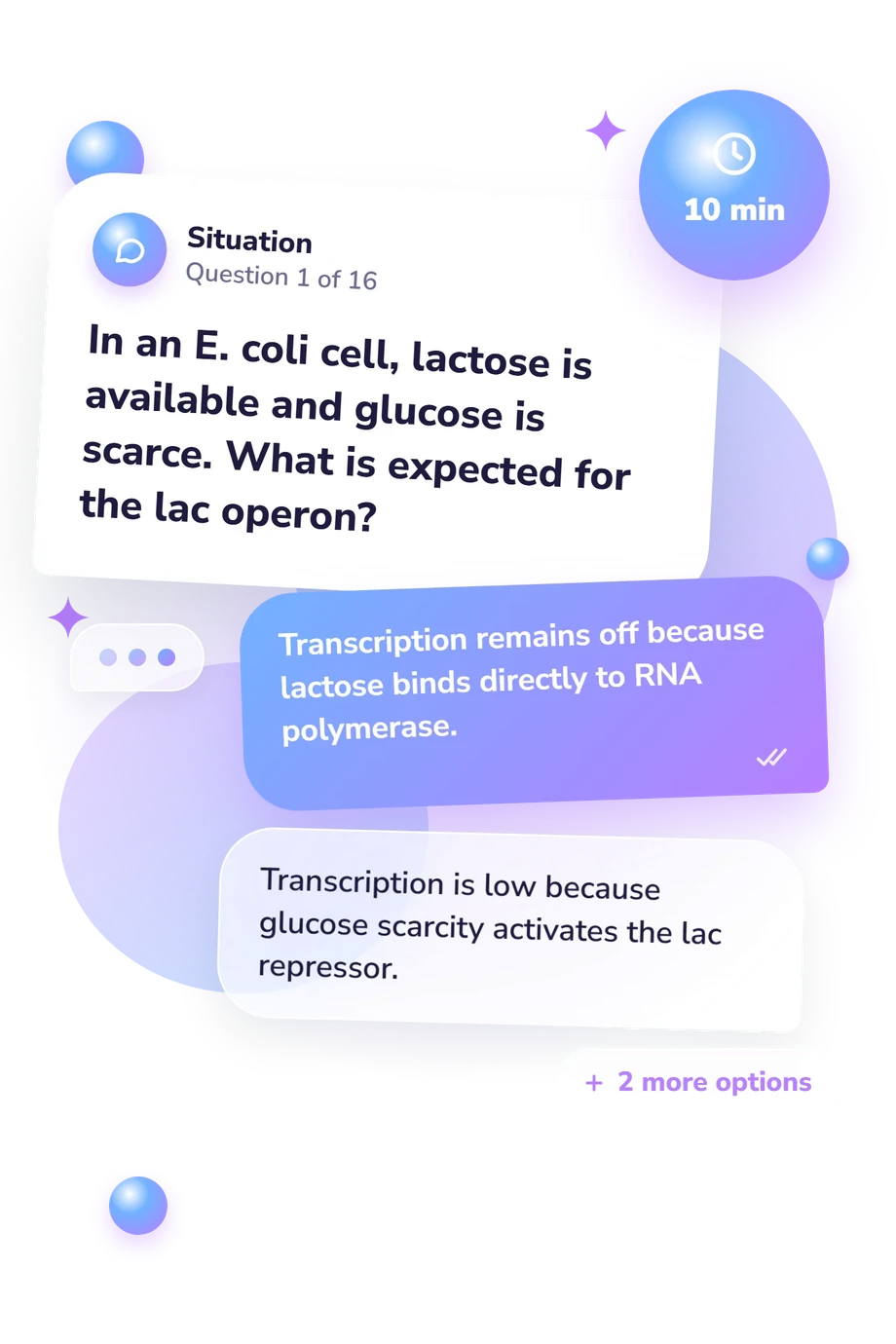
- Transcription remains off because lactose binds directly to RNA polymerase.
- Transcription is low because glucose scarcity activates the lac repressor.
- Transcription is high because the repressor is inactivated and CAP activation is favored.
- The structural genes are permanently removed from the bacterial chromosome.
- Ligase uses the primer to separate the two parental strands.
- Helicase recognizes RNA but cannot recognize DNA.
- DNA polymerase can add nucleotides only to an existing 3′ end.
- RNA nucleotides prevent mutations in newly synthesized DNA.
AP Bio Practice Quiz - Description and methodology of the test
For learners who want an application-focused check of AP Biology knowledge, the AP Bio Practice Quiz supports a decision about whether to continue broad review or move into more demanding practice. It suits independent learners and classroom review, and its scenario-based format makes it a practical AP Biology practice quiz. Questions emphasize mechanisms, evidence, and applications, giving the overall band context for interpreting performance across sampled concepts.
What This Assessment Explores
Questions sample AP Biology reasoning across cellular processes, heredity, evolution, ecology, and experimental design. The groups are:
- Cellular mechanisms link energy, signaling, regulation, and homeostasis to outcomes.
- Genetics and evolution connect inheritance, variation, selection, and relatedness.
- Ecology covers trophic energy flow, resources, population change, and carrying capacity.
- Experimental reasoning shows how controls and evidence support conclusions.
These groups describe content coverage, not separate scores; some course units are absent. The questions provide targeted AP Biology exam practice.
The AP Biology Knowledge scale (0-16) reports performance across sampled concepts. Foundations to Review (0-6) calls for revisiting major concepts and mechanism links; Developing AP Bio Knowledge (7-12) shows many principles understood, with weaker topics to strengthen; Strong AP Bio Knowledge (13-16) shows broad command of sampled concepts; mixed practice and multi-step analysis remain useful. This brief diagnostic is not an official AP score prediction.
Methodology and Evidence Base
Each item presents a biological situation with four answer choices. Respondents select the best explanation or prediction, so the format tests conceptual knowledge alongside transfer, model interpretation, and experimental reasoning. Responses are reported through the single displayed scale, with the displayed band providing the result. Scenarios ask for mechanisms, predictions, and experimental choices rather than isolated term recall.
The AP Biology framework from the College Board organizes content around enduring concepts and science practices. The questions are conceptually consistent with that framework, while their investigation and evidence emphasis also reflects pedagogical themes discussed by Beck, Butler, and Burke da Silva. They provide teaching context, not this questionnaire's scoring model.
Used with notes or teacher feedback, it offers AP Bio study practice by showing performance across the sampled concepts. The limited selection cannot provide a full-course estimate, and results can vary with testing conditions and how each item is read.
- College Board, with contributions from Elizabeth A. Cowles et al. AP Biology Course and Exam Description, Effective Fall 2025. New York, NY: College Board, 2025.
- College Board, with contributions from Elizabeth A. Cowles et al. AP Biology Investigative Labs: An Inquiry-Based Approach, Teacher Manual. New York, NY: College Board, 2012.
- Beck, Christopher, Amy Butler, and Karen Burke da Silva. “Promoting inquiry-based teaching in laboratory courses: are we meeting the grade?” CBE-Life Sciences Education 13, no. 3 (2014): 444-452. 10.1187/cbe.13-12-0245
Updated: