
6th Grade History Quiz
How the Scales are Structured
Who Usually Takes This Test?
See How You Compare
Below is a preview of how scores are typically distributed across each scale.
Example Questions From the Test
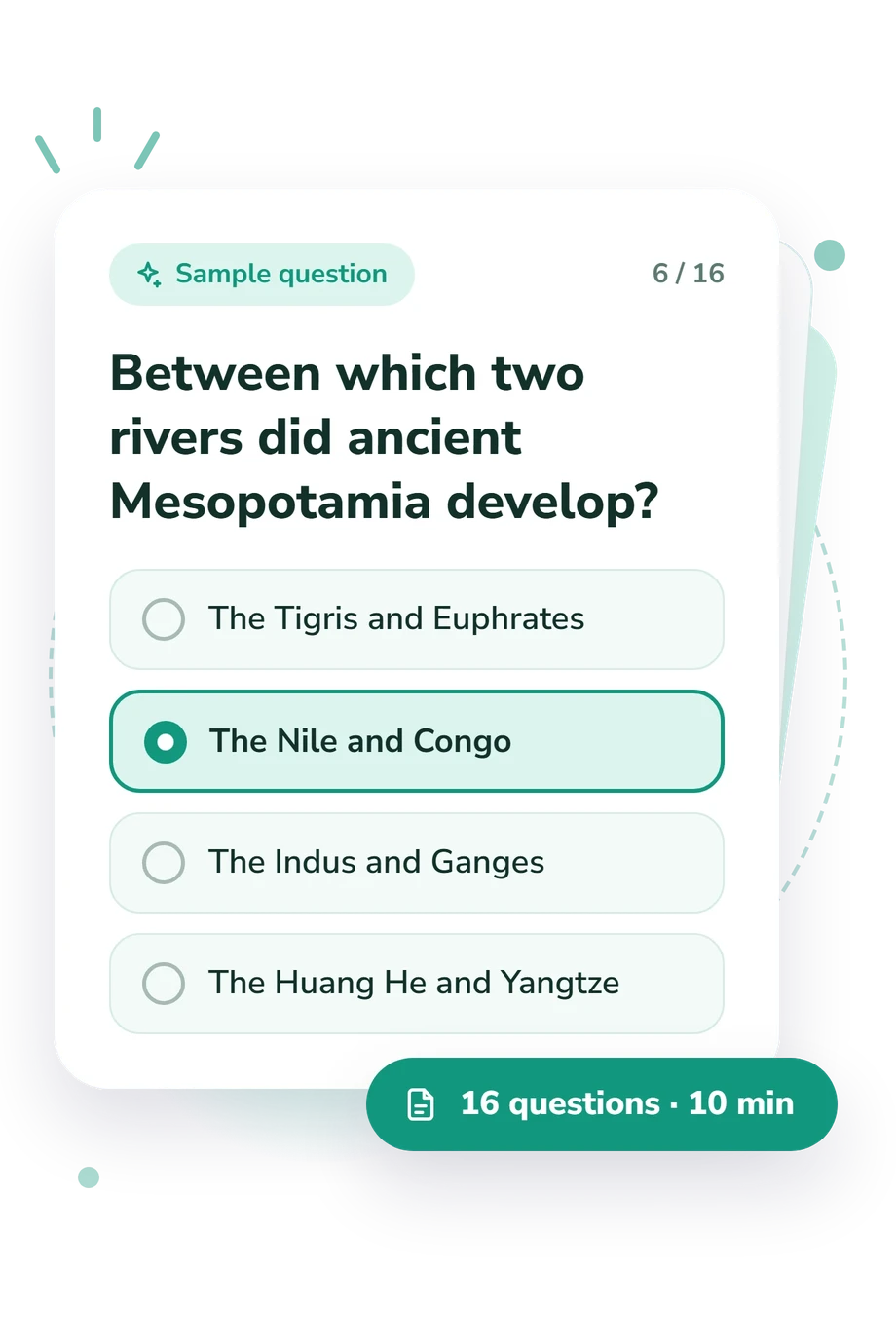
- The Tigris and Euphrates
- The Nile and Congo
- The Indus and Ganges
- The Huang He and Yangtze
- It stopped all crop pests from reaching the fields
- It turned salt water into drinking water
- It allowed farmers to grow crops without sunlight
- It deposited fertile soil and supplied water for crops
- To provide instructions for building pyramids
- To create a calendar based only on the moon
- To set down laws and consequences for offenses
- To record the yearly flooding of the Nile
6th Grade History Quiz - Description and methodology of the test
Students reviewing early world history can use this assessment to check knowledge of core sixth-grade material rather than isolated facts. For students deciding whether this 6th grade history quiz fits their needs, it offers a focused picture of understanding across civilizations, chronology, geography, evidence, and cause and effect. Its broad scope also makes it useful as a 6th grade social studies quiz for targeted review.
What This Assessment Explores
The questions sample knowledge and reasoning in an introductory survey of early world history. They cover agriculture, cities, Mesopotamia, Egypt, Greece, Rome, China, trade, geography, chronology, and primary sources. This ancient civilizations quiz asks readers to connect facts with wider historical processes.
The result appears on the 6th Grade History Knowledge scale, 0-16: Foundations to Build (0-6) means major civilizations, chronology, sources, and cause-and-effect relationships need review; Developing Knowledge (7-12) reflects understanding of central topics, with some periods or comparisons to strengthen; Strong Knowledge (13-16) indicates solid command of common sixth-grade content and evidence interpretation alongside recall.
The main themes are:
- Historical change shows how farming, trade, law, government, and infrastructure shaped societies.
- Time and place explain how chronology and physical geography influenced human decisions.
- Evidence and reasoning require inferences from artifacts, primary sources, and historical causes.
Methodology and Evidence Base
Each item presents a short historical situation or question with four answer choices, asking students to select the option best supported by the information given. The set combines recall with interpretation: it includes dates, artifacts, geography, primary sources, and causal relationships. It therefore works as a world history practice quiz for content and historical thinking.
The online questionnaire reports one overall result. Since no per-answer weighting formula is stated, it is a descriptive summary of performance on these items, not a percentile or norm-referenced standing. Individual answers can reveal gaps in chronology, geography, civilizations, or evidence use.
Its content emphasis is conceptually consistent with National Standards for History (Nash and Crabtree, 1996), the C3 Framework, and Levstik and Barton’s work on historical investigation. These sources support combining knowledge with chronology, evidence, comparison, and causal reasoning; they do not establish that this questionnaire is an adaptation or standardized edition of their work.
Self-report performance can vary with prior instruction, attention, current study context, and confidence, so use the result to choose review topics rather than to make a complete judgment about historical ability.
- Gary B. Nash and Charlotte Crabtree. (1996). National Standards for History: Basic Edition. Los Angeles, CA: National Center for History in the Schools, University of California, Los Angeles. ISBN 0-9633218-4-6.
- National Council for the Social Studies. (2013). The College, Career, and Civic Life (C3) Framework for Social Studies State Standards: Guidance for Enhancing the Rigor of K-12 Civics, Economics, Geography, and History. Silver Spring, MD: National Council for the Social Studies.
- Linda S. Levstik and Keith C. Barton. (2005). Doing History: Investigating with Children in Elementary and Middle Schools (3rd ed.). Mahwah, NJ: Lawrence Erlbaum Associates. 10.4324/9781410613387.
Updated: