
Which Family Guy Character Are You Quiz
How the Scales are Structured
Who Usually Takes This Test?
See How You Compare
Below is a preview of how scores are typically distributed across each scale.
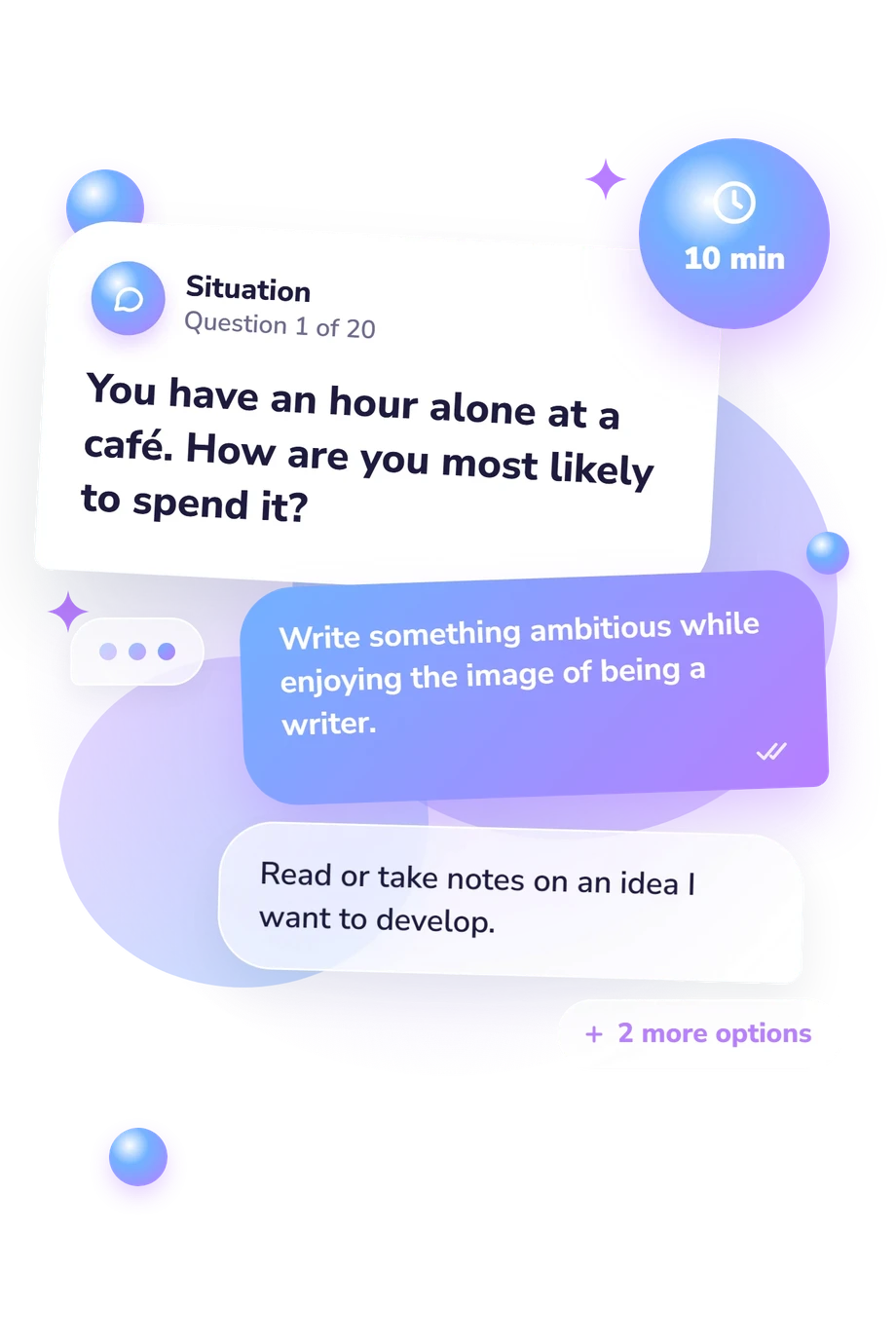
Example Questions From the Test
- Handle my own part and let everyone choose their approach.
- Step back until somebody asks for my input.
- Divide the work collaboratively and check progress later.
- Take charge, set the order, and keep everyone moving.
- Join immediately and assume the details will sort themselves out.
- Try a smaller version with friends before going all in.
- Ask enough questions to understand what could go wrong.
- Choose a familiar activity with fewer moving parts.
- Hope it goes well and prepare more carefully than I admit.
- Confirm the details and look forward to seeing where it leads.
- Wait until that day to decide whether I have the energy.
- Prefer my existing plans or time alone.
Which Family Guy Character Are You Quiz - Description and methodology of the test
For fans who want a light way to compare their habits with familiar fictional personalities, the Family Guy Quiz Which Character Are You turns everyday choices into a character-affinity profile. It frames the what family guy character are you quiz around decisions about creativity, leadership, spontaneity, sensitivity, and strategy. It suits viewers seeking playful self-reflection rather than a fixed personality label.
What This Assessment Explores
Conflict, ambition, creativity, romance, and disorder reveal patterns. Five affinity totals clarify the question behind the what family guy character am i quiz: your highest score marks the match; scores within one point blend.
The affinities are:
- Brian Griffin Affinity (0-12) shows creativity, romance: Unpretentious Path (0-4); Thoughtful Observer (5-8); Brian Energy (9-12).
- Lois Griffin Affinity (0-12) shows leadership, competition, rebellion: Looser Reins (0-4); Capable Challenger (5-8); Lois Energy (9-12).
- Meg Griffin Affinity (0-12) shows sensitivity, persistence, toughness: Independent Orbit (0-4); Quiet Adaptability (5-8); Meg Energy (9-12).
- Peter Griffin Affinity (0-12) shows spontaneity, humor, schemes: Different Frequency (0-4); Occasional Chaos (5-8); or Peter Energy (9-12).
- Stewie Griffin Affinity (0-12) shows planning, wit, invention: Straightforward Style (0-4); Strategic Spark (5-8); Stewie Energy (9-12).
Methodology and Evidence Base
Each item presents a personal or social situation with four response options about conflict, creativity, romance, belonging, responsibility, and surprise. Choosing the closest answer creates a self-report pattern across five affinities. The questionnaire does not disclose individual option weights; displayed totals follow the highest-score rule, while scores within one point produce a blended result.
Character descriptors draw on Callaghan’s 2005 Family Guy books and the series created by Seth MacFarlane, with David Zuckerman serving as an early writer and executive producer. Callaghan’s Stewie-focused guide adds context for strategic imagination, theatrical confidence, and inventive ambition. These are fictional source materials, not scientific evidence or a standardized personality instrument.
Conceptually, this Family Guy character quiz relates to Park and Henley’s 2007 study of personality and preferences for fantasy game characters. That study offers context for linking personality tendencies with fictional preferences, but it does not validate these items, character mappings, ranges, or bands.
Results are descriptive self-report snapshots: mood, context, self-awareness, and identification with a character can influence the pattern, while a blended score signals overlap.
- Callaghan, Steve. Family Guy: The Official Episode Guide, Seasons 1-3. New York: HarperCollins Publishers, 2005. ISBN 9780060833053.
- MacFarlane, Seth, and David Zuckerman. Family Guy. Fox Broadcasting Company, 1999-present.
- Callaghan, Steve. Family Guy: Stewie’s Guide to World Domination. New York: HarperCollins, 2005. ISBN 9780060773212.
- Park, Anna E., and Tracy B. Henley. “Personality and Fantasy Game Character Preferences.” Imagination, Cognition and Personality, vol. 27, no. 1, 2007, pp. 37-46. DOI 10.2190/IC.27.1.d.
Updated: