
Funny What Came First Quiz
How the Scales are Structured
Who Usually Takes This Test?
See How You Compare
Below is a preview of how scores are typically distributed across each scale.
Example Questions From the Test
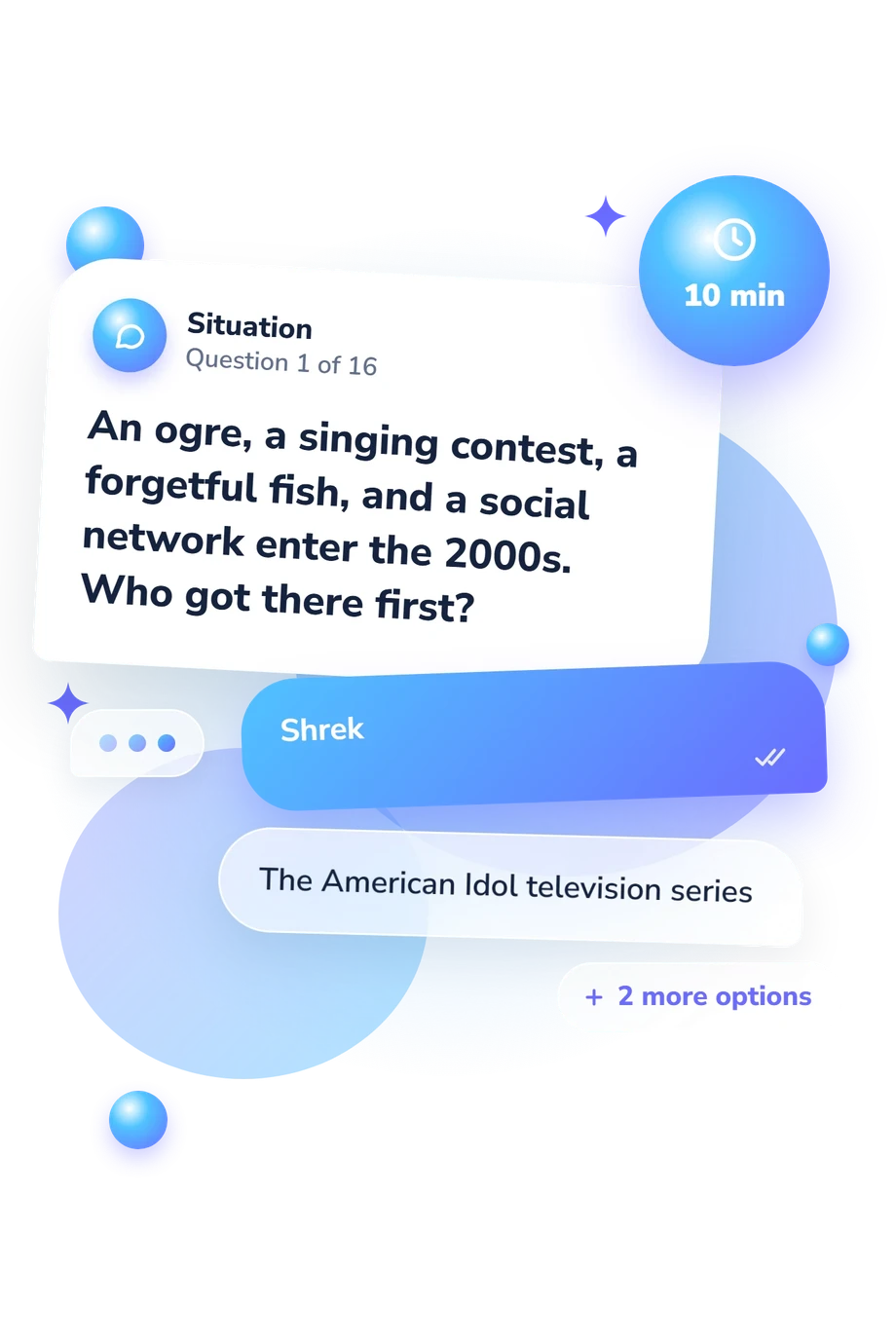
- Shrek
- The American Idol television series
- Finding Nemo
- The debut of the Peanuts comic strip
- Mr. Potato Head going on sale
- The television premiere of I Love Lucy
- Elvis Presley’s first commercial single
- MTV
- The Pac-Man arcade game
- Michael Jackson’s Thriller album
- Super Mario Bros.
Funny What Came First Quiz - Description and methodology of the test
Curious readers who enjoy connecting familiar cultural moments can use the Funny What Came First Quiz to test how accurately they place them in time. Its format makes it a which came first quiz for people who remember films, songs, television, games, brands, and digital milestones but want to test how accurately those memories form a sequence. The result gives a playful snapshot of chronological recall.
What This Assessment Explores
Rather than asking for isolated facts, this pop culture timeline quiz asks you to identify an earliest arrival or arrange several landmarks from oldest to newest. Film, music, television, games, publishing, technology, and online culture all appear, so the task tests sequencing as well as recognition.
That makes it suitable for curious general readers who want to examine cultural memory. The result can show whether you anchor events to eras, confuse neighboring debuts, or maintain an accurate order across decades.
The single dimension is Pop Culture Timeline Knowledge (0-16), presented through these result bands:
- Timeline Tumbler (0-6) indicates that familiar milestones may cross in your memory, so comparing eras and anchor dates could strengthen chronology.
- Culture Chronologist (7-12) indicates that you place many major debuts correctly, although some close neighbors still swap places.
- Time-Travel Expert (13-16) indicates excellent command of pop-culture sequence across multiple eras.
Methodology and Scientific Basis
Each item uses a four-option multiple-choice format. Some questions ask which landmark appeared first; others require ordering four debuts. The items ask for a correct choice or order, while no partial-credit or weighting rules are specified.
The format functions as a chronological trivia quiz built around answers, not ratings of personality or mood. The displayed score summarizes performance on this set of chronology decisions; no partial-credit or answer-weighting rule should be assumed.
The evidence base offers context for current-events knowledge, temporal ordering, and cultural literacy. Beier and Ackerman (2001) connect current-events knowledge with cognitive and nonability influences; Shimamura, Janowsky, and Squire (1990) address temporal-order memory, while Bart and Evans-Stout (1996) discuss cultural literacy. These studies do not establish this questionnaire's validity, and it is not presented as an adaptation or validated equivalent of any one of them.
The questionnaire is an online exercise whose bands describe performance on sequencing decisions, rather than complete cultural knowledge. Performance may vary with generation, education, language, media exposure, and familiarity with English-language culture; the result describes this snapshot, not overall memory or cultural knowledge.
- Beier, Margaret E., and Phillip L. Ackerman. “Current-events knowledge in adults: An investigation of age, intelligence, and nonability determinants.” Psychology and Aging 16, no. 4 (2001): 615-628. 10.1037/0882-7974.16.4.615
- Shimamura, Arthur P., Jeri S. Janowsky, and Larry R. Squire. “Memory for the temporal order of events in patients with frontal lobe lesions and amnesic patients.” Neuropsychologia 28, no. 8 (1990): 803-813. 10.1016/0028-3932(90)90004-8
- Bart, William M., and Karen Evans-Stout. “An investigation of cultural literacy among high school students and prospective high school teachers.” Psychological Reports 79, no. 3, Part II (1996): 1163-1168. 10.2466/pr0.1996.79.3f.1163
Updated: