
Masculine Archetype Quiz
How the Scales are Structured
Who Usually Takes This Test?
See How You Compare
Below is a preview of how scores are typically distributed across each scale.
Example Questions From the Test
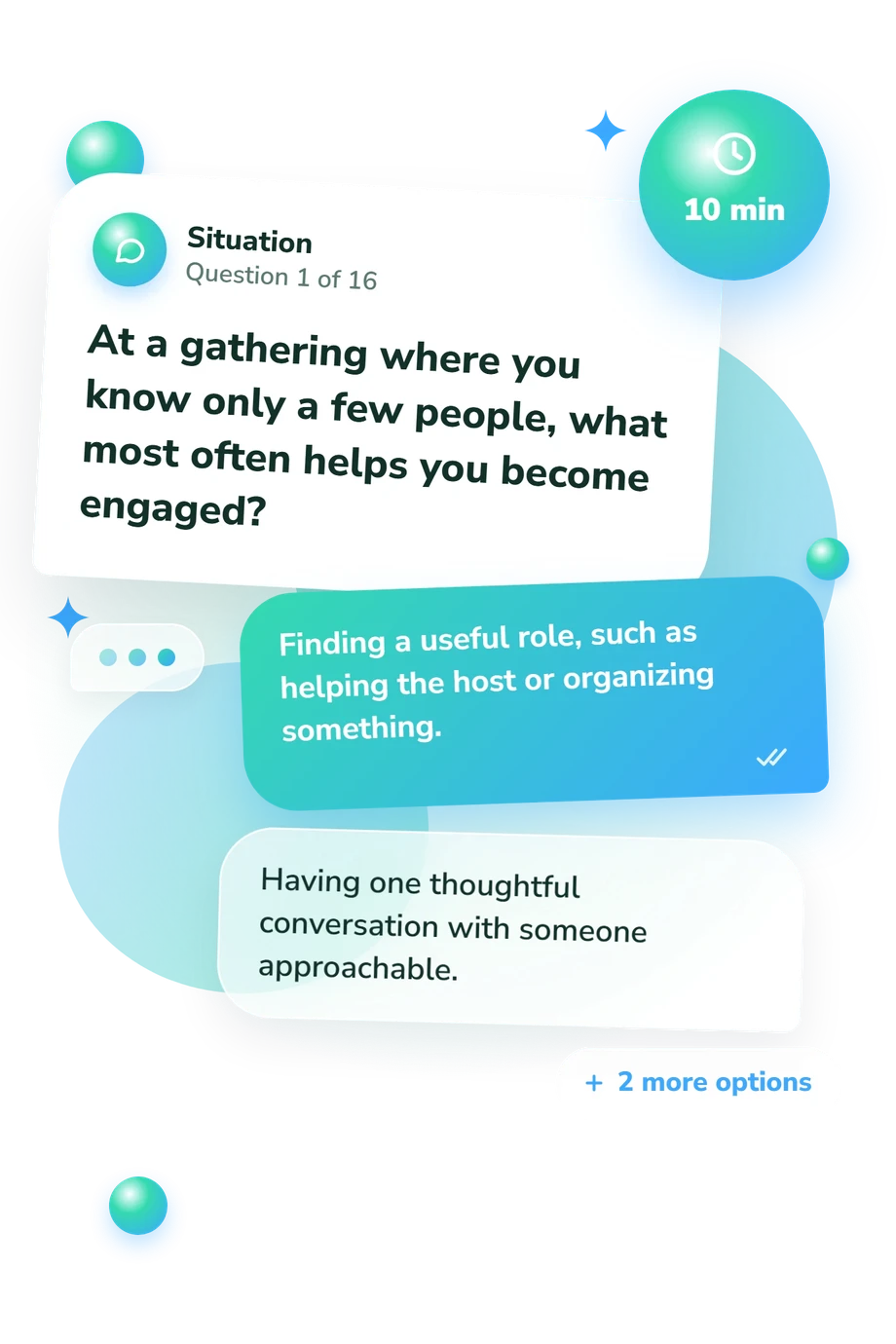
- Finding a useful role, such as helping the host or organizing something.
- Having one thoughtful conversation with someone approachable.
- Observing the mood until I know where I fit.
- Following the warmth, humor, music, or conversation that makes the room feel alive.
- Clarify the purpose, invite key views, and establish a direction everyone can work from.
- Take ownership of one difficult part and complete it independently.
- Suggest a simple division of responsibilities so the group can begin.
- Support whoever steps forward to coordinate the group.
- A reliable method they can apply immediately.
- A new perspective that changes how they understand the situation.
- A useful observation that helps them refine their plan.
- Hands-on assistance that reduces the burden in front of them.
Masculine Archetype Quiz - Description and methodology of the test
People who want to understand how they approach connection, insight, responsibility, and purposeful action can use this masculine archetype quiz as a structured reflection exercise. A masculine type quiz can make recurring patterns easier to name without reducing them to a single stereotype. The result offers a profile of current affinities, helping you notice strengths, tensions, and areas for deliberate development.
What This Assessment Explores
These patterns describe tendencies, not fixed identities. Situations involving connection, setbacks, learning, responsibility, boundaries, beauty, and persistence reveal which responses feel familiar. Your male archetype quiz result can show a leading affinity or a blended pattern. The dimensions are:
- Lover (0-12) reflects broad, nonsexual connection: Reserved Appreciator (0-4) is understated, Responsive Connector (5-8) welcomes feeling and closeness, and Vivid Participant (9-12) shows wholehearted engagement.
- Magician (0-12) measures interpretation: Practical Knower (0-4) trusts direct experience, Curious Interpreter (5-8) seeks patterns, and Transformative Insight (9-12) pursues perspective shifts.
- Sovereign (0-12) measures stewardship: Quiet Stewardship (0-4) favors informal influence, Emerging Steward (5-8) creates direction, and Guiding Presence (9-12) emphasizes purpose and fair responsibility.
- Warrior (0-12) measures disciplined purpose rather than aggression: Selective Mobilizer (0-4) conserves effort, Purposeful Striver (5-8) sustains priorities, and Focused Protector (9-12) uses decisive action and firm boundaries.
Methodology and Scientific Basis
Each scenario offers four response choices describing ordinary ways of handling a situation rather than clinical symptoms. Responses are tallied into the profile: the highest score marks the strongest current affinity, while scores within one point indicate a blended result.
The conceptual anchor is the King, Warrior, Magician, Lover framework (Moore & Gillette, 1990), which uses four recurring archetypal energies to consider mature masculine development without treating them as exclusive personality boxes. Jung’s archetype concept provides broader context, while Roesler (2021) examines archetypes in theory and research. This questionnaire is conceptually consistent with those works, not a reproduction or validated adaptation of them.
Taken in context, a masculinity archetype assessment result invites reflection on current habits and preferences. Self-report can shift with mood, circumstances, self-awareness, and the wish to present oneself favorably. The bands are interpretive descriptors rather than population norms or clinical thresholds, so they support pattern-spotting rather than a fixed identity.
- Moore, Robert L., and Douglas Gillette. King, Warrior, Magician, Lover: Rediscovering the Archetypes of the Mature Masculine. HarperSanFrancisco, 1990.
- Jung, C. G. The Archetypes and the Collective Unconscious. 2nd ed. Princeton University Press, 1968.
- Roesler, Christian. C. G. Jung’s Archetype Concept: Theory, Research and Applications. Routledge, 2021. 10.4324/9781003058458
Updated: