
Should I Support Israel or Palestine Quiz
How the Scales are Structured
Who Usually Takes This Test?
See How You Compare
Below is a preview of how scores are typically distributed across each scale.
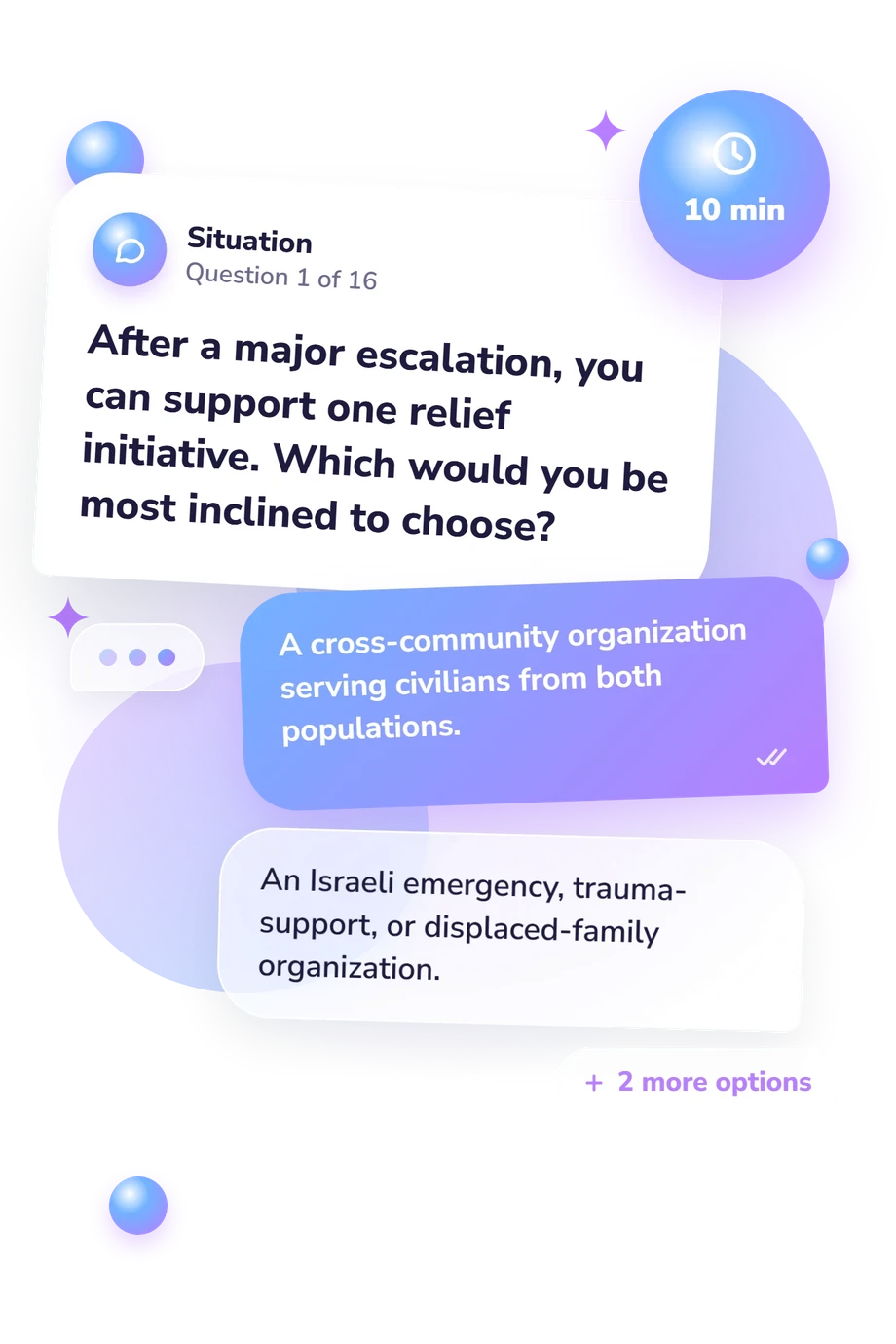
Example Questions From the Test
- Compare their individual proposals, likely consequences, legal constraints, and consistency rather than relying on labels.
- Start with their broad commitments, then investigate the details that matter most to me.
- Prefer the candidate who most clearly promotes reciprocal security and rights for both peoples.
- Prefer the candidate whose overall alignment matches my established pro-Israel or pro-Palestine position.
- Focus mainly on the Palestinian civilian impact and the unequal power affecting Palestinians’ ability to secure their rights.
- Center Israeli civilians’ right to security while insisting that military conduct protect civilians and follow legal constraints.
- Avoid a national alignment and speak primarily about protecting every civilian affected.
- Give substantial weight to Israel’s security needs while judging whether the particular response is proportionate and constrained.
- Treat the report as a reason to advocate directly against policies restricting Palestinian rights and stability.
- Call for remedies while also examining the security rationale and details of each measure.
- Place the report within a broader appeal for equal safety and dignity for both peoples.
- Continue prioritizing Israel’s security framework unless a specific measure is shown to be unnecessary.
Should I Support Israel or Palestine Quiz - Description and methodology of the test
People who want to examine how they form political judgments can use this questionnaire to compare principles without forcing every issue into one durable label. The Should I Support Israel or Palestine Quiz is intended for readers reflecting on civilian safety, rights, political agency, evidence, and policy detail. The result from this Israel or Palestine quiz shows the orientation or combination of orientations that most strongly organizes those choices.
What This Assessment Explores
This Israel-Palestine quiz contrasts four perspectives. The highest score indicates strongest affinity; a result within one point is a blended profile, with no tie-breaker.
These dimensions are:
- Independent Issue-by-Issue Stance (0-12) shows separate evaluation of claims, organizations, leaders, policies: Limited independence (0-4), Selective independence (5-8), Strong independence (9-12).
- Israel-Centered Support (0-12) shows Israeli continuity, civilian security, hostage recovery, and humanitarian limits: Limited affinity (0-4), Conditional affinity (5-8), Strong affinity (9-12).
- Palestine-Centered Support (0-12) shows Palestinian freedom, self-determination, equal rights, civilian protection, and relief from displacement or occupation: Limited affinity (0-4), Conditional affinity (5-8), Strong affinity (9-12).
- Shared Security and Equal Rights (0-12) shows both peoples’ safety, dignity, rights, and political future: Limited affinity (0-4), Conditional affinity (5-8), Strong affinity (9-12).
Methodology and Scientific Basis
Each item presents a dilemma with four response options. The choices distinguish detail-first, Israel-centered, Palestine-centered, and shared-population reasoning, while allowing conditional positions based on evidence, safeguards, or humanitarian effects.
Responses feed four outcomes rather than one ideological score. Together, they show how a respondent’s Israel-Palestine stance combines issue-by-issue judgment, Israel-centered priorities, Palestine-centered priorities, and shared rights. The displayed ranges should not be reverse-engineered into a formula because point values for individual answers are not published.
The closest conceptual reference is the Israeli-Palestinian Conflict Perception Questionnaire (Bulska & Winiewski, 2018); this questionnaire is conceptually consistent with that work, not an adaptation. Khatib, Canetti, and Rubin (2018) differentiate conflict perceptions, while Maoz and McCauley (2005) examine attitudes toward compromise and conflict positions. These studies are conceptual comparators and do not by themselves document this online questionnaire’s standardization, norms, or validation.
Self-report answers can shift with current events, emotional context, information, self-awareness, and self-presentation. The displayed bands are interpretive categories rather than population norms or clinical thresholds, so the profile captures stated priorities at the time of completion.
- Bulska, Dominika, and Mikołaj Winiewski. (2018). "Irrational Critique of Israel and Palestine: New Clothes for Traditional Prejudice?" Social Psychological Bulletin, 13(1), Article e25497. 10.5964/spb.v13i1.25497
- Khatib, Ibrahim, Daphna Canetti, and Aviad Rubin. (2018). "Conflict perception: a new scale with evidence from Israel and Palestine." International Journal of Conflict Management, 29(3), 376-397. 10.1108/IJCMA-06-2017-0048
- Maoz, Ifat, and Clark McCauley. (2005). "Psychological Correlates of Support for Compromise: A Polling Study of Jewish-Israeli Attitudes toward Solutions to the Israeli-Palestinian Conflict." Political Psychology, 26(5), 791-808. 10.1111/j.1467-9221.2005.00444.x
Updated: