
Operations Management Quiz
How the Scales are Structured
Who Usually Takes This Test?
See How You Compare
Below is a preview of how scores are typically distributed across each scale.
Example Questions From the Test
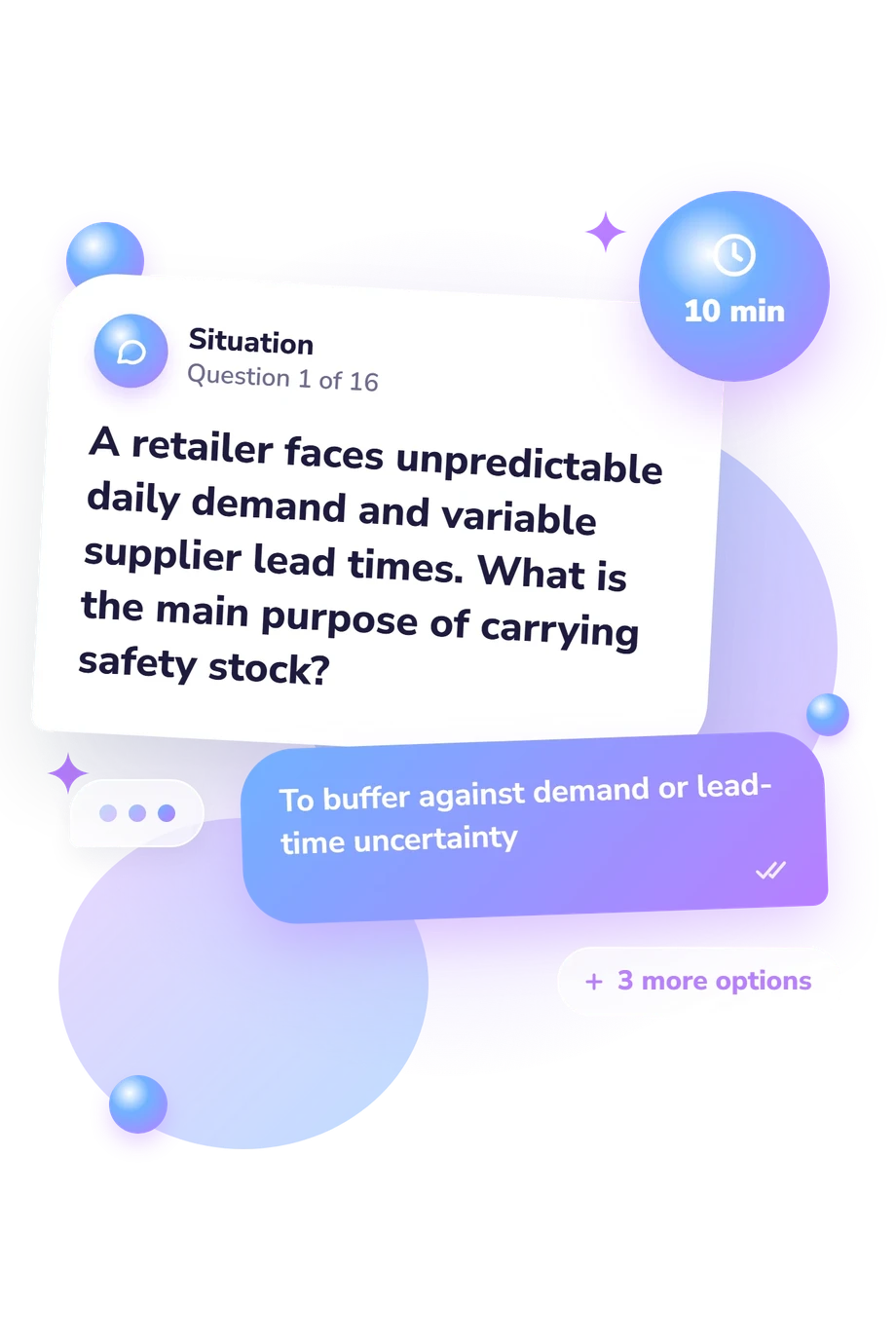
- To buffer against demand or lead-time uncertainty
- To guarantee that inventory holding costs fall
- To replace the need for cycle inventory
- To increase the size of every replenishment order
- Purchase cost and shortage cost
- Transportation cost and inspection cost
- Labor cost and equipment depreciation
- Ordering cost and inventory holding cost
- Availability, performance, and quality
- Cost, speed, and flexibility
- Demand, capacity, and utilization
- Reliability, maintainability, and inventory
Operations Management Quiz - Description and methodology of the test
Designed for learners, managers, and professionals who want to check practical command of operational decision-making, this operations management quiz turns familiar workplace situations into a focused knowledge check. It shows how confidently you connect demand, resources, process design, quality, and supply flow. Reviewing questions and answers from a quiz on operations management can help you identify strengths and choose topics for focused study.
What This Assessment Explores
The assessment checks how well a respondent connects inputs, processes, resources, and outputs in operational decisions. It suits learners and professionals seeking a practical review of core concepts rather than a measure of workplace performance.
Its scenarios examine:
- Inventory and forecasting show how demand variation, lead times, safety stock, and moving averages shape decisions.
- Process flow and capacity show how bottlenecks, utilization, cycle time, and Little’s Law limit output.
- Quality and equipment measures show how Pareto analysis, mistake-proofing, and OEE support consistency.
- Production and supply systems show how push and pull control, make-to-order choices, project paths, and the bullwhip effect differ.
Viewed as operations quiz questions, the items describe situations in which the result reflects breadth of operations knowledge. Operations Management Knowledge (0-16) is reported as Foundations to Build (0-6), Developing Operator (7-12), or Strong Command (13-16).
Methodology and Evidence Base
Each item presents a short workplace or calculation scenario with four answer choices, and the respondent selects the best response. This format tests recognition and application rather than extended written explanation.
Several operations management assessment items require arithmetic involving Little’s Law, moving averages, utilization, or critical-path reasoning; others ask whether a named tool fits a situation.
The questionnaire presents one displayed knowledge result rather than separate subscales. It has no stated external norms, reliability estimate, or standardized administration, so use the outcome as a focused guide to concepts for review, not as a professional qualification.
Its conceptual reference point is Heizer et al. (2022), which covers process strategy, inventory, capacity, quality, scheduling, and supply chains. The questions are conceptually consistent with Little’s Law, the bullwhip effect studied by Lee, Padmanabhan, and Whang, and OEE in Nakajima’s TPM framework. They are not presented as adaptations of those published works.
Guessing, memory, and familiarity with textbook terminology can affect performance, so read the result alongside practical experience and broader learning, especially when one unfamiliar topic lowers the overall outcome.
- Heizer, Jay, Barry Render, and Chuck Munson. Operations Management: Sustainability and Supply Chain Management. 14th ed. Pearson, 2022.
- Little, John D. C. "A Proof for the Queuing Formula: L = λW." Operations Research, vol. 9, no. 3, 1961, pp. 383-387. DOI 10.1287/opre.9.3.383.
- Lee, Hau L., V. Padmanabhan, and Seungjin Whang. "Information Distortion in a Supply Chain: The Bullwhip Effect." Management Science, vol. 43, no. 4, 1997, pp. 546-558. DOI 10.1287/mnsc.43.4.546.
- Nakajima, Seiichi. Introduction to TPM: Total Productive Maintenance. Productivity Press, 1988.
Updated: