
Maslow's Hierarchy of Needs Quiz
How the Scales are Structured
Who Usually Takes This Test?
See How You Compare
Below is a preview of how scores are typically distributed across each scale.
Example Questions From the Test
- Urgent physiological and safety needs often become more immediately motivating than longer-term growth goals.
- Belonging always matters less than every material concern.
- Self-actualization can occur only after all hardship has permanently ended.
- Career development is not a genuine human need.
- It is more socially admirable than other needs.
- It is learned entirely through rewards and punishment.
- It remains equally urgent regardless of circumstances.
- It tends to dominate motivation until it is adequately gratified.
- Wanting reliable access to food and water
- Wanting to feel competent and have one’s contribution respected
- Wanting protection from immediate danger
- Wanting affectionate relationships and group acceptance
Maslow's Hierarchy of Needs Quiz - Description and methodology of the test
Readers who want to study motivation theory can use the Maslow's Hierarchy of Needs Quiz as a focused knowledge check of the model's levels, applications, and qualifications. It suits students, educators, and curious learners who want to test their understanding rather than rate personal wellbeing. The overall band from this Maslow quiz signals how much of the hierarchy may be worth reviewing.
What This Test Measures
Questions test whether you can identify the progression from physiological and safety needs through love and belonging, esteem, and self-actualization. They apply the model to housing disruption, isolation, work insecurity, confidence, creativity, and competing priorities. The result describes understanding of the model, not your personal place within it.
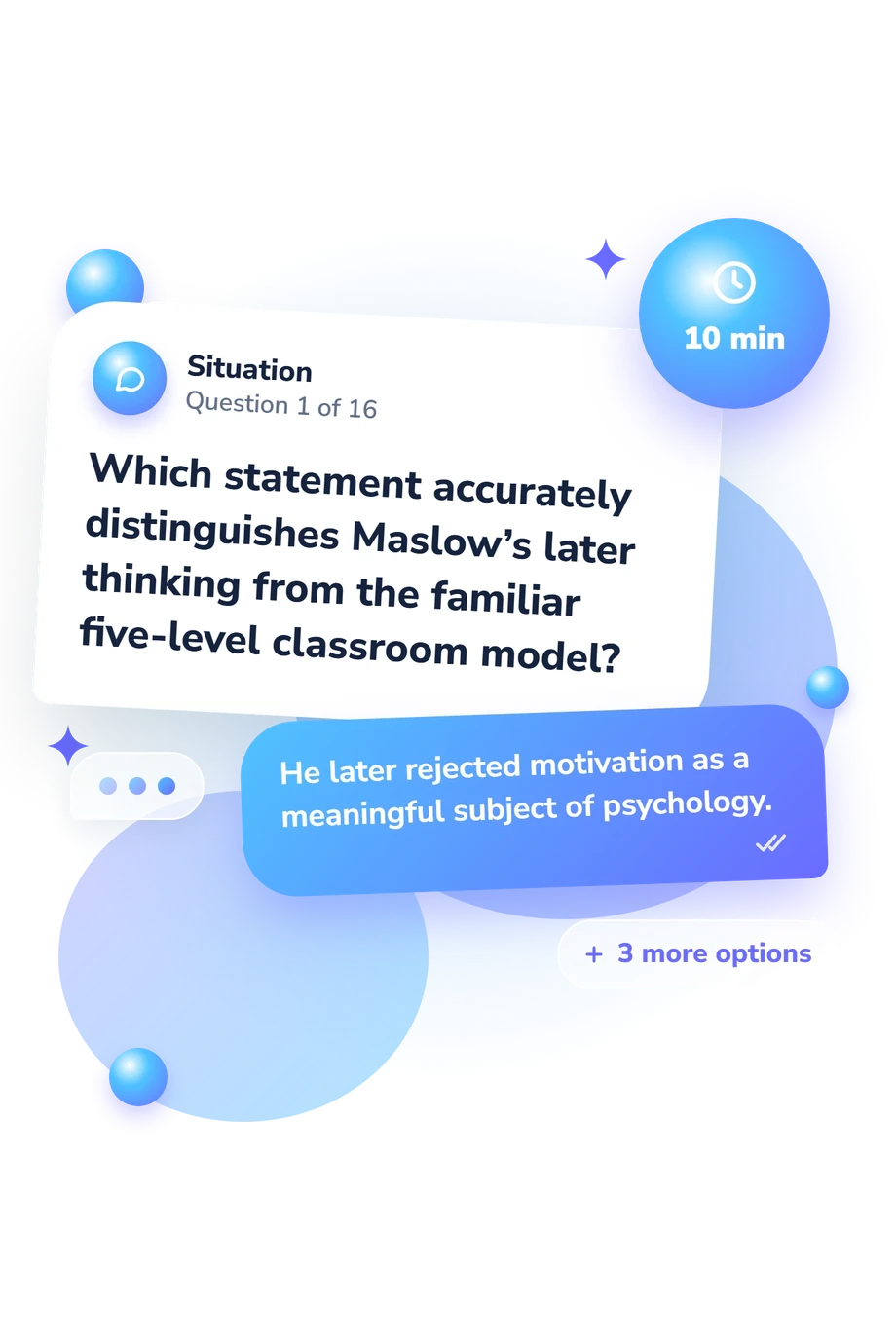
Items distinguish the classroom pyramid from Maslow’s later discussion of cognitive, aesthetic, and self-transcendence needs. They test prepotency, partial gratification, and pursuit of several needs at once. The questionnaire emphasizes interpreting Maslow's hierarchy of needs theory rather than memorizing a rigid ladder.
The Maslow’s Hierarchy of Needs Knowledge scale runs from 0 to 16, with these bands:
- Foundation to build (0-6) shows recognition of core ideas, with confusion about levels or rigidity possible.
- Developing understanding (7-12) indicates command of the model, with nuance still developing.
- Strong understanding (13-16) reflects accurate application and awareness of qualifications.
Methodology and Evidence Base
Each item presents a conceptual or applied question with four answer choices. Selecting the best answer adds one correct response to the displayed total; the score is a count of correct answers, not a rating of personal need, wellbeing, or motivation. The questionnaire is a focused knowledge check of Maslow's needs theory: each item is judged by answer accuracy.
Maslow's hierarchy supplies the core framework: deprivation can make lower needs more prepotent, while higher motives may remain meaningful. Later work by Maslow discusses ideas such as cognitive, aesthetic, and self-transcendence needs. Wahba and Bridwell's review reported mixed support for a strict universal ordering. The questionnaire is conceptually consistent with these works, not an adaptation of them.
Interpret the result as a learning profile. A stronger band suggests accurate recognition of levels, scenarios, qualifications, and later developments; a lower band identifies topics to revisit rather than a fixed limit on understanding. Because this questionnaire uses a raw correct-answer count without norm-based comparison, performance can reflect prior study, attention, and wording interpretation. Cultural context and changing circumstances can also shape interpretation.
- Maslow, A. H. (1943). A theory of human motivation. Psychological Review, 50(4), 370-396. 10.1037/h0054346
- Maslow, A. H. (1954). Motivation and personality. New York, NY: Harper & Brothers.
- Wahba, M. A., & Bridwell, L. G. (1976). Maslow reconsidered: A review of research on the need hierarchy theory. Organizational Behavior and Human Performance, 15(2), 212-240. 10.1016/0030-5073(76)90038-6
Updated: