
How Well Do You Know Your Mom Quiz
How the Scales are Structured
Who Usually Takes This Test?
See How You Compare
Below is a preview of how scores are typically distributed across each scale.
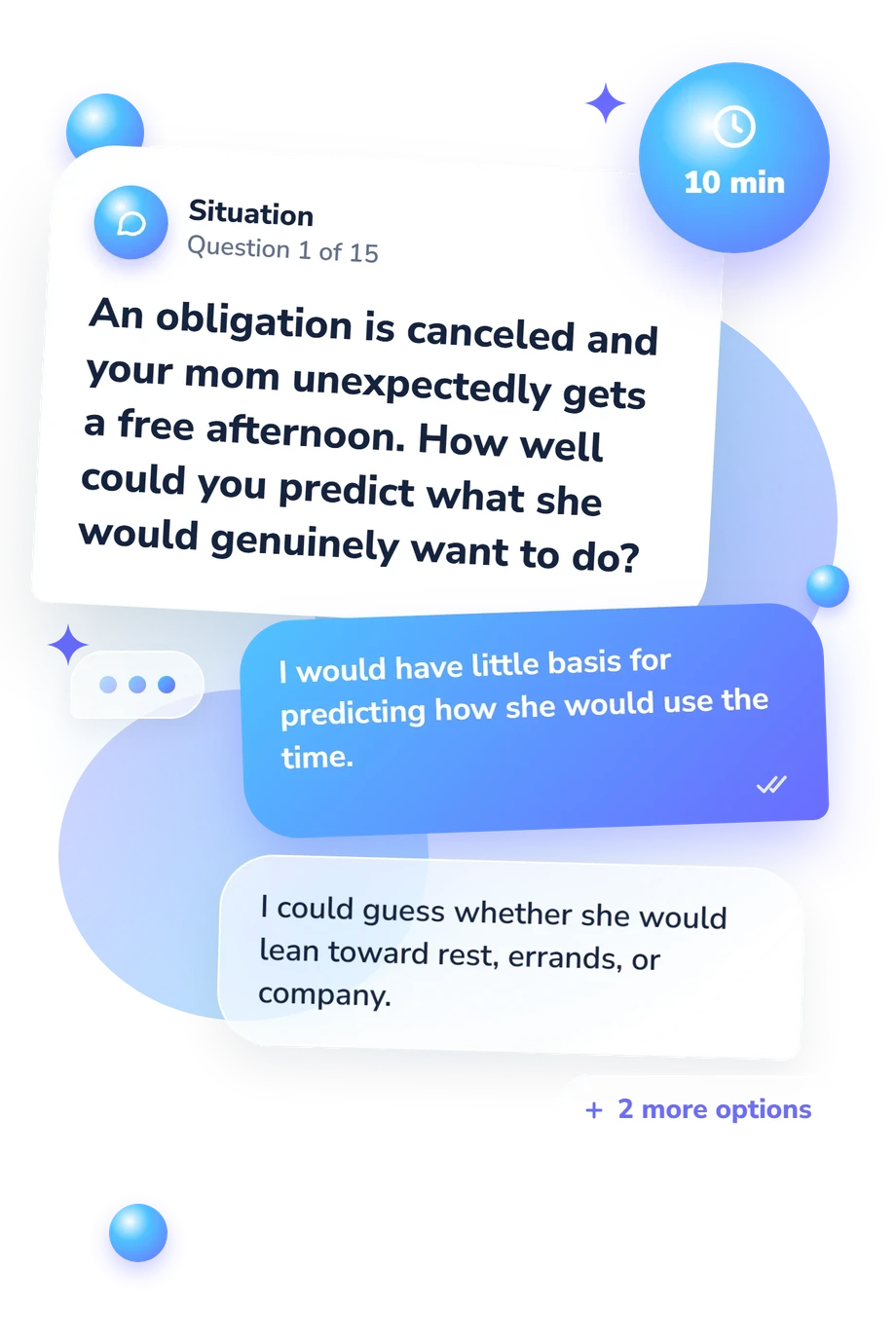
Example Questions From the Test
- I would have little basis for predicting how she would use the time.
- I could guess whether she would lean toward rest, errands, or company.
- I could name one or two activities she would probably choose.
- I could predict her likely choice and explain what might make her choose differently.
- I know little about where or how she grew up.
- I know a place name or one basic fact about her childhood home.
- I know several details about the places, people, or routines of her childhood.
- I understand how those settings changed over time and what they meant to her.
- I know her present or most visible role, but little about the path leading to it.
- I know one or two earlier roles or choices without much detail.
- I know the main stages and some reasons behind her transitions.
- I understand the main stages, trade-offs, detours, and goals she has chosen to discuss.
How Well Do You Know Your Mom Quiz - Description and methodology of the test
For adult children and other family members, the How Well Do You Know Your Mom Quiz offers a structured way to examine what they believe they know about one important relationship. The mom quiz questions can guide reflection when a result feels surprising: it summarizes perceived awareness based on what a mother has shared, rather than establishing objective accuracy or privileged access to her inner life.
What This Assessment Explores
The questionnaire measures perceived awareness of a mother’s daily patterns, life story, and current inner world. Rather than treating familiarity as proof of closeness, it asks about knowledge that can be observed, remembered, or discussed. This ur mom quiz suits anyone interested in understanding your mother more thoughtfully, showing where their awareness is detailed, broad, or ready for a conversation.
The three result dimensions are:
- Everyday Preferences and Routines (0-15) shows how confidently you recognize tastes, routines, and sources of comfort: Room to discover (0-5), Familiar picture (6-10), or Detailed understanding (11-15).
- Personal History and Formative Experiences (0-15) reflects knowledge of experiences and choices that shaped her life: Mostly uncharted (0-5), Key chapters known (6-10), or Rich life-story context (11-15).
- Present Priorities and Inner World (0-15) captures awareness of current concerns, joys, relationships, and hopes: Limited current view (0-5), General awareness (6-10), or Nuanced current picture (11-15).
Methodology and Evidence Base
Each item describes a situation and offers four ordered responses, moving from uncertain knowledge toward specific, contextual understanding. Answers feed the three domains, each with its own result and band; no undisplayed point value should be inferred.
Ordered knowledge responses distinguish specific awareness from broad impressions, clarifying the focus of this how well do you know your mother quiz. Conceptually, its focus is consistent with Cho et al. (2010) on interpersonal knowledge and Pronin et al. (2001) on asymmetric insight, where people may feel they understand someone more deeply than that person understands them. These studies provide context, not validation, norms, or scoring evidence for this online questionnaire, which is not adapted from either source.
Interpretation should stay close to the displayed labels: a higher band indicates more perceived awareness in that domain, not a verified account of a mother’s thoughts or relationship quality. Memory, assumptions, recent contact, and what she chooses to share can shape responses, so scores are reflective summaries rather than proof of relationship quality.
- Cho, Y., Otani, H., Han, K., & Van Horn, K. R. (2010). Cultural differences in asymmetric beliefs of interpersonal knowledge in vertical and horizontal relationships. The Journal of General Psychology, 137(4), 343-361. 10.1080/00221309.2010.499396
- Pronin, E., Kruger, J., Savitsky, K., & Ross, L. (2001). You Don't Know Me, But I Know You: The Illusion of Asymmetric Insight. Journal of Personality and Social Psychology, 81(4), 639-656. 10.1037/0022-3514.81.4.639
- Legree, P. J. (1995). Evidence for an Oblique Social Intelligence Factor Established with a Likert-Based Testing Procedure. Intelligence, 21(3), 247-266. 10.1016/0160-2896(95)90016-0
Updated: