
Spanish Family Members Quiz
How the Scales are Structured
Who Usually Takes This Test?
See How You Compare
Below is a preview of how scores are typically distributed across each scale.
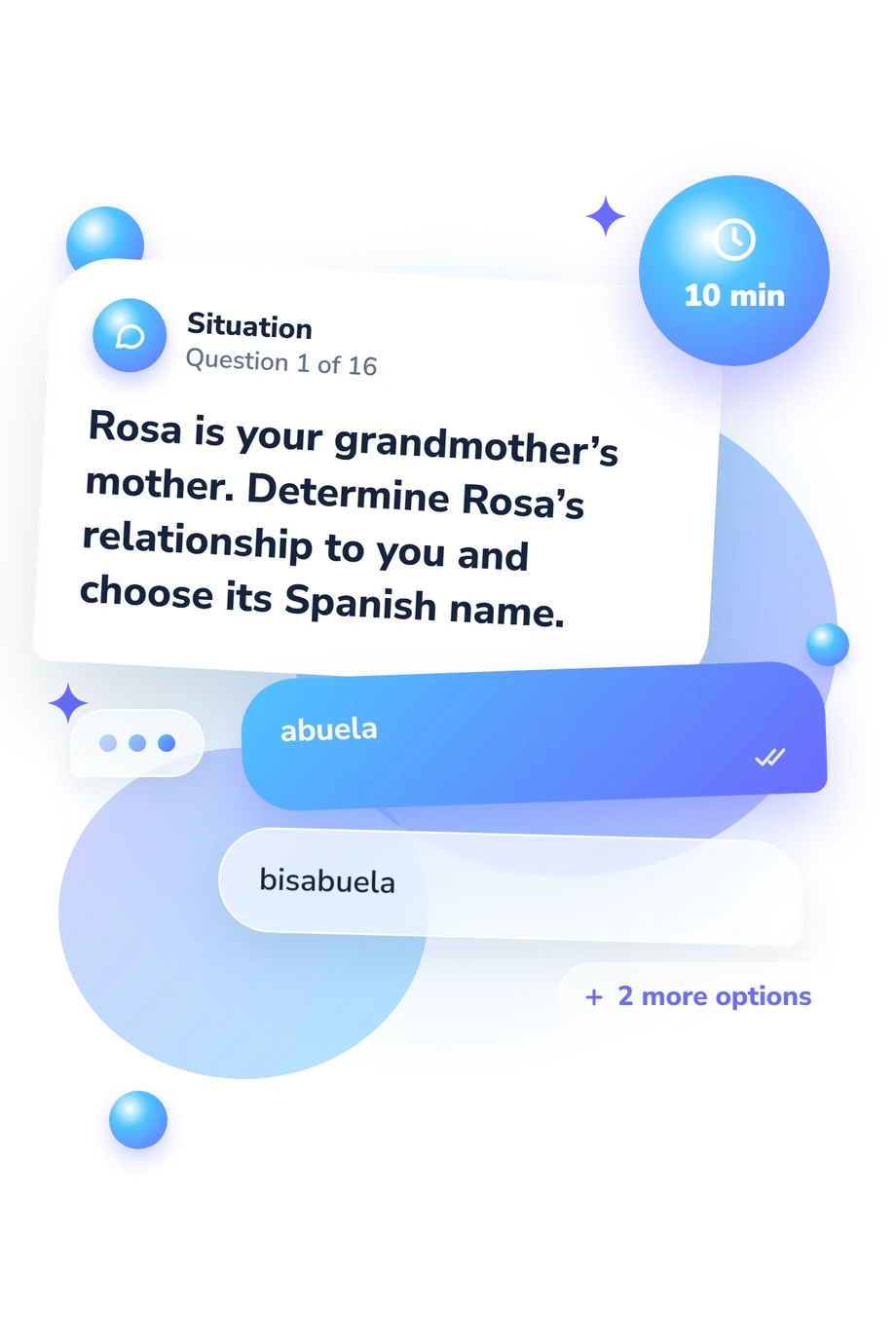
Example Questions From the Test
- abuela
- bisabuela
- madrina
- suegra
- suegra
- cuñada
- madrastra
- nuera
- tía
- sobrina
- prima
- suegra
Spanish Family Members Quiz - Description and methodology of the test
For learners who want to check their grasp of everyday relationship terms, the Spanish Family Members Quiz turns familiar family situations into a focused language-learning exercise. It is suitable for independent students, travelers, and anyone rebuilding basic Spanish vocabulary. This Spanish family quiz gives a practical snapshot of which kinship words you recognize and where targeted review could make communication easier.
What This Test Measures
Rather than testing broad fluency, the questionnaire concentrates on naming relatives and interpreting family relationships. The situations cover direct terms for parents, children, siblings, grandparents, aunts, uncles, cousins, nieces, and nephews, alongside relationships created through marriage or remarriage. The tested Spanish kinship vocabulary includes distinctions such as gendered nouns, plural family labels, and generation-based relationships.
Spanish Family Members Knowledge is reported on a 0-16 scale. The result bands describe the level of command shown by the answers:
- Building Foundations (0-6) indicates recognition of some core vocabulary, with review useful for gendered endings and generations.
- Developing Knowledge (7-12) indicates familiarity with many common terms while extended, blended, or in-law relationships may still cause difficulty.
- Strong Knowledge (13-16) indicates reliable recognition in both direct naming tasks and short relationship scenarios.
Methodology and Language References
Each item presents an English-language situation, translation prompt, or sentence completion with four choices. Items link relationship descriptions with appropriate Spanish nouns rather than isolated words. The result is one knowledge score, not a clinical interpretation, diagnostic threshold, or norm-referenced classification.
Conceptually, the content is consistent with kinship terminology discussed by De Toffol (2011), while Butt, Benjamin, and Moreira Rodríguez provide a grammatical reference for modern Spanish. Moncó Rebollo and Rivas Rivas are relevant to naming in reconstituted families, reflected in step-relation items; in-law items belong to this questionnaire rather than that study. These sources support language and terminology only; they do not establish reliability, validity, or norms for this online questionnaire, which is not a standardized adaptation of one published instrument.
Performance can reflect study, memory, reading comprehension, or uncertainty about a family arrangement. As a Spanish family names quiz, it is best interpreted as a learning profile: a lower band points to review topics, while a higher band suggests stronger recognition within the tested range. It does not measure conversational fluency, pronunciation, cultural competence, or every regional alternative.
- De Toffol, Marta. An English-Spanish Contrastive Analysis of Culturally Loaded Phraseological Units Containing Kinship Terms. Master's thesis, Complutense University of Madrid, 2011.
- Butt, John, Carmen Benjamin, and Antonia Moreira Rodríguez. A New Reference Grammar of Modern Spanish. 6th ed. Routledge, 2019. 10.4324/9781315648446.
- Moncó Rebollo, Beatriz, and Ana María Rivas Rivas. The Importance of Naming: The Use of Kinship Terminology in Reconstituted Families. Gazeta de Antropología, vol. 23, article 23, 2007. 10.30827/DIGIBUG.7038.
Updated: