
Flag Football Quiz
How the Scales are Structured
Who Usually Takes This Test?
See How You Compare
Below is a preview of how scores are typically distributed across each scale.
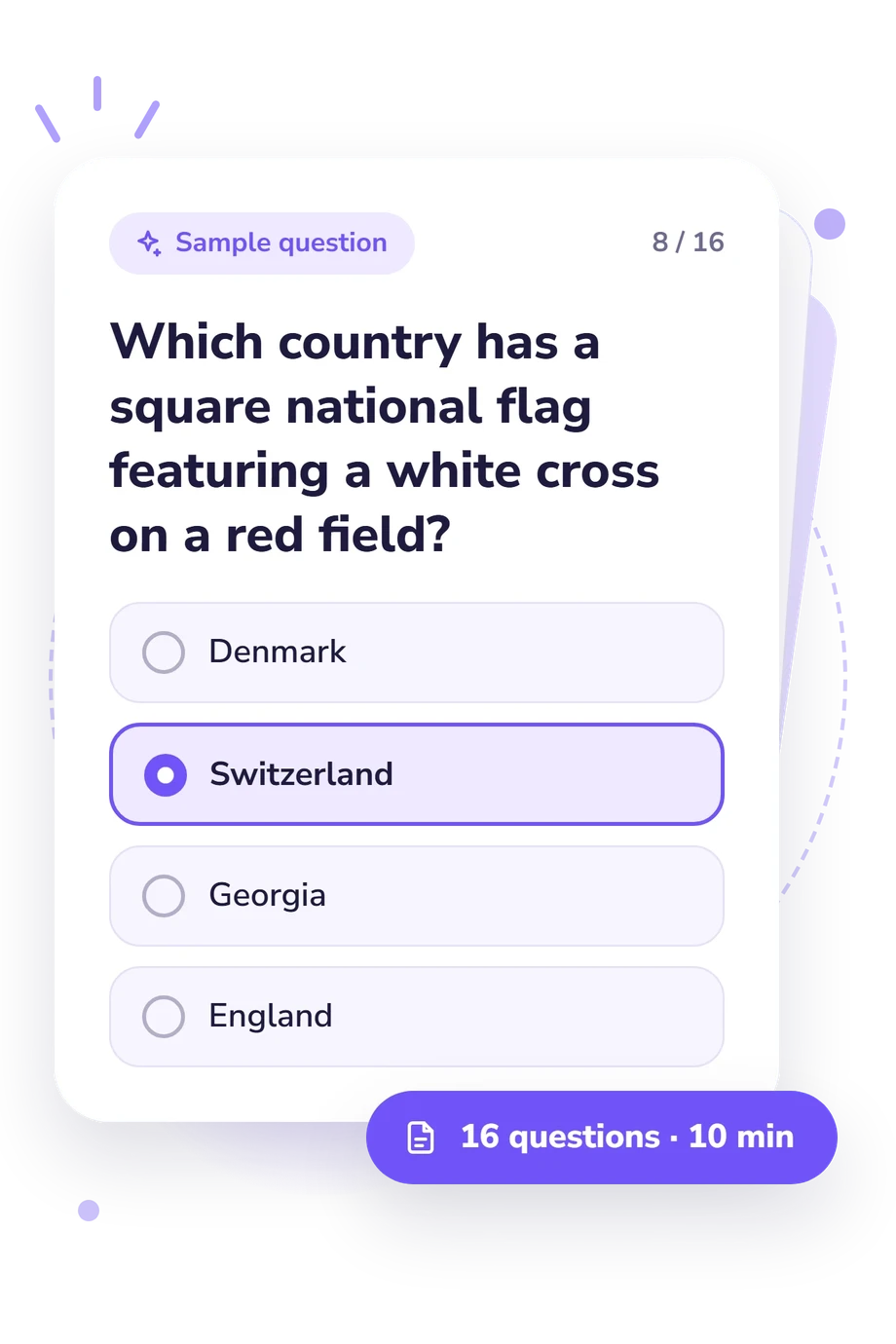
Example Questions From the Test
- A legal stiff-arm because no tackle occurred
- An incomplete-play violation
- Pass interference by the defender
- Flag guarding by the ball carrier
- Bhutan
- Nepal
- Sri Lanka
- Vatican City
- Namibia
- Seychelles
- South Africa
- Eswatini
Flag Football Quiz - Description and methodology of the test
Designed for readers who want a quick way to check practical sports knowledge alongside visual-cultural recall, this flag football quiz turns rules and national-flag descriptions into a single self-assessment. It can suit a player, coach, fan, student, or curious learner who treats it as a football trivia quiz and wants to see which topics feel secure and which deserve review, without treating the result as a formal ability measure.
What This Assessment Explores
The questions move between non-contact gameplay and written descriptions of national flags. Rules items address flag guarding, legal pulls, tackling, forward passes, downs, catches, touchdowns, and interceptions. Together, these tasks make a practical flag football rules quiz, while the flag items ask you to identify countries from distinctive shapes, colors, symbols, and layouts.
Flag Football and World Flags Knowledge (0-16) combines performance across both themes rather than producing separate totals. Its bands describe the level shown by the total:
- Starting Line (0-6) indicates recognition of some core ideas while leaving room to build familiarity.
- Developing Knowledge (7-12) indicates a useful foundation for solving many rules and flag-description items.
- Strong Knowledge (13-16) indicates accurate use of the stated football conventions and recognition of most described flags.
Use the profile to choose what to revisit: football conventions, national symbols, or both. Because leagues differ, verify rule-sensitive points against your competition’s regulations.
Methodology and Evidence Base
Each item offers four answer choices. You select the option that best matches the stated rule convention or flag description, so the task measures recognition and applied recall rather than open-ended explanation. Scoring uses one combined total for the full set, without separate football and flag totals; the result is interpreted through the displayed performance bands.
Football content is conceptually consistent with IFAF Flag Football Rules (2023), covering non-contact play, possession, passing, scoring, and downs. Flag identification draws on geometry, color, emblems, and unusual shapes, with Znamierowski’s work providing a factual reference point. Blake and Castel (2019) and Conci et al. (2021) show how familiarity and learned color-shape associations can affect flag recall. The questionnaire is not a standardized adaptation of these publications.
Your answers to the quiz about flag football may reflect current knowledge, wording attention, country familiarity, and the league convention used in a rules item. The bands are descriptive categories rather than population norms, and the combined result cannot show whether difficulty came mainly from football or flags. Review missed topics, then verify rule-sensitive answers against your competition’s regulations.
- International Federation of American Football. International Flag Football Rules 2023. International Federation of American Football, 2023.
- Znamierowski, Alfred. The World Encyclopedia of Flags: An Illustrated Guide to International Flags, Banners, Standards and Ensigns. Lorenz Books, 2020. ISBN 9780754834809.
- Blake, Adam B., and Alan D. Castel. "Memory and availability-biased metacognitive illusions for flags of varying familiarity." Memory & Cognition, 47(2), 365-382, 2019. 10.3758/s13421-018-0872-y.
- Conci, Markus, Philipp Kreyenmeier, Lisa Kröll, Connor Spiech, and Hermann J. Müller. "The nationality benefit: Long-term memory associations enhance visual working memory for color-shape conjunctions." Psychonomic Bulletin & Review, 28(6), 1982-1990, 2021. 10.3758/s13423-021-01957-2
Updated: