
Charlotte's Web Quiz
How the Scales are Structured
Who Usually Takes This Test?
See How You Compare
Below is a preview of how scores are typically distributed across each scale.
Example Questions From the Test
- He wins the regular blue ribbon for the largest pig.
- He is selected to lead the fair's animal parade.
- He is purchased by another farmer as a breeding pig.
- A special prize and medal honor the remarkable pig and his owner.
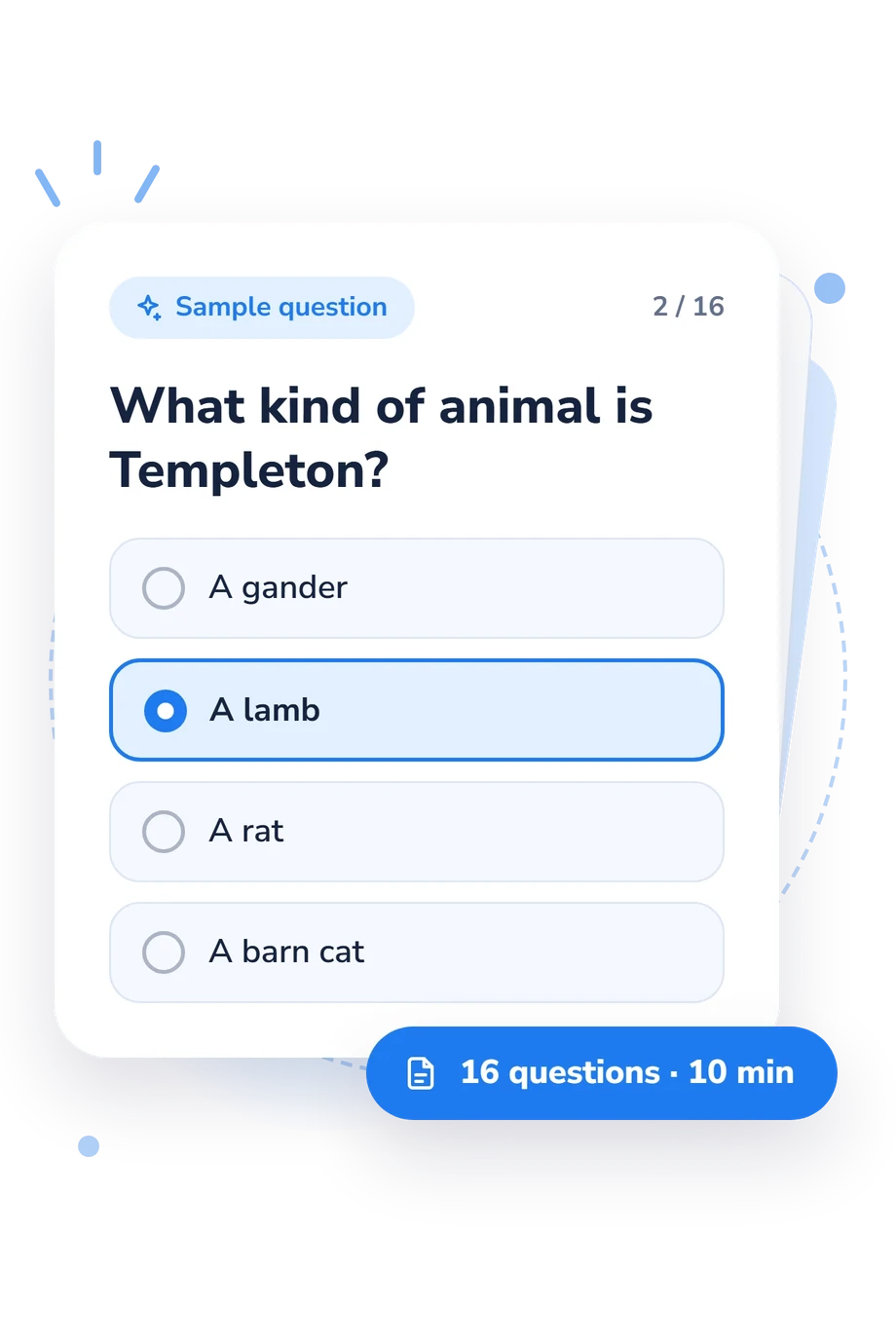
- A gander
- A lamb
- A rat
- A barn cat
- Humble, Terrific, Radiant, Some Pig
- Terrific, Some Pig, Humble, Radiant
- Some Pig, Radiant, Humble, Terrific
- Some Pig, Terrific, Radiant, Humble
Charlotte's Web Quiz - Description and methodology of the test
Readers deciding whether to revisit E. B. White’s novel can use the Charlotte's Web Quiz to judge whether their familiarity is ready for discussion, study, or a fresh reading. It offers a structured Charlotte's Web knowledge check for students, book-club members, and independent readers choosing between a quick review and a deeper return to the story.
What This Test Measures
Rather than asking whether a reader enjoyed the novel, the assessment checks comprehension of Charlotte's Web. The items move across named characters, relationships, animal behavior, important locations, event order, Charlotte’s web messages, key vocabulary, and interpretations of friendship, sacrifice, and loss. This makes the result useful for rereading, classroom review, or discussion preparation.
The displayed scale summarizes how much of that material the respondent recognizes and connects:
- Charlotte’s Web Knowledge (0-16) reflects knowledge of the novel’s characters, plot, language, and themes; Foundations to Revisit covers 0-6, Developing Knowledge covers 7-12, and Strong Knowledge covers 13-16.
A higher band indicates stronger command of factual details and the ideas they carry. It does not rank personal reactions, imagination, or a reader’s interpretation. The factual prompts form part of that broader knowledge check, so the result captures comprehension and recall.
Methodology and Evidence Base
Each item uses a four-option multiple-choice format, with one answer intended to fit the stem better than the alternatives. The quiz questions on Charlotte's Web combine direct recall with sequence, vocabulary, cause and effect, relationships, and central-idea interpretation. This range moves beyond isolated facts toward how the novel develops meaning.
White (1952) supplies the content anchor, while Kinghorn’s analysis helps situate the story’s treatment of friendship, wonder, mortality, and moral choice. The questionnaire is conceptually consistent with those works, not an adaptation of a published psychometric instrument.
Results are presented as a single total for the questionnaire’s knowledge construct. The item-writing approach can be considered alongside principles discussed by Haladyna, Downing, and Rodriguez (2002), including clear wording, a focused task, and alternatives that require attention to the text. Those principles describe good multiple-choice construction; they do not establish that this online assessment has been formally standardized or independently validated.
Responses may still reflect memory, guessing, rereading history, and current attention. The bands are therefore text-specific indicators of knowledge, not norm-based measures of reading ability or literary judgment.
- White, E. B. Charlotte's Web. New York: Harper & Brothers, 1952.
- Kinghorn, Norton D. "The Real Miracle of Charlotte's Web." Children's Literature Association Quarterly, 11(1), 1986, 4-9. 10.1353/chq.0.0418
- Haladyna, Thomas M., Steven M. Downing, and Michael C. Rodriguez. "A Review of Multiple-Choice Item-Writing Guidelines for Classroom Assessment." Applied Measurement in Education, 15(3), 2002, 309-333. 10.1207/S15324818AME1503_5
Updated: