
Demiboy Quiz
How the Scales are Structured
Who Usually Takes This Test?
See How You Compare
Below is a preview of how scores are typically distributed across each scale.
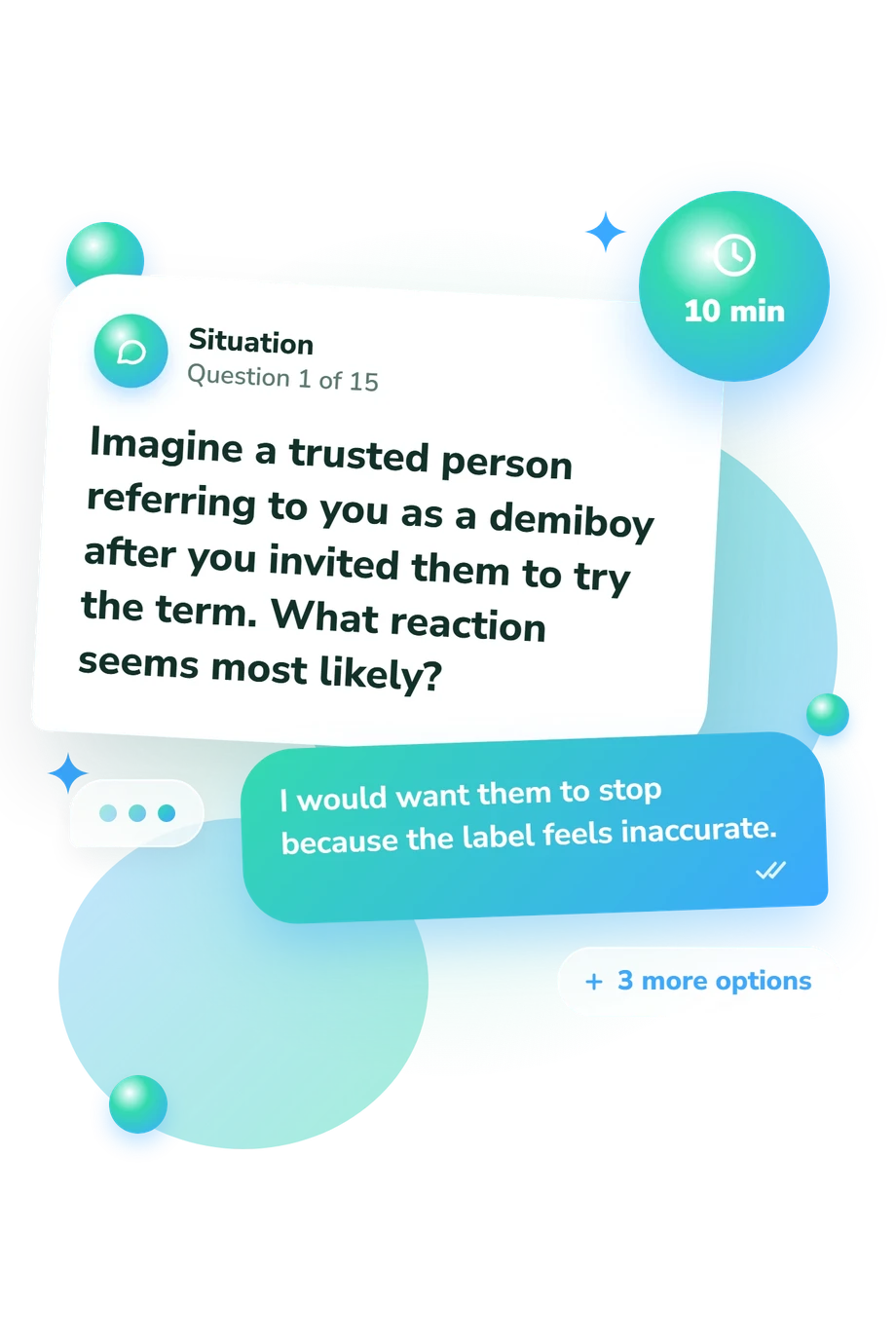
Example Questions From the Test
- Clearly inaccurate or disconnected from me.
- Possible in theory, but not especially meaningful.
- Somewhat fitting, with reservations or questions.
- Noticeably fitting, relieving, or affirming.
- It generally feels unlike my experience of gender.
- I can recognize a faint or occasional connection to it.
- It feels meaningful in some contexts but not consistently.
- It feels like a steady and important part of my identity.
- It does not seem to be part of what I notice.
- It generally feels like the whole relevant identity.
- It feels like only part of the picture on some of those days.
- It consistently feels present but not like the entire picture.
Demiboy Quiz - Description and methodology of the test
People exploring a connection to boyhood or manhood may want language that leaves room for partiality, change, and overlap with another gendered or nongendered experience. For anyone wondering, an am I demiboy questionnaire can organize reflection around recognition, resonance, and personal fit. This demiboy quiz offers a structured way to consider those patterns without requiring an immediate label.
What This Assessment Explores
Rather than asking for a single yes-or-no identity verdict, the questionnaire examines three related experiences: meaningful boy/man identity, whether that connection is partial or nonexclusive, and whether the demiboy label feels useful in private or social contexts. As a demiboy identity test, it suits people reflecting across changing settings, relationships, language, and imagined futures. Results form a profile showing resonance, label recognition, partiality, or combinations of these patterns.
The displayed dimensions are:
- Boy/Man Identity Resonance (0-15) reflects how personally meaningful boy/man identity feels: Limited resonance 0-5, Mixed resonance 6-10, Strong resonance 11-15.
- Demiboy Label and Recognition Fit (0-15) reflects whether the label feels useful or affirming: Limited fit 0-5, Tentative fit 6-10, Strong fit 11-15.
- Partial and Nonexclusive Gender Experience (0-15) reflects whether boyness feels partial or shared: Little partiality 0-5, Emerging partiality 6-10, Clear partiality 11-15.
Methodology and Evidence Base
Each item presents a self-report scenario with four ordered choices. Prompts cover being addressed as a boy or man, trying the label in writing or conversation, comparing it with broader terms, imagining future descriptions, and noticing whether boyness feels complete or partial. Together, they examine resonance, recognition, and partiality.
Scores summarize responses across the three dimensions. The displayed bands describe the strength of each pattern here, not universal cutoffs, and no general rule is stated for how many points an answer adds. As a demiboy self-assessment, the result is a reflective profile rather than an identity verdict.
Conceptually, the themes align with Fiani and Han (2019), whose qualitative work describes identity as negotiated across personal and social contexts. They also fit Bradford et al. (2019) on multiple or nonexclusive gender experiences and St Amant et al. (2025) on context-sensitive identity language and pronoun use. These studies provide comparison, not evidence of adaptation or validation.
Responses may shift with current circumstances, self-awareness, and comfort with language. The questionnaire has no stated normative standardization, so scores offer one perspective on reflection.
- Fiani, Chassitty N., and Heather J. Han. (2019). Navigating identity: Experiences of binary and non-binary transgender and gender non-conforming (TGNC) adults. International Journal of Transgenderism, 20(2-3), 181-194. 10.1080/15532739.2018.1426074
- Bradford, N. J., Rider, G. N., Catalpa, J. M., Morrow, Q. J., Berg, D. R., Spencer, K. G., and McGuire, J. K. (2019). Creating gender: A thematic analysis of genderqueer narratives. International Journal of Transgenderism, 20(2-3), 155-168. 10.1080/15532739.2018.1474516
- St Amant, M., Cai, J., Rider, G. N., and Lee, R. M. (2025). Nonbinary identity and pronoun use: A qualitative analysis. International Journal of Transgender Health, 26(2), 413-427. 10.1080/26895269.2024.2362916
Updated: