
Basic Programming Quiz
How the Scales are Structured
Who Usually Takes This Test?
See How You Compare
Below is a preview of how scores are typically distributed across each scale.
Example Questions From the Test
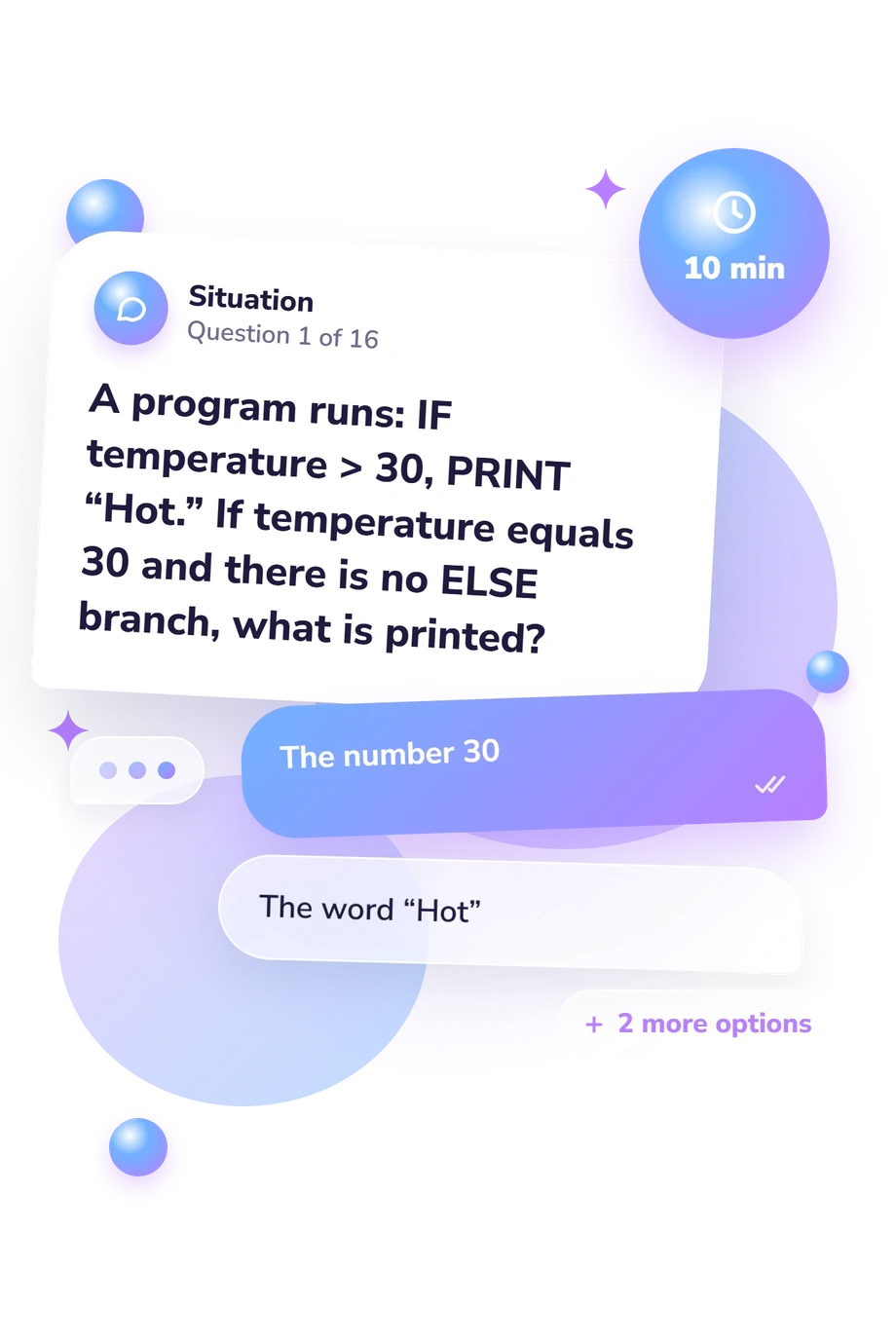
- The number 30
- The word “Hot”
- No message is printed
- The condition automatically causes an error
- Declaring every variable before a program starts
- Choosing a data type based on user input
- Repeating a block of instructions under defined conditions
- Converting comments into executable instructions
- A return value
- A Boolean operator
- A loop counter
- A parameter
Basic Programming Quiz - Description and methodology of the test
Designed for learners checking introductory code, the basic programming quiz provides a focused way to assess how they handle foundational programming ideas. It suits beginners, students revisiting fundamentals, and anyone deciding which topics deserve more practice. For learners seeking a quiz that provides an introduction to coding, the result can guide suitable next steps without treating one score as a complete picture.
What This Assessment Measures
The items examine whether you can follow program behavior and identify its underlying concept in these coding quiz questions. The emphasis is understanding, not memorizing syntax. You work with conditions, Boolean logic, loops, variables, functions, data types, algorithms, comments, arithmetic, syntax errors, and boundary cases.
The main areas are:
- Program flow and conditions show whether you can predict branches, evaluate Boolean expressions, and trace loops.
- Core concepts show whether you can distinguish parameters, return statements, variables, data types, and comments by their roles.
- Problem solving and correctness show whether you can recognize algorithms, calculate a mean, identify syntax mistakes, and test an input boundary.
The result is reported on one scale, Basic Programming Knowledge (0-16). Foundations to Build covers 0-6, Developing Knowledge covers 7-12, and Strong Foundation covers 13-16. These bands describe consistency with introductory concepts, not fixed future ability.
Methodology and Evidence Base
Each item presents a programming scenario, definition, pseudocode trace, or rule with four choices. The test uses computer programming quiz questions and answers in a multiple-choice format, so you select the best answer rather than write or execute code. This format samples recognition and reasoning about code behavior.
Scoring is direct: each correct answer adds one point to the total. The score is a raw total of correct responses and summarizes performance on these introductory items. Missed items are useful prompts for review; the total is a snapshot of introductory knowledge, not a forecast of performance in every programming context.
The content is conceptually consistent with the Computer Science Concept Inventory (Caceffo et al., 2016), which targets foundational programming concepts, but this questionnaire is not presented as an adaptation of that instrument. It also connects with the FCS1 approach described by Tew and Guzdial (2011), emphasizing language-independent CS1 knowledge. These sources provide context, but this online form is not presented with standardized norms.
Guessing, familiarity with the wording, prior exposure, and temporary lapses in recall can affect the score. Practice and instruction may change the picture.
- Ricardo Caceffo, Steven A. Wolfman, Kellogg S. Booth, and Rodolfo Azevedo. (2016). Developing a Computer Science Concept Inventory for Introductory Programming. In Proceedings of the 47th ACM Technical Symposium on Computing Science Education (SIGCSE '16), 364-369. ACM. 10.1145/2839509.2844559
- Allison Elliott Tew and Mark Guzdial. (2011). The FCS1: A Language Independent Assessment of CS1 Knowledge. In Proceedings of the 42nd ACM Technical Symposium on Computer Science Education (SIGCSE '11), 111-116. ACM. 10.1145/1953163.1953200
Updated: