
Idiom Quiz
How the Scales are Structured
Who Usually Takes This Test?
See How You Compare
Below is a preview of how scores are typically distributed across each scale.
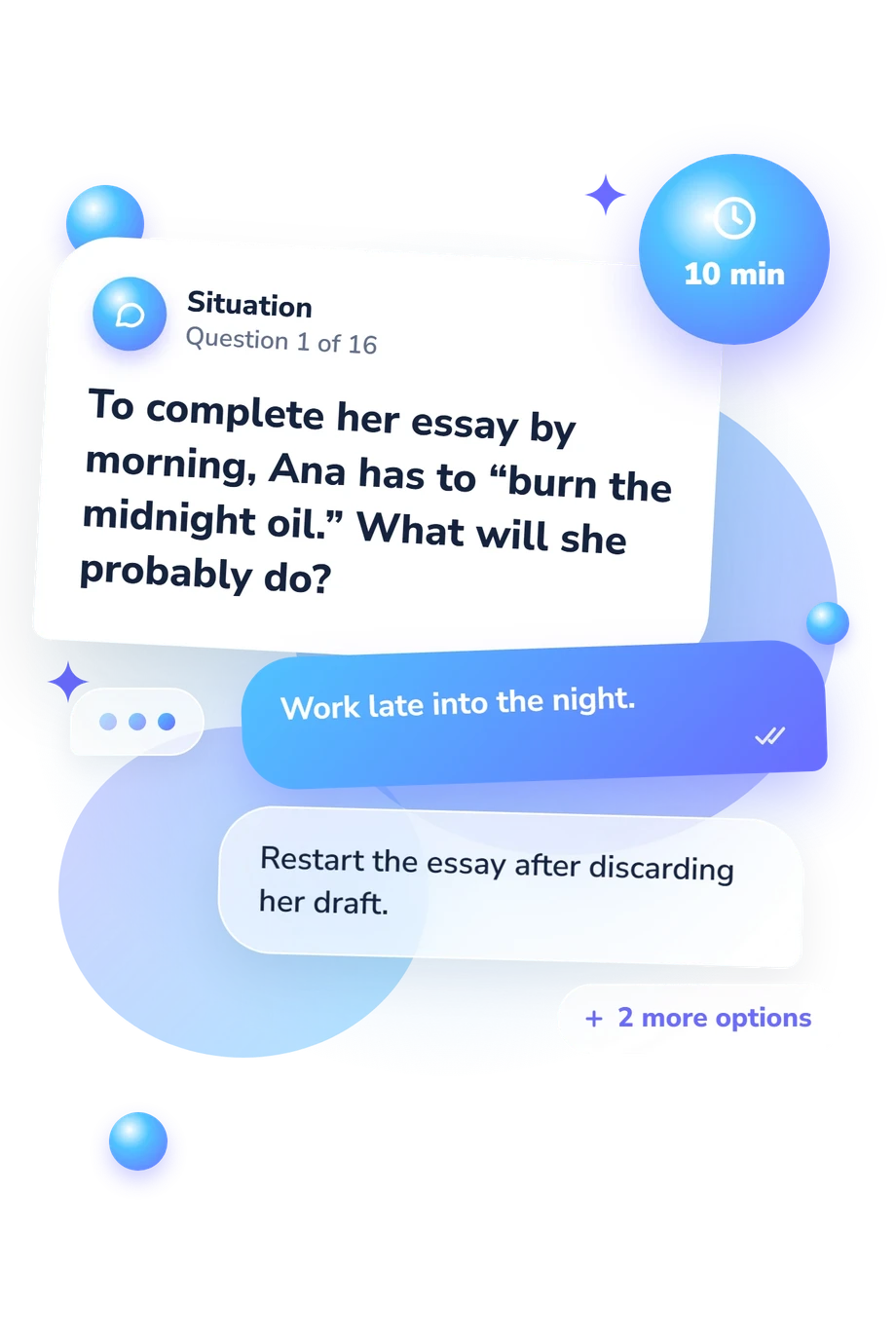
Example Questions From the Test
- Work late into the night.
- Restart the essay after discarding her draft.
- Use old-fashioned research materials.
- Rush through the essay without checking it.
- He made a confusing comment.
- He disclosed the secret plan.
- He drew attention away from the award.
- He caused the ceremony to be postponed.
- Schedule another full day of work immediately.
- Review everything completed that morning.
- Stop working for now.
- Name a date for the project launch.
Idiom Quiz - Description and methodology of the test
Visitors who want to check how readily they understand figurative English can use this idiom quiz as a self-check. It suits learners, teachers, and fluent speakers seeking a look at everyday expressions. Rather than testing vocabulary in isolation, it shows how meaning is recovered when an expression appears in a situation. Because it places idioms in situations, this quiz on idioms and phrases offers a starting point for targeted practice.
What This Assessment Explores
The items test whether readers can move beyond literal wording and infer meaning from context. They cover secrecy, uncertainty, illness, effort, conflict, cost, timing, responsibility, and social interaction. The surrounding situation provides cues for inferring meaning.
This assessment functions as an idiom comprehension quiz, and its result indicates overall familiarity with the included expressions. A higher result reflects stronger command of the included expressions; a lower result points to review, not to overall intelligence or total English proficiency.
The displayed Idiom Knowledge scale runs from 0 to 16 and reflects the number interpreted correctly. Its bands are:
- Foundations to build (0-6) indicates some recognition, with literal readings still likely; full-sentence review can help.
- Developing knowledge (7-12) indicates understanding of many common idioms, though unfamiliar contexts may confuse.
- Strong knowledge (13-16) indicates accurate interpretation across varied situations and conversations.
Methodology and Evidence Base
Each item places an expression in a short situation and offers four answer choices, with the intended interpretation among them. It is a contextual multiple-choice comprehension task: scoring counts correct interpretations, so the result reflects performance on the included expressions and contexts rather than a weighted profile of separate abilities.
The closest named comparison is the Idiom Comprehension Test, which examined how familiarity affects idiom understanding. Related idiom-comprehension research connects interpretation with context, familiarity, academic language experience, and second-language learning. This questionnaire is conceptually consistent with the Idiom Comprehension Test and related idiom-comprehension research, but it is not an adaptation, translation, or independently validated version.
Its scoring is not standardized or norm-referenced. Performance may vary with prior exposure to particular phrases, attention during the task, and guessing among the choices. This idiom test shows current performance on the included material, while broader language assessment would require more varied evidence.
- Qualls, C. D., & Harris, J. L. (1999). Effects of Familiarity on Idiom Comprehension in African American and European American Fifth Graders. Language, Speech, and Hearing Services in Schools, 30(2), 141-151. 10.1044/0161-1461.3002.141
- Qualls, C. D., Lantz, J. M., Pietrzyk, R. M., Blood, G. W., & Hammer, C. S. (2004). Comprehension of idioms in adolescents with language-based learning disabilities compared to their typically developing peers. Journal of Communication Disorders, 37(4), 295-311. 10.1016/j.jcomdis.2003.12.001
- Qualls, C. D., O'Brien, R. M., Blood, G. W., & Hammer, C. S. (2003). Contextual Variation, Familiarity, Academic Literacy, and Rural Adolescents’ Idiom Knowledge. Language, Speech, and Hearing Services in Schools, 34(1), 69-79. 10.1044/0161-1461(2003/007)
- Cooper, T. C. (1999). Processing of Idioms by L2 Learners of English. TESOL Quarterly, 33(2), 233-262. 10.2307/3587719
Updated: